
By Last Letter First Editorial Team | Last updated: November 2026
Key Takeaways
- Free online spelling bee games are browser-based hive puzzles that let players form words from seven letters, and dozens of quality options exist beyond the well-known NYT Spelling Bee.
- No single free platform in 2026 combines daily puzzles, unlimited play mode, and full mobile support in one package, so choosing the right game means deciding which tradeoff matters least.
- Parents and educators should verify HTTPS, privacy policies, and app store listings before letting younger players use any free spelling bee site.
- The comparison table below rates each game on play limits, mobile responsiveness, ad intrusiveness, and multiplayer support.
- Most free alternatives are solo experiences, leaving multiplayer competition as a gap only a handful of platforms address.
What Are Free Online Spelling Bee Games and Who Plays Them
Free online spelling bee games challenge players to build words from a limited set of letters, blending vocabulary growth with quick-hit fun. At Last Letter First, we see this format as proof that the best learning happens when players don’t realize they’re learning.
Head-to-Head Comparison of Free Spelling Bee Games
Several alternatives cover two of those three needs well. The right choice depends on which limitation bothers you least.
Feature Breakdown
| Game | Daily vs. Unlimited | Center-Letter Rule | Pangram Bonus | Mobile-Friendly | Ad Level | Multiplayer |
|---|---|---|---|---|---|---|
| NYT Spelling Bee | Daily (paywalled) | Yes | Yes | Yes (app) | None (subscription) | No |
| Spelling Bee Hub | Unlimited | Yes | Yes | Responsive web | Low | No |
| WordGa | Unlimited | Yes | Yes | Responsive web | Moderate | No |
| Buzzwords | Daily + timed | Yes | No | Responsive web | Moderate | No |
| Vinish.Dev Spelling Bee | Daily (mirrors NYT) | Yes | Yes | Responsive web | Low | No |
| Crosswordle | Daily only | No | No | Responsive web | Low | No |
| Boatload Puzzles | Unlimited | No | No | Responsive web | Moderate-High | No |
| Arkadium word games | Unlimited | No | No | Yes (app + web) | Moderate | No |
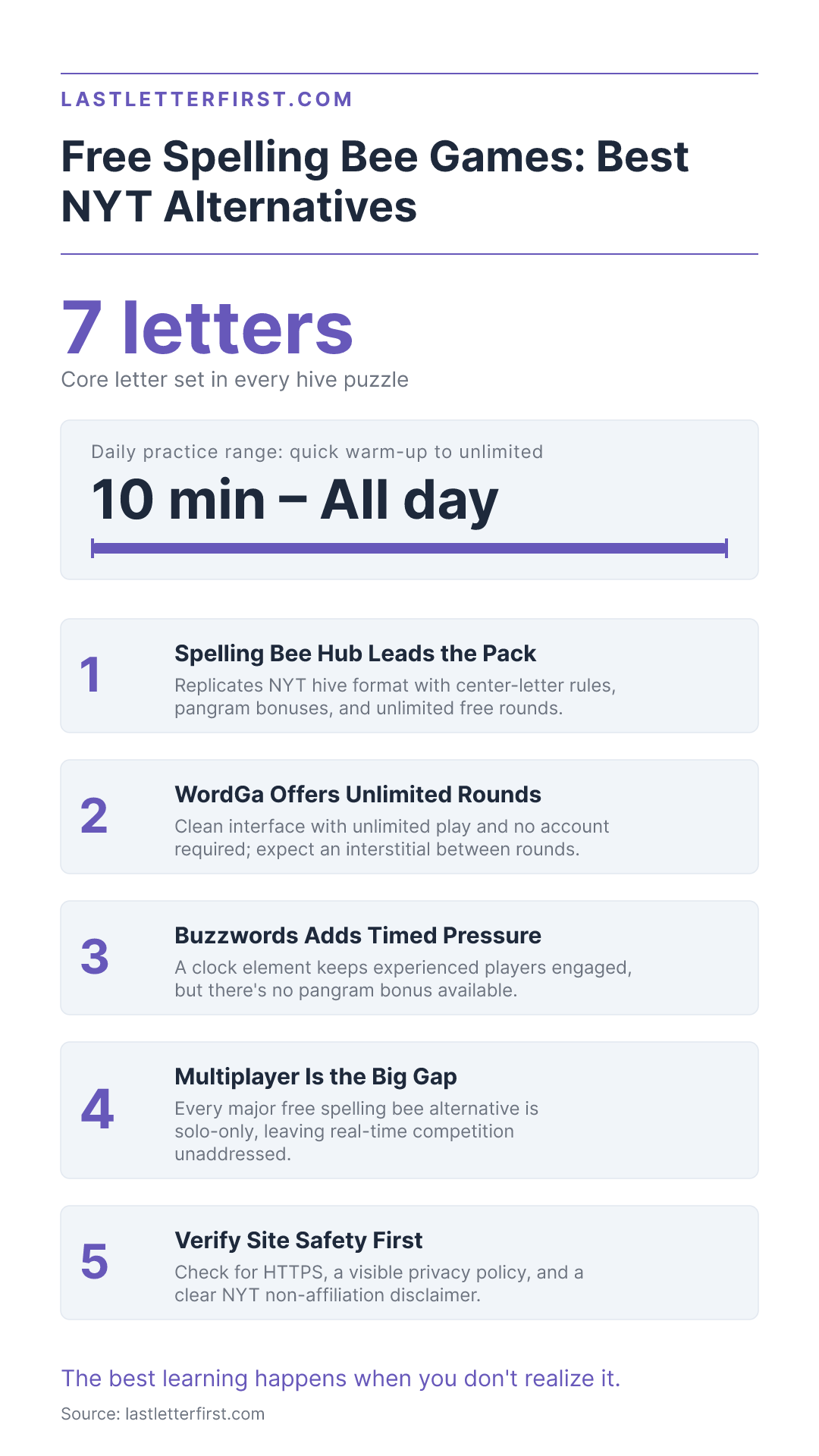
Spelling Bee Hub replicates the NYT hive format most faithfully, including center-letter rules and pangram bonuses, and it costs nothing to play. Ad presence is minimal, usually a single banner.
WordGa offers unlimited rounds with a clean interface, making it a solid pick for players who burn through one daily puzzle. Expect an interstitial between rounds, but nothing that hijacks your screen.
Buzzwords adds a timed element that keeps experienced players engaged. The clock changes the dynamic entirely. Tradeoff: no pangram bonus.
Vinish.Dev mirrors the actual NYT daily puzzle for free. Lightweight, low on ads, but daily-only.
For adults who want depth beyond a single daily puzzle, Spelling Bee Hub and WordGa offer unlimited rounds with no account required, while Buzzwords adds timed pressure that keeps experienced players engaged.
The pattern is clear: you can get faithful hive mechanics for free, or unlimited play for free, or a polished mobile app for free. Getting all three without a subscription? That’s the gap the market hasn’t closed.
Where Multiplayer Word Games Fill the Gap
Here’s the elephant in the room: every major free spelling bee alternative is a solo experience. No opponent, no shared board, no real-time competition.
That’s a significant blind spot. The social sharing culture around word games, streak screenshots and score posts, proves players want a competitive dimension. They’re already competing informally. The games just haven’t caught up.
Real-time multiplayer word games fill this gap by turning vocabulary into a head-to-head contest. Losing to someone who found a word you missed is a far more memorable teacher than a score screen. Playing against opponents forces faster thinking and reaches for words you wouldn’t attempt solo, and it’s worth its weight in gold for long-term retention.
How to Spot Trustworthy Free Spelling Bee Sites
A trustworthy free spelling bee site displays HTTPS encryption, a visible privacy policy, and a clear disclaimer stating it is not affiliated with The New York Times. That sentence alone filters out a surprising number of sketchy clones.
The popularity of the NYT Spelling Bee has spawned dozens of copycat sites. The cheaper the site looks, the more expensive the hidden costs tend to be, whether that’s your data or your device’s security. Before you bookmark any free game: Does the URL match the platform’s actual domain? Does the site load over HTTPS? Legitimate alternatives like Spelling Bee Hub and WordGa are upfront about being unofficial. The shady ones aren’t.
Safety Checklist for Parents and Educators
Parents and educators need a tighter filter. Here’s a practical checklist, adapted from guidance by the North American Scrabble Players Association on vetting online word game platforms:
- HTTPS encryption: The padlock icon isn’t optional. Any site without it is a red flag.
- Visible privacy policy: No policy? No play.
- App store distribution: Games on Google Play or the Apple App Store have passed baseline review. Browser-only games skip that scrutiny.
- No-account play: Sites that let you play without login collect less data by default.
- Ad behavior: Load the site on a phone before handing it to a child. If ads cover gameplay or redirect to external pages, move on. Check our FAQ about online word games for more guidance.
Strategies to Improve Your Spelling Bee Score
Getting better at spelling bee games isn’t about memorizing the dictionary. It’s about training your brain to see patterns faster.
Shuffle the letters. Every hive game includes a shuffle button, and using it isn’t lazy. It’s strategic. Your visual cortex locks onto letter arrangements fast, and shuffling breaks that lock.
Hunt by prefix and suffix. Start with “un-,” “re-,” “pre-,” “over-.” Then flip to endings: “-ing,” “-tion,” “-ness,” “-able.” This sweep catches words free-association misses.
Don’t ignore short words. Players fixate on long finds while leaving three- and four-letter words on the table. A dozen four-letter words can outscore a single seven-letter discovery.
Pairing daily puzzle play with intentional study, like learning new words monthly through word games, compounds progress faster than either approach alone.
Pangram-Finding Tips for NYT-Style Puzzles
Pangrams use all seven letters and earn substantial bonuses. Every daily puzzle contains at least one.
Start with the least common letter in the set, since rare letters like “z” or “x” narrow your options dramatically and that constraint actually speeds up pangram discovery. Common letters like “e” and “s” appear in thousands of words, making them terrible starting points.
Scan for compound words early. Try less obvious pairings: “ph,” “th,” “gh,” and “wr” combinations hide words simple letter-by-letter scanning misses.
And if you’ve been staring for three minutes without progress, shuffle again. Pattern blindness is real. Say the letters aloud. Hearing the sounds activates different neural pathways, and words you couldn’t see on screen sometimes pop into your head the moment you vocalize them.
Building a Complete Spelling Practice Toolkit
No single game covers every dimension of spelling and vocabulary development. The smartest approach combines different tools.
| Toolkit Layer | Purpose | Free Options |
|---|---|---|
| Daily hive puzzle | Consistent warm-up, pattern recognition | Spelling Bee Hub, WordGa, Vinish.Dev |
| Structured word lists | Targeted vocabulary building | Scripps Word Club, SpellQuiz, Quizlet |
| Multiplayer word games | Competitive pressure, social retention | Real-time word battle apps on iOS/Android/web |
Start with a daily puzzle habit. Ten minutes is plenty. Layer in structured word lists from resources like Scripps Word Club. Add multiplayer word games as a third pillar, because research on how multiplayer word games improve family vocabulary suggests social play strengthens retention more effectively than solitary study.
Here’s the paradox worth sitting with: the more structured your practice toolkit becomes, the more natural and effortless your word-finding feels during unstructured play. Discipline creates fluency. Every tool mentioned here offers a free tier or is entirely free. The investment is consistency, not cash.
Frequently Asked Questions
Where can I play spelling bee-style games online without paying?
Spelling Bee Hub, WordGa, Buzzwords on Arkadium, and the Vinish.Dev clone all offer daily hive-format puzzles without a subscription. Each provides the core seven-letter mechanic. Features vary: some offer unlimited rounds, others limit you to one fresh puzzle per day. Ad-supported models are common, so expect banner or interstitial ads. None require payment for the primary puzzle experience.
Are there free alternatives to the NYT Spelling Bee that work just as well?
Yes, several closely replicate the NYT format. Spelling Bee Hub uses the same daily letter set. WordGa mirrors the seven-letter mechanic with unlimited rounds. The tradeoffs are real: free versions typically lack archive modes, hint systems, and the polished NYT interface. For casual daily play, these alternatives hit the mark. For completionists who want full puzzle history, the gap is noticeable.
What are the best browser-based word games for adults?
Spelling Bee Hub and Buzzwords offer hive-format challenges. Crosswordle and Quordle provide crossword and multi-grid Wordle variants. Contexto tests semantic understanding rather than spelling. For competitive play, multiplayer word games add a social dimension solo formats can’t match. Rotating between two or three games keeps your brain encountering different word-finding challenges.
What is the best strategy for finding the pangram in the NYT Spelling Bee?
Identify the least common letters in your set and build outward from them. A “z” or “x” dramatically narrows word options, which counterintuitively makes the pangram easier to find. Scan for compound words first, since multi-part words naturally incorporate more letters. Use the shuffle button aggressively. If you’re stuck after several minutes, step away briefly. Players consistently report pangrams surface more easily after a short mental break.
Are free spelling bee games safe for children to use?
Many are safe, but parents should verify first. Check for HTTPS encryption, a clear privacy policy, and COPPA-relevant disclosures about data collection from minors. Games playable without login reduce data exposure. Ad-supported games may display age-inappropriate advertisements, so preview the experience yourself. App-store-distributed games undergo additional review, making them a safer default. Visit the Last Letter First FAQ page for more details.
Do free spelling bee games work on mobile devices?
Most browser-based options are responsive and playable on phones without downloading anything. But the experience varies. Some web-only clones have small tap targets or awkward scrolling on smaller screens. Dedicated apps tend to offer smoother touch optimization and offline capability. Test whether letter tiles are large enough to tap accurately and whether the keyboard overlay obscures the puzzle grid. A game that’s technically “mobile-friendly” but frustrating on a phone isn’t really mobile-friendly at all.
How do Scrabble word finders differ from spelling bee games?
They serve fundamentally different purposes. Scrabble word finders, like those cataloged in NASPA resources, help players validate or discover words for board-game play. You input tiles and the tool outputs legal plays. Spelling bee games challenge you to form words from a fixed letter set without external help. One gives you answers; the other makes you find them. Both build vocabulary, but through opposite mechanics.
Can I use free spelling bee games to prepare for the Scripps National Spelling Bee?
Hive-format games build general vocabulary recognition and are a good warm-up, but they aren’t designed for Scripps competition prep. The Scripps National Spelling Bee tests pronunciation, etymology, and language-of-origin knowledge, none of which hive games address. For serious preparation, Scripps Word Club provides official word lists and SpellPundit offers etymology drills. Free hive games complement these tools by keeping daily practice fun, but they can’t replace competition-level study.
What is a pangram in spelling bee games?
A pangram is a word that uses all seven letters available in the puzzle. Finding one earns a significant point bonus. Every daily puzzle contains at least one, and some include multiple. Pangrams tend to be seven to nine letters long and are almost always the highest-scoring individual words in a given puzzle. Spotting the pangram early often reveals related words you hadn’t considered, creating momentum for the rest of your solve.
Are there multiplayer spelling bee or word games I can play with friends?
Frankly, most spelling bee-style games are solo experiences. For real-time multiplayer word competition, the format shifts away from the hive mechanic. Words With Friends and Scrabble GO offer turn-based tile-rack alternatives. For faster head-to-head word battles, real-time multiplayer word games on iOS, Android, and web provide that competitive edge. Playing against someone who might find your missed word adds urgency solo puzzles can’t replicate.
What Your Spelling Practice Looks Like Six Months From Now
Indie developers keep launching new variants, daily puzzle formats are multiplying, and the line between “word game” and “vocabulary trainer” gets blurrier every month.
Vocabulary growth is slow until it isn’t. And then one day you spot “quixotic” in a seven-letter set before your coffee gets cold, and you realize the daily habit did its job.
Pick two games from the comparison table. Add one study tool. Play every day for a month. Then come back and tell us your score didn’t improve. We’ll wait.
By the Last Letter First Editorial Team | Last updated: November 2026
The Last Letter First Editorial Team covers word games, vocabulary building, and language learning. Our writers and editors bring backgrounds in education, linguistics, and game design to every piece we publish. Learn more about our editorial approach on our blog.