

By Last Letter First Editorial Team | Last updated: November 2026

Key Takeaways About Best Online Brain Games
- Online brain games are digital activities designed to target specific cognitive skills like memory, attention, processing speed, and language fluency, with built-in progress tracking that measures improvement over time.
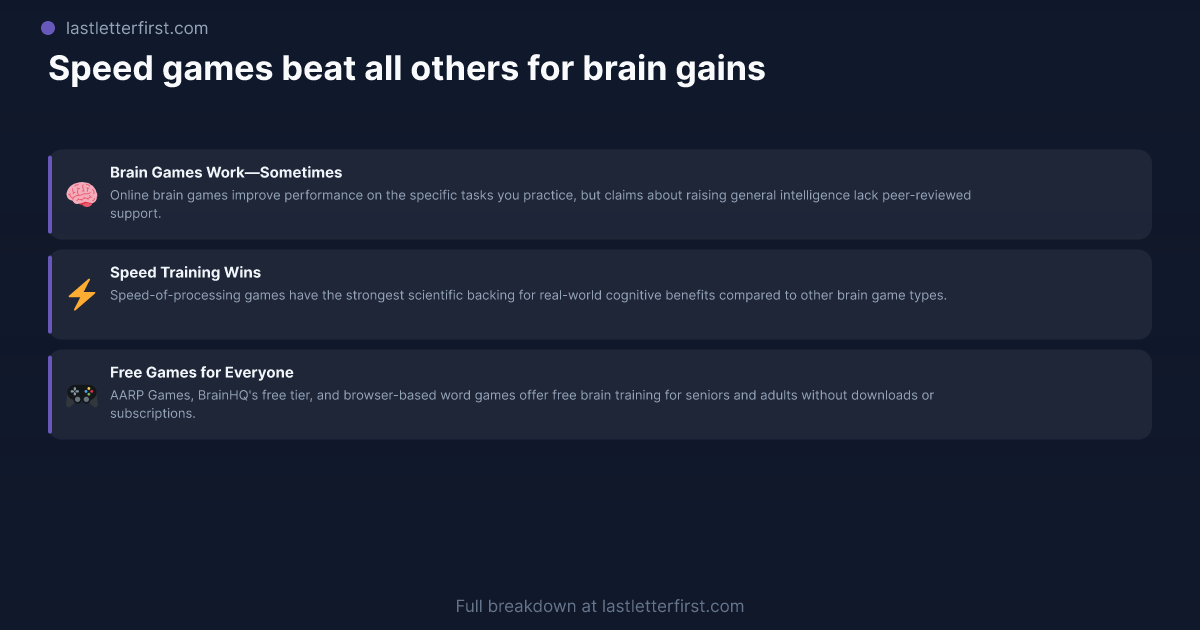
- Speed-of-processing training is the single game type with the strongest scientific backing for real-world cognitive benefits.
- Free brain games for seniors are widely available through platforms like AARP Games, BrainHQ’s limited free tier, and browser-based crossword and word game sites that require no downloads or subscriptions.
- The difference between entertainment and training comes down to adaptive difficulty, structured repetition, and measurable progress tracking.
- Multiplayer word games combine language processing, strategic thinking, and social engagement in a single activity, offering advantages most solo apps can’t match.
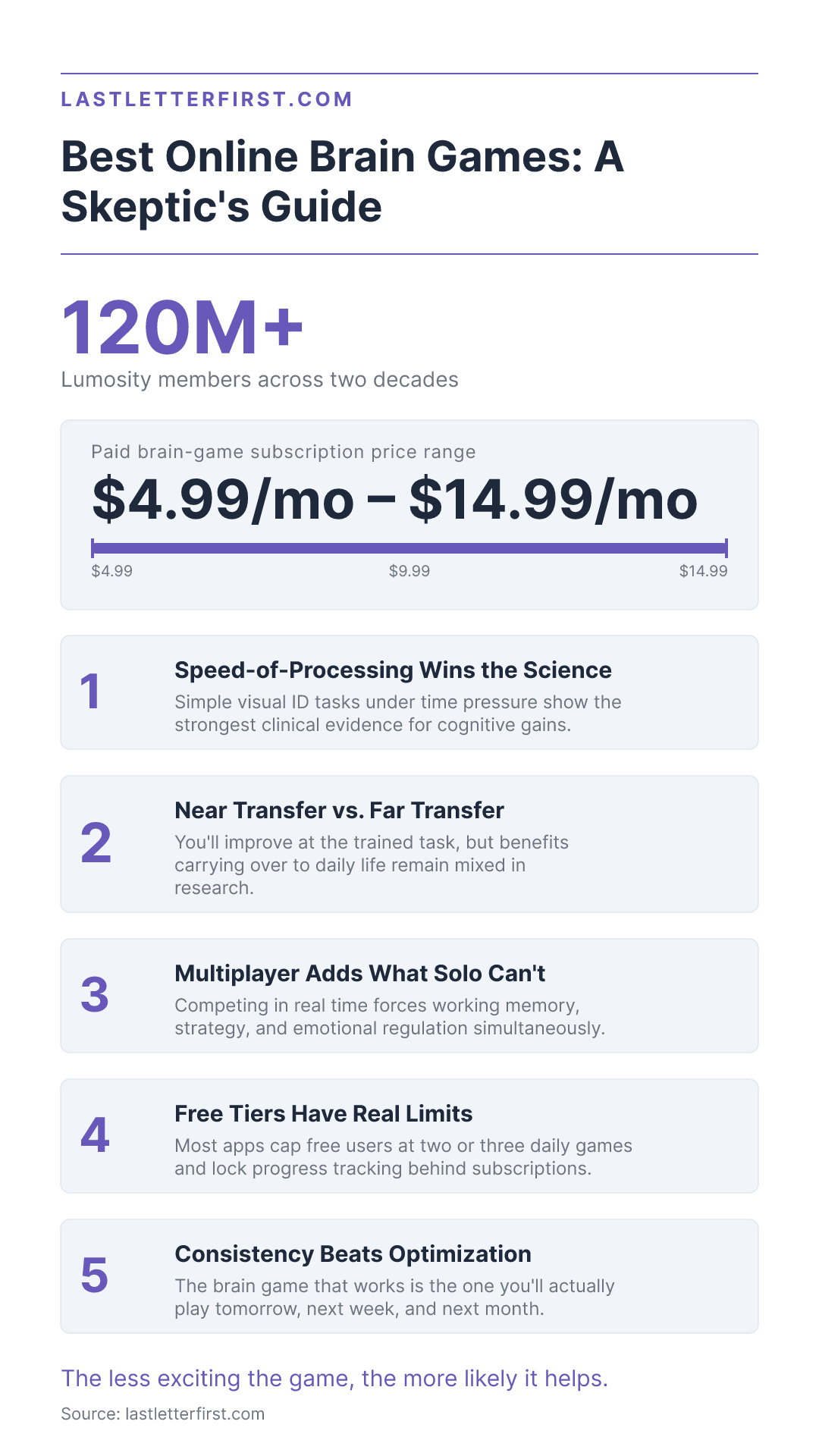
Lumosity [1] reports over 120 million members across two decades of brain training (lumosity.com [1]). Honestly? I didn’t buy the premise for a long time. Tapping colorful tiles for ten minutes a day felt like a stretch for meaningful cognitive improvement.
Then I looked at the peer-reviewed studies. Some brain games do deliver measurable benefits. Others are digital candy in a lab coat. This guide separates the science from the sales pitch so you can find brain games and cognitive training that actually work in 2026 (atlantaparent.com [2]).
What Counts as a Brain Game and Why It Matters
The best online brain games adapt to your skill level, isolate specific cognitive domains, and track measurable progress over time. Platforms like Last Letter First at lastletterfirst.com exemplify this approach , each round pushes vocabulary recall and processing speed harder as you improve. If a game never challenges you beyond your comfort zone, it’s entertainment, not training.
Top Brain Game Categories and What Each One Trains
The best online game for your brain depends on which cognitive skill you want to train, but speed-of-processing games and vocabulary-building word games consistently show the strongest evidence for transferable cognitive benefits. Most people benefit from rotating across categories rather than grinding one type.
Memory games train short-term recall through card-matching, sequence recall, and spatial challenges. Free brain exercises for memory online include pattern-matching games on AARP and BrainHQ’s free tier, as well as word recall games that strengthen short-term memory through active retrieval practice.
Word games build vocabulary, spelling, and language fluency, spanning crosswords, anagram solvers, and competitive multiplayer formats. If you want to learn 100 new words a month using word games, structured word play is one of the most effective paths.
Strategy and logic games sharpen problem-solving and spatial reasoning. Chess, Sudoku, and tower-defense puzzles force multi-step planning and adaptation.
Speed-of-processing games are the dark horse: simple visual identification tasks under increasing time pressure, but the category with the strongest clinical evidence.
Free online brain games for adults include AARP’s browser-based puzzle library, BrainHQ’s free exercises, NYT’s daily Wordle, and multiplayer word games that train vocabulary and recall without a subscription.
Online solitaire offers light cognitive engagement through sequencing and pattern recognition, but it lacks the adaptive difficulty and structured skill tracking that define a true brain training game. Fine for unwinding. Not reliable for training.
Platform Comparison
| Platform | Skills Trained | Free Tier | Paid Price | Research Cited? | Best For |
|---|---|---|---|---|---|
| Lumosity | Memory, attention, flexibility | 3 games/day | ~$11.99/mo | Yes (in-house) | Broad training with tracking |
| BrainHQ | Speed, memory, attention | Limited exercises | ~$14/mo | Yes (100+ studies) | Evidence-backed, seniors |
| Elevate | Vocabulary, math, memory | Limited daily | ~$14.99/mo | Limited | Verbal and math skills |
| Peak | Problem-solving, memory | Limited games | ~$4.99/mo | Some | Affordable variety |
| AARP Games | Words, crosswords, Sudoku | Fully free | Free with membership | No | Free, no-download games |
| NYT Games | Vocabulary, logic, patterns | Wordle free | ~$6.99/mo | No | Daily habit, family play |
AARP Games wins for anyone wanting free, browser-based play with zero friction.
Does the Science Support Brain Training Apps
Online brain training is effective at improving performance on the specific tasks you practice, but broad claims about raising general intelligence remain unsupported by most peer-reviewed research. That’s the honest, slightly uncomfortable answer.
The debate centers on “transfer.” Getting better at a memory game is “near transfer.” The real question is whether improvement carries over to daily life: remembering where you parked, staying focused in a long meeting. That’s “far transfer,” and evidence is mixed.
But that’s not the whole story.
Speed-of-processing training is the single game type with the strongest scientific backing for real-world cognitive benefits. That’s remarkable for a simple visual identification task.
Word games forcing active recall, like anagram solving and timed vocabulary challenges, engage multiple cognitive systems simultaneously: semantic memory, phonological processing, and executive function. That multi-system engagement makes broader benefits more likely.
The uncomfortable truth is that brain games with the flashiest marketing often have the weakest science, while the ones with the strongest evidence look pretty boring. The less exciting the game, the more likely it actually helps. That’s a second paradox worth sitting with.
Multiplayer and Social Brain Games Worth Trying
Multiplayer brain games add a layer solo apps can’t replicate: social accountability, competitive motivation, and real-time pressure that forces performance under genuine stakes. Most “best brain games” lists skip this category entirely. That misses the boat.
Racing a friend to form a word under a countdown timer means juggling working memory, strategic planning, and emotional regulation simultaneously. Solo drills rarely demand that combination. Playing against another person creates a feedback loop that keeps you coming back, and consistency matters more than intensity for cognitive training.
Older adults who play free word games with friends and family report higher engagement and longer play streaks than solo-app users. The social element isn’t a bonus. It’s the retention mechanism. If you’re curious about how multiplayer word games improve family vocabulary, the benefits extend beyond individual cognition into shared learning.
How to Choose the Right Brain Game for Your Goals
The best brain game for your goals targets the specific cognitive skill you want to improve, not the one with the flashiest marketing. Match your goal to a category:
| Your Goal | Best Category | Free Options? |
|---|---|---|
| Sharpen memory | Memory-match, dual n-back | Yes (limited daily plays) |
| Build vocabulary | Word games, crosswords, anagrams | Yes (many browser-based) |
| Improve processing speed | Speed-training (BrainHQ-style) | Yes (free tier with caps) |
| Strengthen problem-solving | Chess, logic puzzles | Yes (fully free platforms) |
| Stay sharp casually | Solitaire, jigsaws, casual word games | Yes (AARP, browser portals) |
Three questions cut through the noise:
Is the free tier usable? Many apps limit free users to three games daily with no tracking. AARP offers unlimited access without paywalls.
Does it track progress meaningfully? A rising score isn’t the same as a cognitive profile showing which skills improve. Elevate and BrainHQ both offer skill breakdowns in paid tiers.
Will you actually stick with it? The brain game that works is the one you’ll play tomorrow, next week, and next month. Consistency beats optimization every time. I’d argue that’s worth its weight in gold, because the fanciest program does nothing if you quit after a week.
The North American Scrabble Players Association maintains resources for competitive word game players seeking trustworthy platforms.
Frequently Asked Questions
What are the best free brain training games that actually work?
The strongest free options include BrainHQ’s limited tier, Lumosity’s free tier, AARP Games, the NYT Mini Crossword, and free chess platforms like Lichess. Each targets different skills: BrainHQ covers speed and memory, Lumosity handles attention, and chess builds strategic thinking. Most free tiers cap daily play at two or three games and lock progress tracking behind subscriptions. AARP Games stands out with unlimited puzzle access and no paywall.
Do apps like Lumosity or Peak really improve cognitive function?
Studies suggest improvements largely reflect practice effects on the games themselves, not lasting gains in general intelligence. You get better at the specific tasks trained, but that doesn’t automatically mean sharper focus elsewhere. Many users report anecdotal benefits for brain fog with consistent play over weeks. These apps aren’t snake oil, but they aren’t miracle workers either.
What online brain games are scientifically proven to improve memory?
Memory-match games and dual n-back tasks have received the most research attention, though gains tend to be task-specific. BrainHQ’s memory exercises are among the most studied commercially available options. For free alternatives, card-matching and pattern-recall exercises through browser portals offer similar mechanics. The key is consistency: sporadic play produces sporadic results.
Are AARP’s free online games good for brain health?
AARP Games offers a curated, ad-light portal with puzzles, solitaire, and word games suited to older adults seeking free, browser-based exercise. Solitaire trains sequential planning and pattern recognition as a light workout, though it doesn’t provide structured skill tracking. Pairing AARP’s casual games with a dedicated platform like BrainHQ creates a more complete routine.
Can playing brain games daily actually prevent cognitive decline?
No single brain game is proven to prevent cognitive decline alone. Regular mental stimulation is one recognized component of long-term brain health alongside physical exercise, quality sleep, and social engagement. The ACTIVE trial’s speed-training research is the strongest evidence that a specific game type may reduce dementia risk, but even those authors caution against overgeneralizing. Think of brain games as one tool in a larger toolkit.
Are there any brain games backed by real neuroscience research?
Yes, cognitive speed-training games—particularly those studied in the ACTIVE trial—have shown links to reduced dementia risk and improved processing speed in real-world settings. However, most commercial brain-game apps lack independent research validating their broad claims about memory, attention, or overall cognitive improvement. The strongest evidence exists for targeted speed-of-processing training rather than general brain-game platforms. Before investing time or money, check whether a specific game type has peer-reviewed studies supporting its advertised benefits.
What is the difference between brain games and regular puzzle games?
Brain games are specifically designed to target and track measurable cognitive skills like memory, attention, processing speed, and language fluency, with built-in progress metrics that show improvement over time. Regular puzzle games prioritize entertainment and engagement without structured skill measurement or cognitive targeting. For example, a memory-matching brain game tracks how quickly you improve at recall accuracy, while a jigsaw puzzle app simply rewards completion without measuring cognitive gains.
Which brain training apps are worth paying for?
Paid tiers are worth considering mainly if you want access to full game libraries, advanced progress tracking, and higher difficulty levels that free versions don’t offer. Elevate Premium, Lumosity Premium, and Peak Pro each emphasize different strengths—Elevate focuses on language and math, Lumosity on memory and attention, and Peak on variety—but many casual users report that free tiers provide sufficient challenge and engagement. The decision depends on whether you value comprehensive tracking and expanded content over basic gameplay.
Which puzzle games are genuinely challenging and not just dopamine traps?
Games like chess, Sokoban, crosswords, and Orixo require genuine problem-solving, planning, and pattern recognition rather than reflexive tapping. In contrast, match-and-swipe games often use algorithmic difficulty tuning designed to maximize engagement time and encourage repeat sessions rather than build sustained cognitive challenge. Genuinely challenging games reward strategic thinking and adaptation, while dopamine-trap games rely on variable rewards and escalating speed to keep players engaged without meaningful cognitive growth.
How do word games like Scrabble help with brain training?
Word games like Scrabble build vocabulary, spelling accuracy, and quick recall under time pressure, strengthening both language retrieval and decision-making speed. Competitive formats add an extra layer of strategic thinking, as players must balance word validity, board positioning, and opponent blocking. While word-finder tools and anagram solvers can supplement learning by showing alternative words and patterns, active play without these aids is essential for genuine skill development and retention.
What Your Next Brain Game Session Should Look Like
Here’s what I’d argue after digging through the research, the apps, and the community conversations: the brain game industry has a marketing problem, not a science problem. The science says mental stimulation matters. The marketing says this specific app will make you smarter. Very different claims.
Pick one cognitive skill you care about. Match it to a game category above. Start with a free tier. Play ten minutes a day, five days a week, for thirty days. Then ask honestly whether you feel sharper.
If you want to explore brain games and cognitive training further, the FAQ and support resources cover common starting points.
Stop researching. Start playing. The brain game that changes your cognition is the one you actually use.
By Last Letter First Editorial Team | Last updated: November 2026
About the Last Letter First Editorial Team: The Last Letter First Editorial Team covers word games, cognitive training, and language learning with a focus on accessible, science-informed content. The team draws on backgrounds in education, game design, and digital publishing. For questions or feedback, visit the support page.
References
[1] lumosity.com. Lumosity – Brain Training Games | Exercise Your Mind. https://www.lumosity.com/en/
[2] atlantaparent.com. Brain Training Apps for Kids and Adults. Published July 1, 2026. https://www.atlantaparent.com/brain-training-apps-for-kids-and-adults/