

Key Takeaways
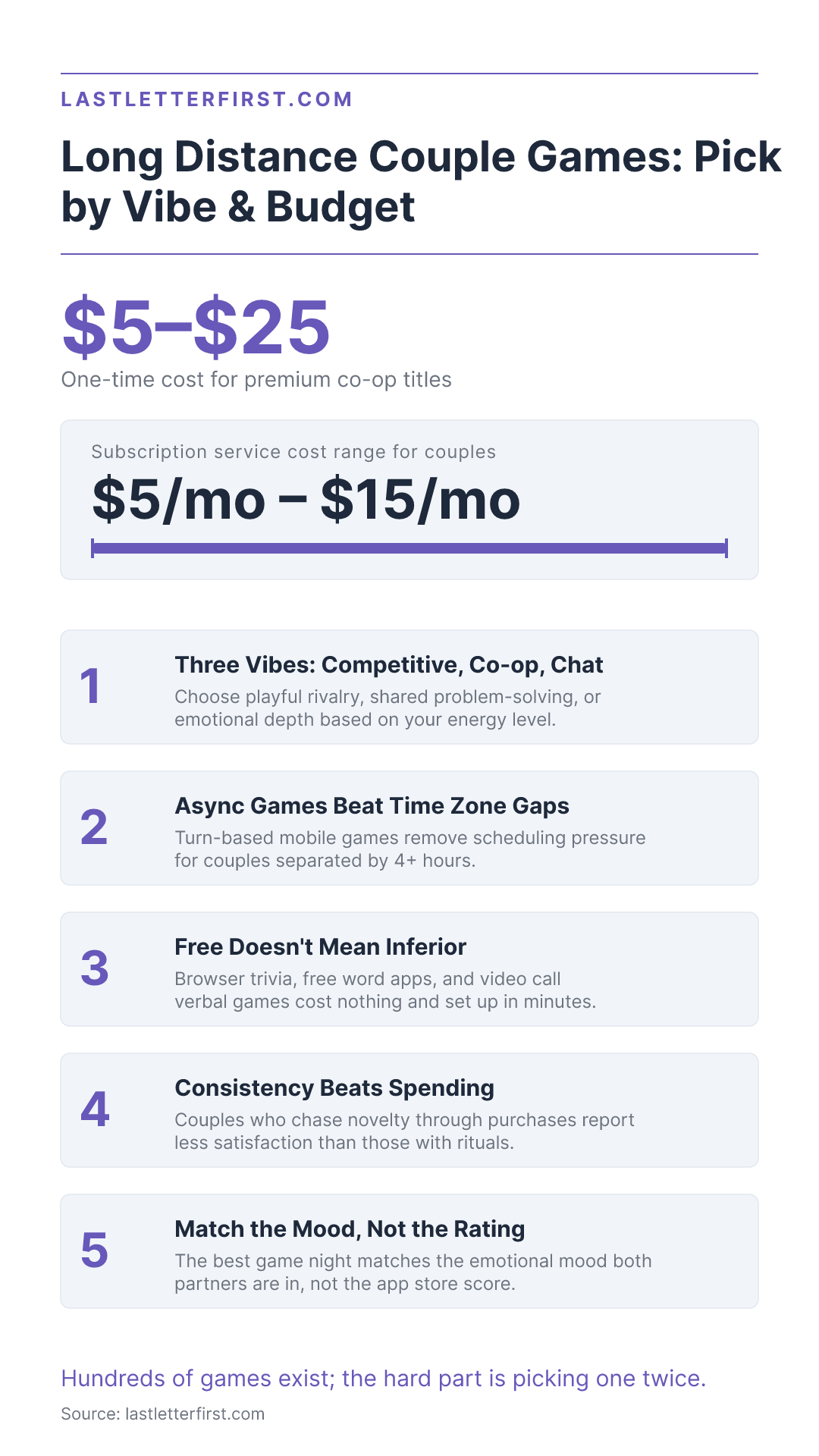
- Long distance couple games fall into three distinct categories: competitive, cooperative, and conversational, and the right choice depends on whether partners want playful rivalry, shared problem-solving, or emotional depth.
- Asynchronous games let partners play across time zones without needing to be online at the same time, solving the single biggest scheduling complaint in long distance relationships.
- Browser-based word games, online trivia platforms, and cooperative puzzle apps all let long distance couples play together without downloads or complicated setup.
- The best game night ritual for long distance couples is one that matches the emotional mood both partners are in, not the one with the highest app store rating.

Most advice about long distance couple games assumes the hard part is finding a game. It isn’t. In 2026, there are hundreds of options. The actual problem is that couples pick games randomly, get bored after two sessions, and conclude that playing together over a screen “just doesn’t feel the same.” That’s a sorting problem, not a game problem.
This guide sorts long distance couple games by interaction style, cost transparency, and schedule overlap. Couples curious about fun word games to play with a partner will find that’s one piece of the puzzle, but the full picture requires thinking about vibe, budget, and time zones together.
Why Long Distance Couple Games Deserve a Spot in Your Routine
Long distance couple games replace the effortless shared experiences that physical separation removes , the idle couch time, the spontaneous walks, the low-stakes moments that build connection. Word games like Last Letter First, cooperative puzzles, and online trivia platforms let partners do something together rather than simply catch up, creating variety that prevents routine fatigue.
Competitive vs. Cooperative vs. Conversational Games for Couples
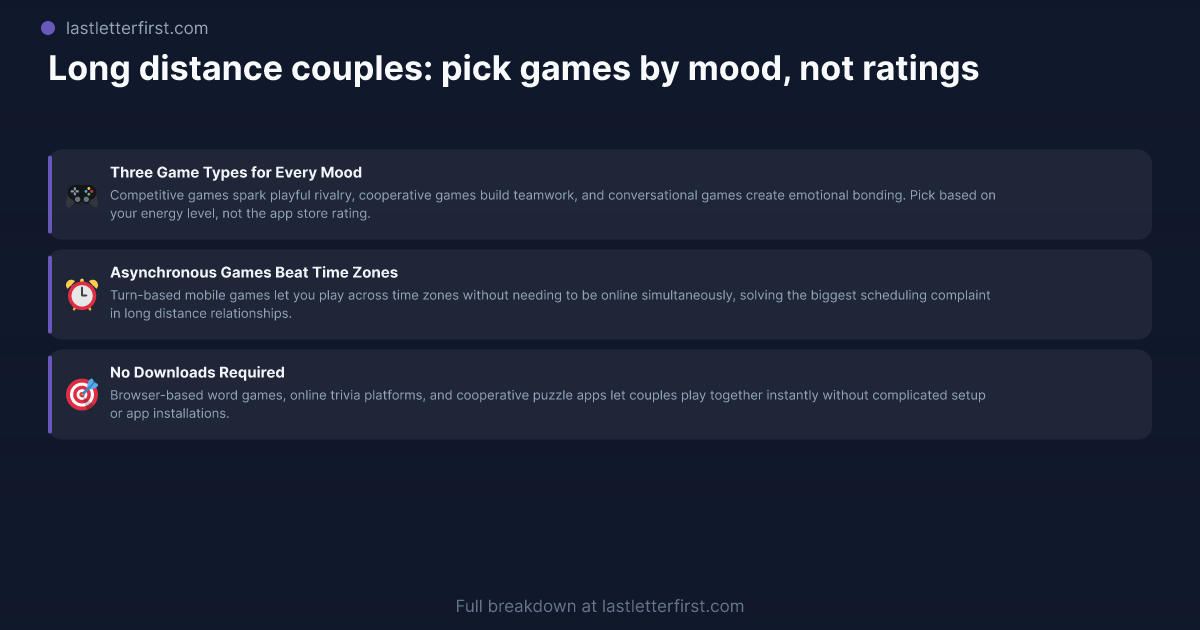
Long distance couple games fall into three distinct categories: competitive, cooperative, and conversational, and the right choice depends on whether partners want playful rivalry, shared problem-solving, or emotional depth. Online games for couples range from competitive word and trivia challenges to cooperative adventures and conversational card-style prompts, each serving a different relationship need.
The tradeoff isn’t about quality. It’s about energy. Competitive games work when both partners are alert. Cooperative games work when you want closeness without confrontation. Conversational games work when you’re emotionally available but physically exhausted.
| Game Type | Best For | Energy Level | Example Format |
|---|---|---|---|
| Competitive | Playful rivalry, laughing at each other | High | Word games, trivia, strategy |
| Cooperative | Teamwork, shared accomplishment | Medium | Co-op puzzles, escape rooms |
| Conversational | Emotional bonding, vulnerability | Low | Prompt cards, question games |
Competitive Games That Spark Playful Rivalry
Word games sit at the top because they require no tutorials and no learning curve beyond knowing a language. Research from NASPA, the North American Scrabble Players Association, confirms that competitive word play strengthens vocabulary recall. Couples curious about how multiplayer word games can improve vocabulary and communication will find the same principles apply to partners. But the tradeoff is real: if one partner wins consistently, the fun erodes. The strongest competitive games keep skill gaps narrow or let luck influence outcomes.
Cooperative and Conversational Games for Deeper Connection
Cooperative online games let long distance couples work toward shared goals, while conversational prompt games create space for emotional bonding that pure video calling rarely achieves. Neither category produces a loser.
Co-op titles tend to be puzzle-based: online escape rooms, collaborative drawing, and board game adaptations. The appeal is solving something together. Conversational card-style games are the sleeper hit: one partner draws a question, both answer, and conversation flows naturally. They’re low-energy and surface topics couples wouldn’t organically discuss. The risk is they feel forced if both partners aren’t in the right headspace.
Time-Zone-Friendly Games: Asynchronous and Turn-Based Picks
Turn-based mobile games with asynchronous modes are the strongest phone option for long distance couples because they remove the pressure to be online at the same time. This is arguably the most important section for couples separated by more than a few hours.
Synchronous games feel more like “real” game night, but they require overlapping free time. For couples split across time zones, that overlap might be a 30-minute weekday window. That’s not sustainable.
| Format | Pros | Cons | Best For |
|---|---|---|---|
| Synchronous | Live reactions, shared energy | Requires schedule overlap | Same or adjacent time zones |
| Asynchronous | No scheduling pressure, daily touchpoints | Less immediate excitement | 4+ hour time zone gaps |
| Hybrid | Flexibility with occasional live play | Fewer titles support this | Variable schedules |
Word games with async modes dominate this category because each move is self-contained. You play your word, send it. Your partner sees it hours later and responds. For couples who want to learn how these games work, the barrier to entry is genuinely low.
The honest assessment: async games won’t replace live game night. They’re a complement. Treat async play as the weekday baseline and save synchronous sessions for weekends.
Free vs. Paid: Honest Cost Breakdown of Couple Games Online
The single biggest misconception about couple games online is that free means inferior. It doesn’t. Some of the most engaging games to play on FaceTime or through a browser cost nothing.
| Game Type | Typical Cost | Setup Time | Best For |
|---|---|---|---|
| Browser-based trivia | Free | Under 1 minute | Quick, spontaneous sessions |
| Free word game apps | Free (optional cosmetic purchases) | 2-5 minutes | Vocabulary-focused couples |
| Video call verbal games | Free | None | Conversation-driven play |
| Premium co-op titles | $5-$25 one-time | 5-10 minutes | Deeper gameplay |
| Subscription services | $5-$15/month | Varies | Frequent players wanting variety |
The cheaper the tool, the more expensive the mistakes it hides. Freemium apps that lock meaningful features behind paywalls waste time, not money. Read app store reviews and search specifically for paywall complaints before downloading.
Paid games earn their price when they offer experiences free alternatives can’t replicate. A $10-$25 co-op title delivers weeks of entertainment, cheaper than a single dinner out. Subscriptions make sense only if the couple plays regularly enough to justify recurring cost.
Here’s the paradox worth sitting with: the couples who spend the most on long distance couple games often report the least satisfaction, because they chase novelty through purchases rather than building rituals around a few games they genuinely enjoy. Consistency beats spending. Start free, identify what type resonates, then consider paid options. Couples who explore multiplayer word games often discover months of free engagement before any upgrade becomes tempting.
Creative Virtual Date Activities Beyond Traditional Games
Virtual date activities work best when they blend structured play with genuine shared experience. A cooking challenge over video call, a synchronized movie watch party, or collaborative playlist-building all qualify as date ideas for long distance relationships. Couples who rotate between competitive games one week, a watch party the next, and a cooking challenge after that report less routine fatigue.
Playing a word or trivia challenge during a video call transforms passive screen time into active engagement. For couples ready to play word games together online, the entry point is simpler than most expect. A browser, a video call, and a willingness to look silly are the only requirements.
Frequently Asked Questions
What are the best games to play with my long-distance partner over the phone?
Word games, trivia apps, and cooperative puzzle games are the most accessible phone options. Word challenges work especially well because they require no tutorial and generate natural conversation. For couples whose schedules rarely overlap, turn-based options let each partner play on their own time. Pick something both partners find genuinely engaging rather than defaulting to whatever appears first in an app store search.
How do couples in LDRs keep things fun and avoid boring routines?
Rotating between competitive, cooperative, and conversational games across different weeks sustains novelty without requiring constant new app discovery. The ritual itself, a recurring scheduled time for shared play, matters more than any individual game choice. Competitive games satisfy challenge-seekers, cooperative games build teamwork, and conversational games deepen emotional connection.
Are there co-op mobile games that actually work well for couples who are apart?
Yes. Several cooperative mobile titles are designed for two-player remote play, including puzzle games and adventure games with shared narratives. Verify stable internet requirements and cross-platform support before downloading. Most couples prefer running a separate video call alongside the game for a more personal connection than built-in voice chat provides.
What are creative activities long-distance couples can do together beyond video calling?
Online multiplayer games, virtual watch parties, shared playlist creation, and cooking challenges all extend beyond basic video calling. Doing something together while talking feels fundamentally different from simply talking, and that difference sustains connection over months of distance. Synchronized movie watching and cooking the same recipe simultaneously turn mundane tasks into shared events.
What is a Scrabble Word Finder and how does it help couples playing word games?
A Scrabble Word Finder checks whether a word is valid and suggests possible words from a given set of letters by cross-referencing an official word list. For couples, it levels the playing field when one partner has a stronger vocabulary. Rather than creating an unfair advantage, it functions as a learning tool. The North American Scrabble Players Association maintains resources explaining how official word validation works.
Is there a free Scrabble Solver or Anagram Solver for online word games?
Yes, several free browser-based solvers exist requiring no download or account. These tools unscramble letters, verify words against official dictionaries, and display results instantly. The distinction between a solver and a cheat tool is intent: using it to learn new words after a round builds vocabulary, while using it mid-turn defeats the purpose of playing together.
What is the North American Scrabble Word List and does it matter for casual play?
The North American Scrabble Word List contains over 190,000 valid entries and serves as the definitive authority on playable words. For casual couples, it matters primarily as a dispute-resolution tool. When one partner plays a word the other challenges, checking it against the official list settles the argument instantly. Most free online word checkers reference this list indirectly.
How does a Scrabble Best Move Finder work?
A Scrabble Best Move Finder analyzes your rack letters alongside the current board layout to suggest the highest-scoring possible play. It evaluates every valid combination, considers placement bonuses, and ranks options by total points. For casual couple games, using it after a round as a review tool is genuinely educational. Partners can compare their actual play against the optimal suggestion.
Can I check if a word is valid in Scrabble before playing it?
Yes. A Scrabble Valid Word Checker cross-references any word against the Official Scrabble Dictionary and returns an instant yes-or-no answer. Most checkers are free and browser-based. For couples playing remotely, this eliminates the most common source of friendly arguments. Hasbro’s official Scrabble resources provide additional context on valid word standards.
What are the best free online games for two people in different time zones?
Asynchronous turn-based games are the strongest category for couples separated by significant time zone differences. Word games, chess apps, and collaborative puzzle games all fit this model. Each turn creates a small moment of connection throughout the day. Couples eight or more hours apart consistently describe async games as the format that actually sticks, because it respects both partners’ daily rhythms.
Are video call games a good date idea for long-distance relationships?
Yes. Video call games combine face-to-face interaction with shared play, addressing the two biggest long-distance complaints: feeling disconnected and running out of things to do. Trivia, drawing games, and word puzzles all translate well to FaceTime or Zoom. Adding a ten-to-fifteen-minute game segment to regular calls requires minimal effort and meaningfully changes the quality of the interaction.
We talk a lot in our LDR. How can we use that time more productively?
Layer a game or shared activity onto your existing calls to transform passive conversation into interactive engagement. Word games and trivia are particularly effective because they create natural turn-taking, give you both something to focus on beyond just talking, and generate moments of friendly competition or collaboration. This structured approach keeps the conversation flowing while adding a purpose beyond catching up, which many long distance couples find deepens their connection during call time.
What Comes Next for Your Game Nights
The landscape of long distance couple games is shifting in 2026 toward more integrated experiences where the line between “playing a game” and “spending time together” disappears. Browser-based multiplayer options are improving. Async formats are getting smarter about notification timing. And the couples who build a rotation system now will find that distance starts to feel like a logistical detail rather than an emotional barrier.
Pick one free game from any category. Schedule thirty minutes this week. If it doesn’t click, try a different category next week. The system matters more than the selection.
Distance tests everything. But the couples who play together tend to stay together.
By Last Letter First Editorial Team | Last updated: October 2026
About the Last Letter First Editorial Team: The Last Letter First Editorial Team covers word games, vocabulary building, and language-based activities for players of all ages. The team focuses on practical, research-informed guides that help readers connect through language and play. Visit the Last Letter First FAQ page for more about the games discussed in this guide.