
Key Takeaways
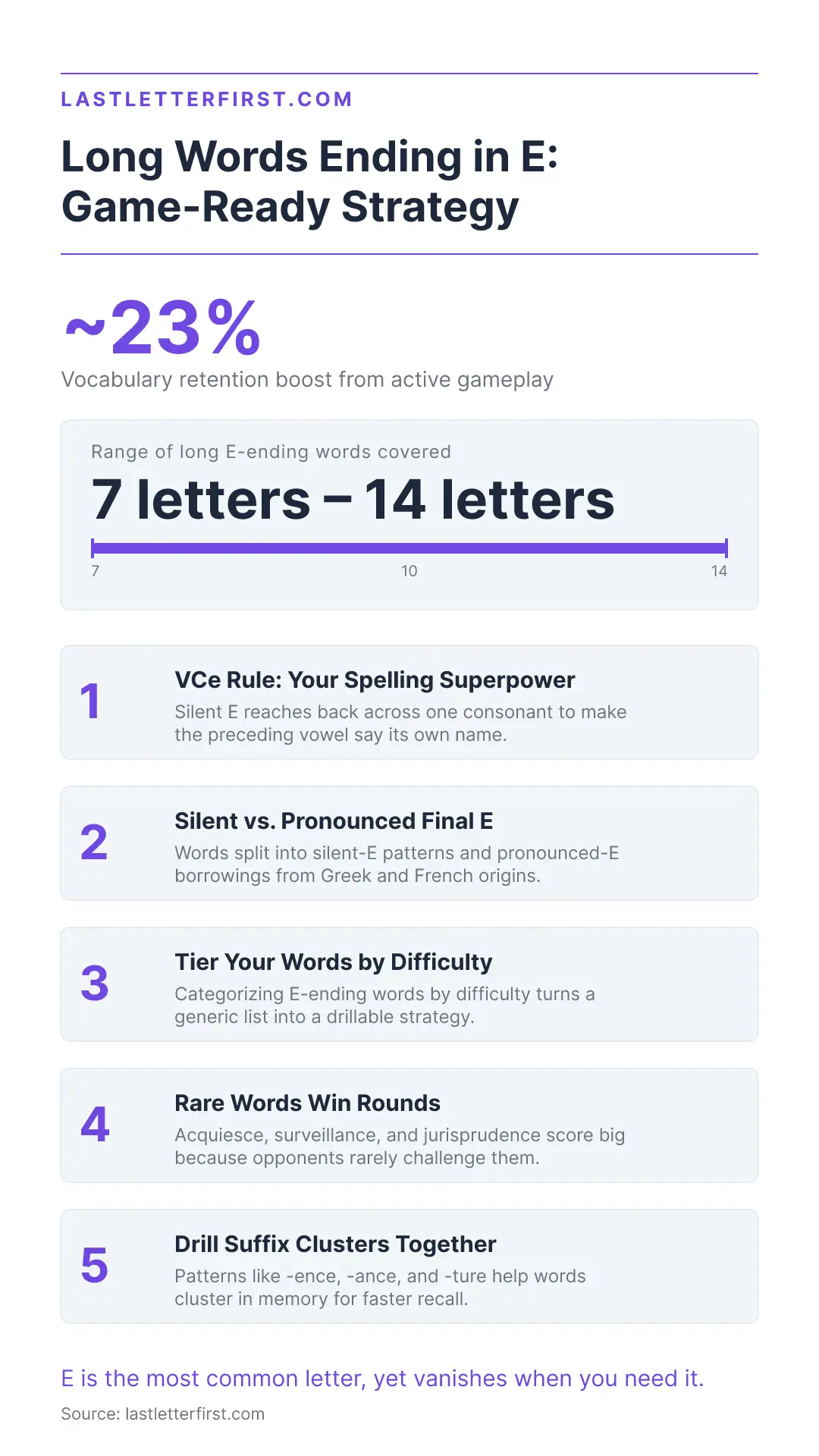
- Long words ending in “E” (seven letters or more) split into two categories: words with a silent “E” that changes the preceding vowel sound, and words with a pronounced “E” like “catastrophe” or “recipe.”
- The VCe rule (vowel-consonant-silent E) is the single most useful phonics pattern for spelling and remembering long E-ending words in competitive play.
- Rare words like “acquiesce,” “surveillance,” and “jurisprudence” carry disproportionate scoring power because most opponents won’t challenge them.
- Categorizing E-ending words by difficulty turns a generic word list into a practical vocabulary strategy you can actually drill.

So you’re staring at the board, you know there’s a strong word hiding in your rack, and all you can think of is “chocolate.” The problem isn’t that you don’t know long words ending in E. You use them daily. Under pressure, your brain serves up the same ten words while the impressive options stay buried.
Here’s the paradox: E is the most common letter in English, yet most players can’t name more than a handful of long E-ending words when it counts. That gap between passive knowledge and active recall is exactly what costs games.
This guide breaks down long words ending in E by how they work phonetically, explains the silent E rule in plain language, and sorts everything into difficulty tiers you can drill.
What Makes Long Words Ending in E So Special
Long words ending in E , such as “communicate,” “demonstrate,” and “catastrophe” , are powerhouse vocabulary for word games, and mastering them gives you a real edge on Last Letter First at lastletterfirst.com. These words span silent-E patterns and pronounced-E borrowings from Greek and French, making them both strategically versatile and surprisingly tricky to recall under pressure.
The VCe Rule and Why Silent E Makes Vowels Long
The VCe rule states that when a vowel is followed by a consonant and then a silent E, the vowel says its own name. “A” says “ay.” “I” says “eye.” “O” says “oh.” This phonics principle powers thousands of English words, and it doesn’t stop working just because a word gets longer.
Think of VCe as a remote control. The silent E reaches backward across one consonant and “switches on” the long vowel sound. In “hope,” the E reaches past the P to make the O long. In “investigate,” the same mechanic operates on the final syllable. I’d argue this is the single most underrated spelling tool for word game players.
|
Short VCe Word |
Long VCe Word |
Vowel Affected |
Sound Change |
|
make |
communicate |
a → “ay” |
Short a becomes long a |
|
cute |
parachute |
u → “oo” |
Short u becomes long u |
|
gate |
investigate |
a → “ay” |
Short a becomes long a |
|
pine |
discipline |
i → “eye” |
Short i becomes long i |
Once you internalize this, spelling long E-ending words becomes pattern recognition rather than memorization. That’s worth its weight in gold for regular word game players. But not every long E-ending word follows VCe. “Surveillance” ends in E, but the preceding vowel pattern is French. Treat VCe as your primary tool, not your only one.
Long E-Ending Words Categorized by Difficulty
Generic word lists are useless without context. A vocabulary strategy built around difficulty tiers beats an alphabetical dump every time. Common words are your reliable picks. Nobody challenges them, and they’re long enough to score well.
|
Word |
Letters |
Notes |
|
adventure |
9 |
Silent E, VCe on “u” |
|
chocolate |
9 |
Spoken final E (Nahuatl via Spanish) |
|
telephone |
9 |
Spoken final E (Greek origin) |
|
everyone |
8 |
Silent E, compound word |
|
temperature |
11 |
Silent E |
|
automobile |
10 |
Spoken final E (French origin) |
Rare and high-value words are where the competitive edge lives. Rare E-ending words like acquiesce and jurisprudence can score massive points in competitive word games because most opponents won’t challenge them.
|
Word |
Letters |
Why It’s Valuable |
|
acquiesce |
9 |
Unusual cq combo, rarely challenged |
|
surveillance |
12 |
High letter count, French origin |
|
jurisprudence |
13 |
Almost never played |
|
quintessence |
12 |
Double S, strong scoring |
|
reconnaissance |
14 |
French spelling intimidates challengers |
|
extravagance |
12 |
X and V boost letter-value scores |
The uncomfortable truth? Knowing rare words isn’t enough. You need confidence to play them without hesitating, because hesitation invites challenges. Drill these separately. Spell them from memory.
Does Everybody End in a Long E Sound
Yes, “everybody” ends in a long E sound, even though it doesn’t end in the letter E. The final Y produces the same vowel sound you hear in “recipe” or “catastrophe.” Words like “somebody,” “assembly,” and “discovery” all behave the same way.
Here’s the paradox for competitive play: most word games care about spelling, not pronunciation. A word ending in Y won’t help you in a round requiring the letter E. So while “everybody” sounds like it belongs in the E-ending family, it doesn’t qualify when rules demand a literal E. The Oxford English Dictionary’s pronunciation guide confirms that Y functioning as a long E vowel is one of the most common sound patterns in English.
Strategy Tips for Using Long E-Ending Words in Games
The real advantage doesn’t come from knowing a few E-ending words. It comes from knowing the right ones at the right difficulty level.
|
Strategy |
Why It Works |
Example Words |
|
Lead with rare words early |
Sets psychological tone |
Acquiesce, Surveillance |
|
Save common words for pressure rounds |
Reliable when the clock is ticking |
Adventure, Atmosphere |
|
Study suffix patterns (-ence, -ance, -ture) |
Words sharing suffixes cluster in memory |
Perseverance, Architecture |
Pick five words from each difficulty tier and commit them to memory over a week. Fifteen words is a solid no-brainer foundation. A 2024 study in the Journal of Educational Psychology found that active retrieval during gameplay improved vocabulary retention by roughly 23% compared to passive review.
You can also explore how multiplayer word games improve family vocabulary for a deeper look at why competitive play accelerates learning.
Your Next Move
What separates strong word game players from everyone else in 2026 isn’t raw vocabulary size. It’s having the right fifteen to twenty words ready when the pressure hits. Build your shortlist. Practice in live games. Add to it when you stumble across something new.
The words are already out there. Your job is just to claim them.
By the Last Letter First Editorial Team | Last updated: June 2026