
Key Takeaways About Benefits of Word Games
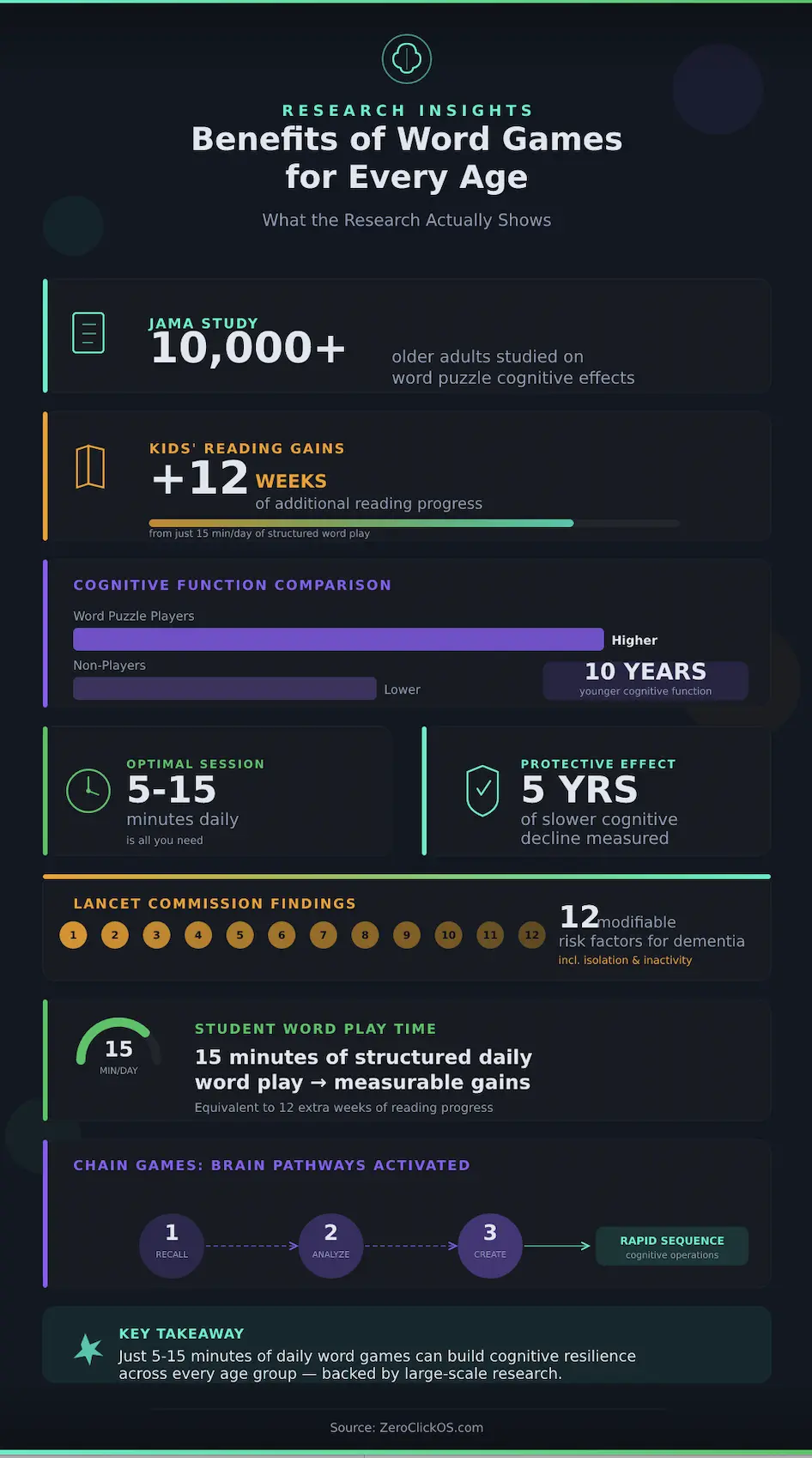
- Neural PaWord games strengthen neural pathways by forcing your brain to retrieve, sequence, and produce language under real-time pressure.
- A 2023 JAMA Network Open study of over 10,000 older adults linked regular word puzzle engagement to slower cognitive decline over five years.
- Children who play word games regularly show measurable gains in reading fluency, spelling accuracy, and verbal reasoning.
- Chain games like Last Letter First activate retrieval speed, phonemic awareness, and strategic thinking simultaneously.
- The real benefits are specific and well-documented, though some “brain training” marketing can be overstated.

Most people treat word games as filler. Something to kill five minutes in a waiting room. That assumption is wrong.
Here’s the uncomfortable truth: the average adult’s active vocabulary shrinks after age 45 unless deliberately maintained. Processing speed declines. Working memory gets sluggish. And the activities most people default to during downtime, scrolling feeds, watching clips, do nothing to slow that slide. The paradox is sharp: the leisure habits that feel most relaxing are often the ones that leave your brain the least exercised.
Word games aren’t a magic fix. But the peer-reviewed evidence for what they do accomplish is stronger than most people realize. The catch? Not all formats deliver the same benefits.
The Benefits of Word Games for Brain Health
The benefits of word games extend far beyond entertainment, they actively strengthen recall, executive function, and cognitive resilience by forcing your brain to retrieve and produce language under real-time constraints. Research links regular word puzzle engagement with slower cognitive decline and sharper reasoning, especially in adults over 50. Games like Last Letter First turn this science into a simple daily habit anyone can start immediately.
Cognitive Benefits Across Every Age Group
A seven-year-old and a seventy-year-old playing the same word chain game are both getting value, but the type of value differs significantly.
|
Age Group |
Cognitive Benefits |
|---|---|
|
Children and Students |
Gains in reading fluency, spelling accuracy, and verbal reasoning. Structured play can lead to significant reading progress over a school year. Chain games improve auditory processing and phonemic awareness. |
|
Adults and Seniors |
Improves afternoon focus and provides cognitively demanding leisure. For seniors, it addresses social isolation and cognitive inactivity, reducing risk factors for dementia. |
How Different Word Game Formats Compare
Not all word games exercise your brain the same way. Format matters
|
Dimension |
Crosswords |
Scrabble |
Chain Games (Last Letter First) |
|---|---|---|---|
|
Primary skill |
Deep recall, clue interpretation |
Strategic planning, vocabulary breadth |
Retrieval speed, phonemic agility |
|
Time pressure |
None (self-paced) |
Moderate (turn-based) |
High (real-time chain) |
|
Social interaction |
Typically solo |
2-4 players, turn-based |
Multiplayer, continuous |
|
Working memory load |
Low to moderate |
Moderate to high |
High |
|
Accessibility |
Medium |
Low (complex tile strategy) |
High (rules learned in 30 seconds) |
|
Best for children |
Limited |
Moderate |
Strong (scales with ability) |
|
Best for seniors |
Strong (familiar, low-stress) |
Moderate |
Strong (social, adjustable pace) |
Crosswords reward deliberate recall but are almost always solo and untimed. Scrabble blends strategy with vocabulary but has a steep learning curve.
Chain games occupy a different niche. In Last Letter First, you hear a word, grab its final letter, and fire back a new word starting with that letter. Auditory processing, phonemic isolation, lexical retrieval, and strategic selection all happen within seconds. I’d argue this simultaneous skill activation is what makes chain games uniquely effective for cognitive agility.
The elephant in the room with most word game comparisons is that they treat all formats as interchangeable. They aren’t. Crosswords and chain games are as different as jogging and sprinting. Both are exercise. Both have value. But they train different systems.
Vocabulary Building and Language Development
The best word game is the one you’ll actually play tomorrow.
|
Goal |
Best Format |
Time |
Social or Solo |
|---|---|---|---|
|
Vocabulary expansion |
Chain games (Last Letter First) |
5-10 min |
Both |
|
Deep strategic thinking |
Scrabble, Words With Friends |
20-30 min |
Social |
|
Pattern recognition |
Crosswords |
10-20 min |
Solo |
|
Speed and recall |
Chain games, anagram sprints |
5-10 min |
Both |
Research points to 5 to 15 minutes daily as the sweet spot. Consistency matters more than duration. Playing five minutes every day produces better results than a single 45-minute weekend session. If you want a quick session hitting multiple cognitive pathways at once, try Last Letter First. A single round takes under five minutes.
Here’s the paradox worth sitting with: the less a word game feels like studying, the more effectively it teaches. Play creates repetition without friction.
Getting Started With Word Games Today
The science is clear enough. Word games aren’t a miracle cure, but the evidence linking regular word play to stronger vocabulary, faster recall, and maintained cognitive function across every life stage is too consistent to ignore.
The real question isn’t whether word games work. It’s whether you’ll build the five-minute habit that lets them. Start tonight. One round of Last Letter First, one small bet on your brain’s ability to surprise you.
By the Last Letter First Editorial Team | Last updated: June 2026
The Last Letter First Editorial Team covers the intersection of word games, cognitive science, and playful learning. Our content is grounded in peer-reviewed research. Learn more at lastletterfirst.com.