
By Last Letter First Editorial Team | Last updated: October 2026
Key Takeaways
- A keyword game is any word game that challenges players to guess a hidden word using letter-based clues, pattern recognition, or deductive reasoning, spanning formats from board games to browser puzzles to voice apps.
- The genre traces back to Parker Brothers’ 1953 board game and has evolved through the Washington Post’s daily Keyword puzzle, mobile apps, and Alexa skills.
- Keyword games strengthen pattern recognition, vocabulary recall, and deductive reasoning, which is why educators and therapists use them as low-pressure cognitive exercises.
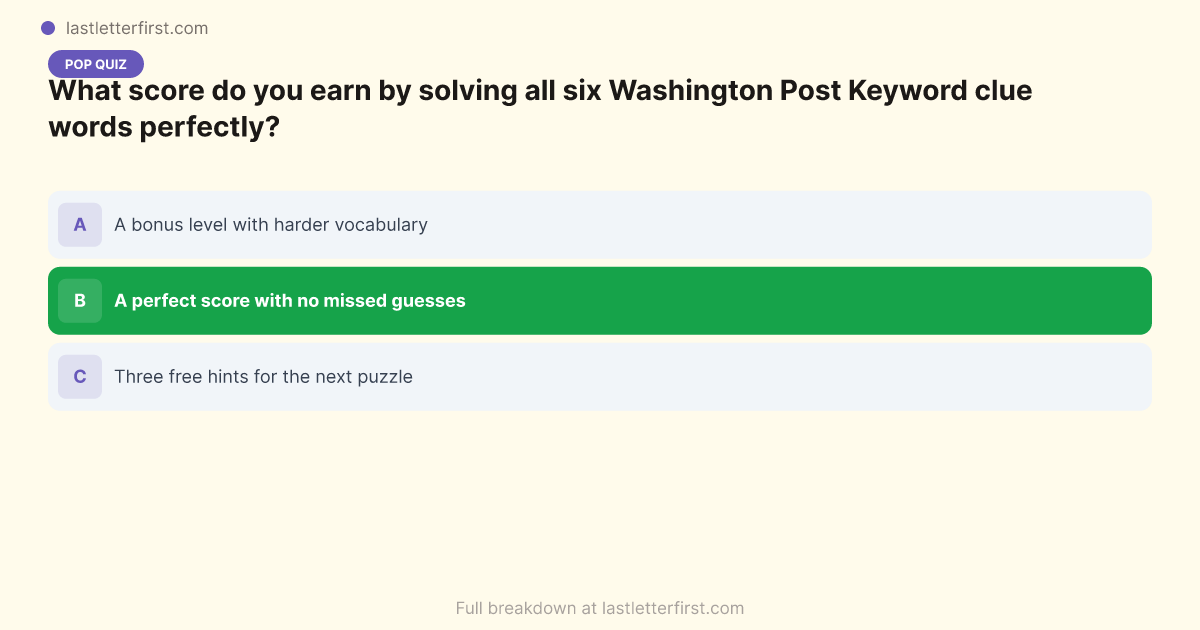
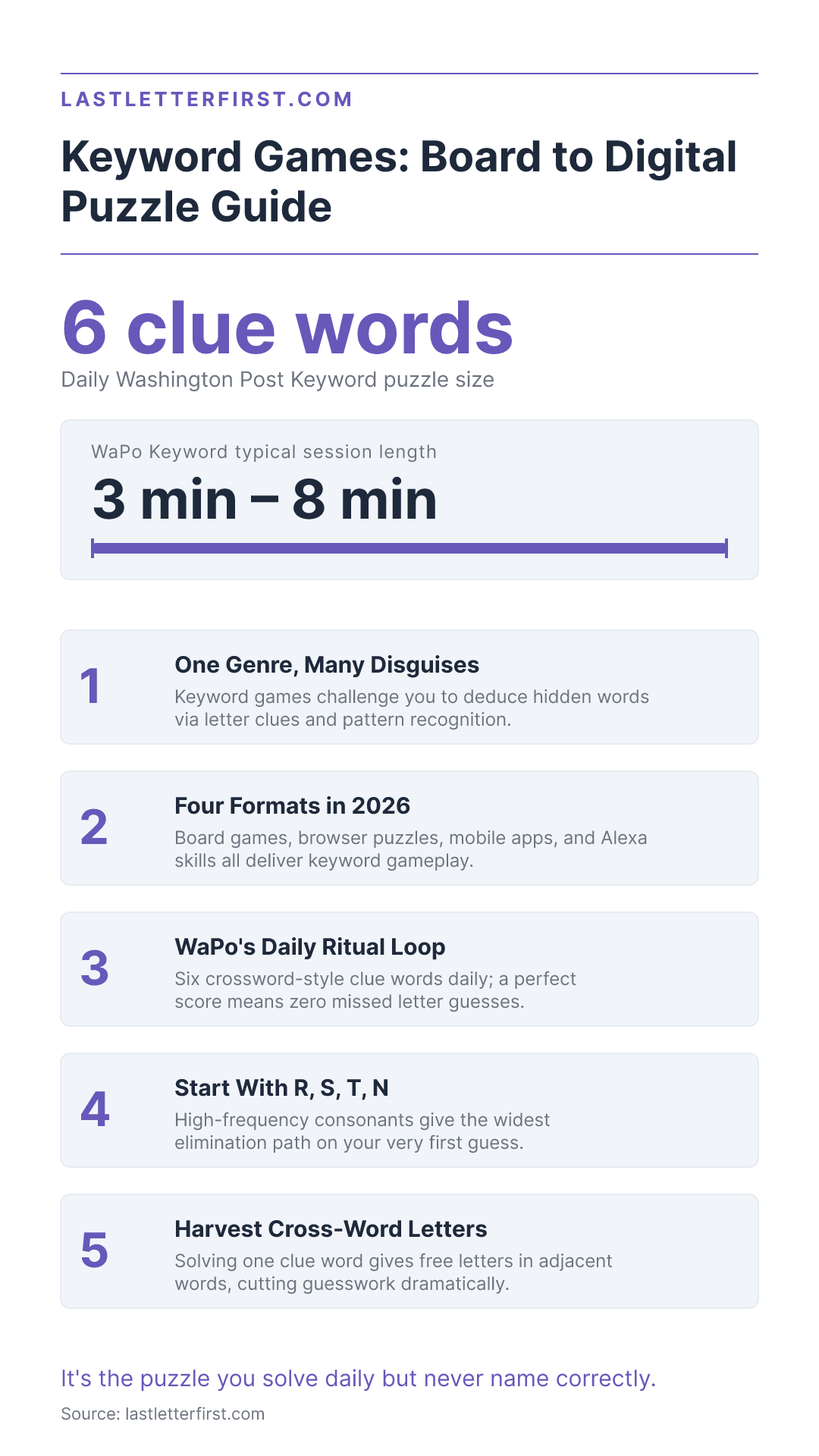
- The Washington Post Keyword puzzle awards a perfect score when you solve all six clue words without a single missed guess.
- Starting with high-frequency consonants and common vowel patterns gives you the widest elimination path in any keyword-style puzzle.
You’ve been solving that daily Washington Post puzzle every morning, arguing with coworkers about whether “THROVE” is a real word, and you didn’t even realize you’ve been playing a keyword game. That’s the funny thing about this genre. It doesn’t announce itself. It just shows up inside crosswords, board games, party nights, and classroom warm-ups wearing a different outfit every time.
People search for the keyword game expecting one thing and find three completely different products. A vintage board game. A daily browser puzzle. An Alexa skill. They’re all correct. The keyword game isn’t a single product. It’s a format built around deduction and letter logic. And in 2026, it’s quietly powering some of the most engaging word games online, even if most players don’t call it by name.
If you’re looking to expand your vocabulary through word games, keyword games are one of the most effective ways to do it.
What Is a Keyword Game and Why It Endures
A keyword game challenges players to deduce hidden words through letter clues and pattern recognition , a format that scales from casual fun to serious cognitive exercise. Last Letter First builds on this tradition by adding a chain-linking twist, where each word must connect to the last. Whether you’re an educator, a puzzle enthusiast, or a competitive word nerd, the genre’s simple-rules-deep-strategy appeal keeps players coming back.
Keyword Game Formats Compared: Board vs Digital vs Voice
The keyword game landscape in 2026 splits into four distinct formats, and they play nothing alike.
| Format | Platform | Session Length | Cost | Best For |
|---|---|---|---|---|
| Board game (Parker Brothers, vintage) | Physical tabletop | 20-40 min | $10-$30 secondhand | Group play, collectors |
| Washington Post Keyword | Browser (wapo.com) | 3-8 min | Free (with WaPo access) | Daily puzzle habit |
| Mobile apps (Android/iOS) | Smartphone | 5-15 min | Free with ads | On-the-go play |
| Alexa Keyword Game skill | Amazon Echo | 2-5 min | Free | Hands-free, accessibility |
Washington Post Keyword: Rules, Scoring, and Bonus Levels
The Washington Post Keyword puzzle presents six crossword-style clue words daily, and players type letter guesses to fill blanks, earning a perfect score by solving all six words without a single missed letter. Each clue word shares letters with adjacent words, so solving one gives you free letters in the next.
You start with a full score and lose points for every incorrect guess. String together three perfect rounds in a single week, and a bonus level with harder vocabulary opens up. The puzzle refreshes daily, creating a strong ritual loop.
Players who enjoy this format often branch out. You can explore how multiplayer word games boost family vocabulary for a social spin on the same skills.
Mobile and Voice Alternatives
Android keyword apps on Google Play show limited adoption, with most sitting around 500+ downloads rather than the hundreds of thousands Wordle clones pulled. The Alexa Keyword Game skill carries mixed reviews pointing to limited word banks and repetitive clues.
The real opportunity lies in combining formats: a daily puzzle with the Post’s clue quality, delivered through a voice assistant with leaderboard tracking. Nobody’s built that yet. The NASPA Scrabble community has shown that competitive word game players crave structured challenge formats, and keyword games are ripe for that treatment.
Winning Strategies and Tips for Keyword Puzzles
Winning a keyword puzzle isn’t about having the biggest vocabulary. It’s about elimination speed. The best players don’t guess words. They guess letters strategically to rule out the most possibilities with each attempt.
Starting with high-frequency consonants like R, S, T, and N gives you the widest elimination path on your first guess. Pair those with common vowel patterns, and you’ll crack most keyword puzzles in fewer attempts than someone who starts with obscure letters.
Cross-word letter intersections are your best friend in grid-style puzzles. When you solve one clue word, immediately check which letters it shares with adjacent words. Those free letters often reveal enough structure that you can solve the next word without guessing a single new letter. It’s worth its weight in gold once the habit clicks.
| Strategy | When to Use It | Why It Works |
|---|---|---|
| High-frequency consonant opening | First guess in any round | Eliminates the most possibilities early |
| Vowel pattern scanning | After 1-2 consonant guesses | English words cluster around predictable vowel combos |
| Cross-word intersection harvesting | Grid-based puzzles (WaPo) | Free letters reduce guesswork on adjacent words |
| Reverse-engineering from word length | Any keyword puzzle | Six-letter words have fewer candidates than you’d think |
| Clue-context narrowing | Category-based clues | Limits your mental word bank to a manageable subset |
For players who want to sharpen these skills, the Last Letter First learning hub offers resources on rapid word recall.
The uncomfortable truth is that clue design is the hardest part of building a keyword game. Ambiguous clues that accept multiple valid answers but recognize only one remain the format’s biggest frustration. Don’t commit to a full word until you’ve confirmed at least three or four characters through intersecting letters.
Search Trends and the Future of Keyword Games
The Washington Post hosts its free daily Keyword puzzle at washingtonpost.com, where players solve intersecting horizontal clues one letter at a time. For alternatives, keywordsgame.com offers its own daily puzzles, and the dmApps Keyword app on Google Play provides a mobile option.
Beyond dedicated keyword puzzles, Merriam-Webster hosts adjacent word games like Quordle and Blossom. AARP games sections feature accessible word games with clean interfaces. Pogo remains a destination for classic browser-based word games. Last Letter First runs weekly word game tournaments that test vocabulary under time pressure.
Here’s the paradox: no major publisher currently offers official downloadable keyword puzzle PDFs, making printable formats one of the biggest unmet demands in the word game market. Teachers and hospital staff needing screen-free activities can create custom keyword grids using free crossword-building tools online.
| Platform | Format | Cost | Best For |
|---|---|---|---|
| Washington Post | Daily browser puzzle | Free | Solo daily solvers |
| keywordsgame.com | Daily browser puzzle | Free | Players wanting variety |
| dmApps (Google Play) | Mobile app | Free | On-the-go play |
| Merriam-Webster | Quordle, Blossom, etc. | Free | Adjacent word game fans |
| AARP Games | Mixed word games | Free | Clean, ad-light interface |
| Pogo | Browser word games | Free/Premium | Community-oriented players |
| Last Letter First | Multiplayer word game | Free | Competitive vocabulary building |
Frequently Asked Questions
What is the typical average score for the Washington Post Keyword puzzle?
Most players average 8 to 10 guesses per puzzle, though sessions swing widely depending on clue difficulty. Community discussions on Reddit noted the displayed average shifted without official explanation. Some players speculate a scoring recalculation, while others believe an expanded player pool diluted the average. If you’re consistently landing under 10 guesses, you’re performing at or above the community norm.
Has the Washington Post changed its Keyword scoring algorithm?
No official announcement has been made. However, players noticed the stated average changed recently, suggesting a backend update. The Post may have expanded the data window or adjusted how incomplete games factor in. Track your own performance over time rather than benchmarking against a displayed average that may shift without warning.
Which keyword mechanics in board games do players find most enjoyable?
Players prefer keywords that serve as concise shorthand for specific effects, similar to how Magic: The Gathering uses “flying” or “trample” to encode complex rules into a single term. The best keyword mechanics are intuitive enough to guess from context, specific enough to avoid ambiguity, and modular enough to combine for emergent strategy.
Are there standalone apps that replicate the Washington Post Keyword experience?
No perfect replica exists. The dmApps Keyword app on Google Play offers a similar letter-guessing format with daily puzzles, but it has modest downloads and limited community support. For mobile access to the Post’s version specifically, the Washington Post’s mobile site works well in any browser without requiring an app download.
Can I use a Scrabble word finder for keyword games?
Scrabble word finder tools check whether a word is valid against official dictionaries, but they aren’t designed for keyword puzzle logic. Keyword puzzles require contextual clue interpretation and positional deduction, not just letter validation. Think of Scrabble tools as a dictionary check, not a puzzle solver. For checking word validity, a Scrabble valid word checker from NASPA Scrabble is the gold standard.
How does the Keyword game compare to Wordle?
Keyword is a crossword-style deduction game where you solve intersecting horizontal words by guessing letters. Wordle uses color-coded feedback on standalone five-letter guesses with no crossword structure. Keyword rewards vocabulary breadth because you solve multiple intersecting words, while Wordle emphasizes elimination logic. Many dedicated word game fans play both daily.
Where can I find printable keyword puzzle PDFs?
No major publisher currently offers official downloadable keyword puzzle PDFs. For educators and health care professionals who need printable word activities, the closest alternatives are crossword puzzle generators that let you create custom grids. Sites like Boatload Puzzles offer printable crosswords that share structural DNA with keyword puzzles.
Is search interest in keyword games growing or declining?
Search interest has declined from a mid-2026 peak. But declining search volume doesn’t mean declining engagement. Discovery increasingly happens through AI chatbot recommendations and social media rather than traditional search. The keyword game format is shifting from mass-market curiosity to dedicated niche, a pattern we’ve seen with crossword puzzles and Sudoku after their initial hype cycles.
How does the Keyword game compare to Wordle and other daily word games?
Keyword is a crossword-style deduction game where you guess a six-letter word to complete intersecting horizontal words, while Wordle uses color-coded feedback on standalone five-letter guesses. Keyword rewards vocabulary breadth and contextual reasoning, whereas Wordle emphasizes systematic letter elimination. Both are daily puzzles, but Keyword integrates your guess into a larger grid structure.
How do you find the best keywords for an Android game listing?
Start by brainstorming keywords across six categories: genre, player traits, environment, game elements, gameplay mechanics, and user interaction. Validate your selections with ASO tools to ensure relevance and search volume. On Apple App Store, avoid duplicating keywords already in your title, though Google Play handles keyword overlap differently.
What is the Official Scrabble Dictionary used for word validation?
The Official Scrabble Players Dictionary (OSPD) and the North American Scrabble Word List (TWL/NWL) are the standard references for validating legal words in tournament Scrabble. Word game enthusiasts use these dictionaries to verify uncommon or disputed words during play.
Does a Scrabble anagram solver help with keyword puzzles?
An anagram solver rearranges letters to find valid words, which can assist when a keyword puzzle reveals scattered letters. However, keyword games typically require interpreting contextual clues and cross-referencing intersecting words, not just letter rearrangement, so a solver is only partially useful.
What is a Scrabble best move finder and how does it work?
A Scrabble best move finder analyzes your rack letters against the current board state to suggest the highest-scoring legal play by referencing the Official Scrabble Dictionary and factoring in premium squares. These tools are distinct from keyword game solvers, as they optimize for board positioning and point value rather than crossword-style deduction.
Where to Play Keyword and Other Word Games Today
The keyword game has traveled a long road from Parker Brothers’ 1953 living room box to the Washington Post’s daily browser puzzle to voice-activated rounds on Alexa. The formats that survive aren’t always the ones with the biggest audiences. They’re the ones with the most devoted players.
If you’re one of those players, branch out. Try a format you haven’t touched yet. If you’ve only played the Post’s daily puzzle, grab a friend and try a competitive multiplayer word game. The vocabulary you’ve been building deserves a bigger stage.
The games that keep you sharp are the ones that keep surprising you.
By Last Letter First Editorial Team | Last updated: October 2026
About the Last Letter First Editorial Team: The Last Letter First Editorial Team covers word games, vocabulary building, and puzzle strategy for players of all levels. The team combines expertise in game design, language education, and digital publishing to create guides that help players get more from every round. Learn more at Last Letter First.