
By Last Letter First Editorial Team | Last updated: October 2026

Key Takeaways For Learn Words start with E
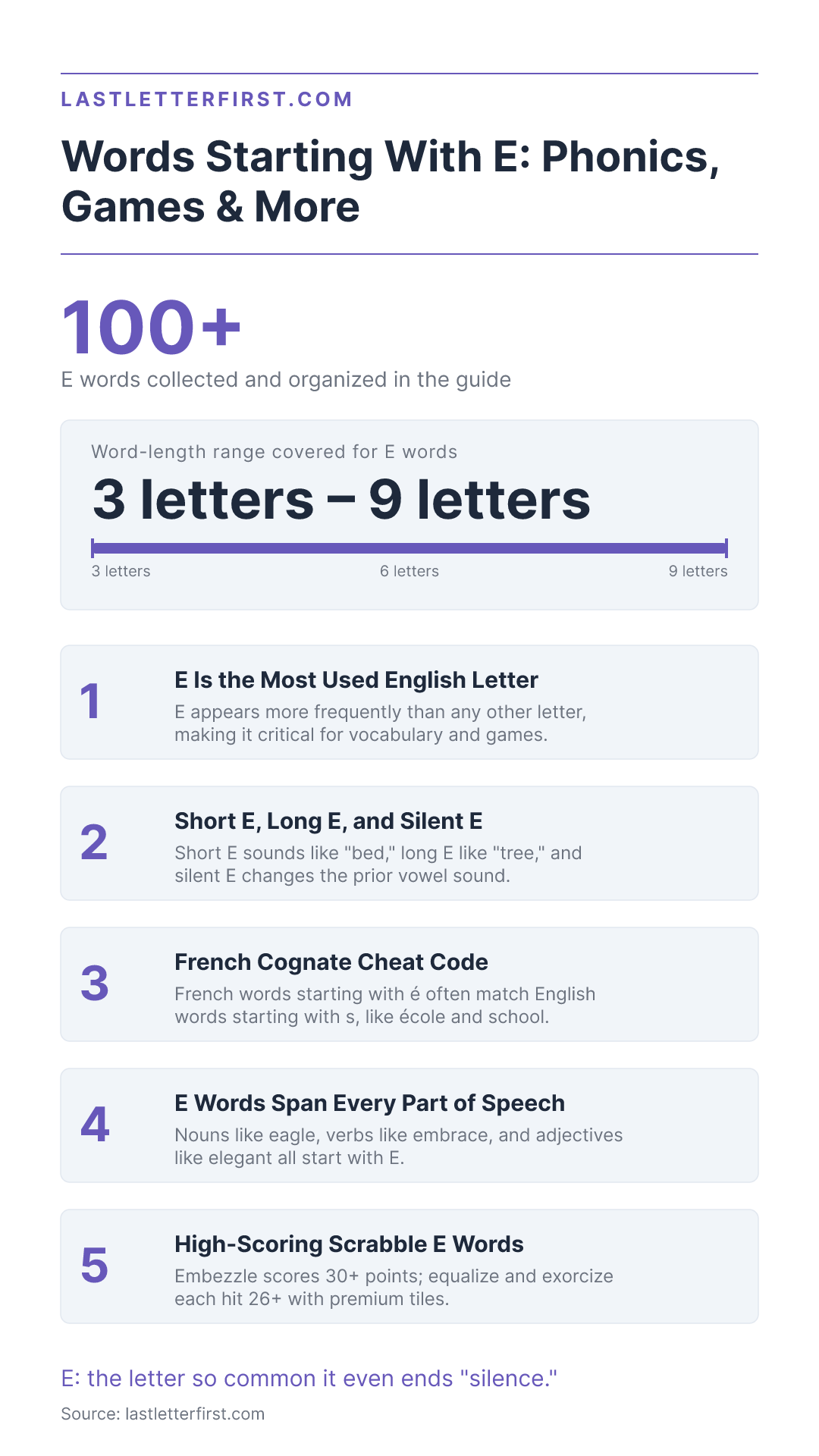
- E is the most frequently used letter in the English language, making words that start with E critical for vocabulary building, phonics instruction, and word-game strategy.
- Common words starting with E span every part of speech: nouns like eagle, earth, and energy; verbs like earn, embrace, and enjoy; and adjectives like eager, efficient, and elated.
- Silent E at the end of a word changes the preceding vowel from short to long, turning “cap” into “cape” and “bit” into “bite.”
- French words beginning with é often correspond to English words beginning with s, because the accent replaced an older Latin s that English kept, giving ESL learners a cognate shortcut.
- Grouping E words by ending letter opens up chain-game advantages that flat alphabetical lists completely miss.
What Words Start With the Letter E in English , and Why It Matters
What words start with the letter E in English spans an enormous range , from everyday essentials like “eat,” “end,” and “every” to expressive gems like “ephemeral,” “eloquent,” and “exuberant.” At Last Letter First, we treat E as a powerhouse letter worth mastering, since it appears more frequently than any other letter in the language and covers emotions, actions, and abstract concepts alike.
Common E Words Organized by Part of Speech
Common words starting with E span every part of speech: nouns like eagle, earth, and energy; verbs like earn, embrace, and enjoy; and adjectives like eager, efficient, and elated. The tables below collect more than 100 words starting with E, grouped by part of speech and word length, each with a brief definition so you can see how it works in context.
Frankly, dumping E words into one flat pile is like organizing a toolbox by color instead of function.
| Nouns | Definition |
|---|---|
| eagle | a large bird of prey |
| ear | the organ of hearing |
| earth | the planet we live on; soil |
| economy | a system of production and trade |
| education | the process of teaching and learning |
| elephant | a large mammal with a trunk |
| an electronic message | |
| energy | the capacity to do work; vitality |
| envelope | a paper cover for a letter |
| emotion | a strong feeling (joy, fear, anger) |
| Verbs | Definition |
|---|---|
| earn | to receive payment for work |
| edit | to revise or correct written material |
| educate | to teach or instruct |
| enhance | to raise to a higher level |
| embrace | to hold closely; to accept willingly |
| emerge | to come out or appear |
| employ | to hire or put to use |
| enable | to make possible |
| enjoy | to take pleasure in |
| erase | to remove or delete |
| Adjectives | Definition |
|---|---|
| eager | enthusiastic and ready |
| early | before the expected time |
| easy | not difficult |
| edible | safe to eat |
| eerie | strange and unsettling |
| effective | producing the intended result |
| efficient | achieving results with minimal waste |
| elastic | able to stretch and return to shape |
| elated | extremely happy |
| elegant | graceful and stylish |
E Words by Length: 3-Letter to 8-Letter
Word length matters for games, phonics drills, and reading practice. Three-letter E words are perfect for early readers:
| Word | Definition |
|---|---|
| ebb | to gradually decrease |
| ear | the organ of hearing |
| eat | to consume food |
| egg | an oval reproductive body |
| ego | a person’s sense of self |
| elf | a small mythical creature |
| elm | a type of deciduous tree |
| end | the final part |
| era | a period of time |
| eve | the evening before an event |
| eye | the organ of sight |
Four-letter E words include each, earn, ease, east, echo, edge, edit, and emit, all common in everyday English and useful in word games.
Five-letter words starting with E include eager, early, earth, edict, eight, elect, elite, ember, empty, enjoy, equal, erase, error, essay, event, every, exact, and extra. These are the bread and butter of daily puzzle games.
For longer words (six to eight letters), think educate, elegant, embrace, emotion, emperor, endless, enforce, enhance, episode, essence, examine, example, excited, and exercise.
Phonics Patterns: Short E, Long E, and Silent E
Understanding how E sounds in different positions is the key that opens up confident pronunciation for ESL learners and early readers.
Short E sounds like the vowel in “bed.” You hear it in “end,” “edge,” “elephant,” and “effort.” It stays short when E appears in a closed syllable.
Long E sounds like the vowel in “tree.” Words like “eagle,” “easy,” “email,” and “evening” carry this sound. Long E often appears when two vowels sit together (ea, ee) or when E falls at the end of a short word.
Silent E is trickiest. Silent E at the end of a word changes the preceding vowel from short to long, turning “cap” into “cape” and “bit” into “bite.” In E-starting words, silent E shows up in “erase” and “evolve.”
| Pattern | Sound | Examples |
|---|---|---|
| Short E | /ɛ/ as in “bed” | egg, edge, end, effort, enter |
| Long E | /iː/ as in “tree” | eagle, easy, email, evening, equal |
| Silent E | changes prior vowel | erase, evolve, escape, engage |
French-English Cognates: When E Replaces S
Here’s a pattern that feels like a cheat code for ESL vocabulary building. French words beginning with é often correspond to English words beginning with s, because the accent replaced an older Latin s that English kept.
| French | English | Shared Latin Root |
|---|---|---|
| épice | spice | from Latin species |
| état | state | from Latin status |
| école | school | from Latin schola |
| éponge | sponge | from Latin spongia |
| étude | study | from Latin studium |
| étranger | stranger | from Latin extraneus |
The paradox of cognates is that the words that look most foreign are often the ones hiding the most familiar meanings. “Étranger” looks nothing like “stranger” until you see the Latin root, and then you can’t unsee it. If you speak French, this pattern is worth its weight in gold. The FAQs page covers common questions about word origins and game rules.
E Words for Word Games: Scoring and Strategy
The myth that E words are all low-value couldn’t be more wrong. Words starting with E that contain high-point tiles like Q, Z, X, or J consistently outperform common letter combinations in Scrabble.
| Word | Letters | Key Tiles | Approx. Scrabble Points | Best For |
|---|---|---|---|---|
| Equalize | 8 | Q, Z | 26+ | High-score plays |
| Exorcize | 8 | X, Z | 26+ | Double-letter boards |
| Embezzle | 8 | Z, Z | 30+ | Late-game dominance |
| Equinox | 7 | Q, X | 23+ | Crossword and chain games |
| Ersatz | 6 | Z | 15+ | Quick strategic plays |
| Enzymatic | 9 | Z, Y | 25+ | Bingo-length bonus |
Players who verify words against the North American Scrabble Word List via NASPA avoid the frustration of challenged plays.
Chain-Friendly E Words for Real-Time Play
Chain word games reward players who think about endings, not just beginnings. When you play a word ending in an uncommon letter, you’re boxing your opponent into a corner.
| E Word | Ending Letter | Why It’s Strategic |
|---|---|---|
| Equinox | X | Very few words start with X |
| Ersatz | Z | Forces opponent into Z-start territory |
| Epoch | H | Limits options to H-starters |
| Emboss | S | Common but buys time with double-S |
| Elbow | W | Narrows the field considerably |
Most players completely miss the boat on how their word’s final letter shapes the next move. Flip that habit, and you’ll win rounds you used to lose. For structured practice, the word game tournaments page offers weekly competitive play.
How to Practice E Words Every Day
Building E-word fluency doesn’t require marathon study sessions. Honestly, ten minutes a day beats an hour once a week.
- Flashcards by difficulty. Sort E words into beginner (eat, egg, end), intermediate (effort, embrace, emerge), and advanced (ephemeral, exquisite, enigmatic).
- Word games as reinforcement. Playing under time pressure forces recall in ways passive reading can’t. The learning hub offers structured resources.
- Daily writing prompts. Write three sentences using E words you learned that day. Writing cements recognition faster than reading alone.
And don’t skip the hard words.
Frequently Asked Questions
What are common English words that start with E?
Common E words range from three-letter basics like eat, end, and eye to sophisticated vocabulary like elaborate, exquisite, and ephemeral. Everyday staples include email, event, effort, enjoy, and energy. Animals give us eagle and elephant; nature gives us earth and ember. Grouping them by difficulty level makes any list immediately more useful than a raw alphabetical dump.
How do short E and long E sounds differ?
Short E produces the vowel sound in “bed,” “egg,” and “pen,” a quick, clipped sound. Long E produces the sound in “tree,” “meet,” and “eagle,” a stretched, higher-pitched sound. When E appears between consonants in a short word, it’s usually short. When E appears at the end of a word or is doubled (ee), it’s usually long. Exceptions exist, but this guideline covers most cases.
What English words starting with E correspond to French words where the accent replaces an s?
Many French words beginning with “é” map to English words where that accent historically replaced an “s.” Examples: école/school, état/state, épice/spice, éponge/sponge, étudier/study. The pattern reflects Latin-to-Old-French sound changes that dropped the “s” and added an accent mark. Recognizing this helps ESL learners who speak French decode unfamiliar English words faster.
What is a word beginning with E that means help or intervention?
“Enable” means to give someone the ability to do something. “Encourage” emphasizes confidence and motivation. “Expedite” means to speed up a process. Each captures a different shade of assistance. In professional settings, “enable” and “expedite” tend to fit best. In personal or educational contexts, “encourage” feels more natural. To be fair, none of these are obscure.
What are high-scoring E words for Scrabble?
The highest-scoring E words contain premium tiles: Q, Z, X, or J. “Embezzle” is a powerhouse with its double Z. “Equalize” and “exorcize” combine Q or X with Z for massive point potential. Shorter options like “ersatz” pair well with E tiles already on the board. Verify each word using the NASPA word list before committing it to memory for tournament play.
Are there E words that end in uncommon letters like X or Z?
Yes, and they’re strategically gold in chain word games. “Equinox” ends in X, forcing the next player to find an X-starting word. “Ersatz” ends in Z, creating a similar bottleneck. “Efflux” (meaning an outflow) also ends in X. Memorizing even five or six uncommon-ending E words gives you a disproportionate advantage. The FAQ page covers gameplay specifics.
—
How many categories do E words fall into?
E words span every major part of speech, including nouns, verbs, adjectives, and adverbs. They also divide by phonics patterns such as short E, long E, and silent E. Additionally, E words range in length from three letters to ten or more, creating multiple organizational categories for learners and word enthusiasts.
Can I use E word lists for Scrabble or word-finder tools?
Yes, E word lists are valuable resources for Scrabble play and word-finder tools. To find playable options, filter by word length and verify that words have valid dictionary status. Always cross-reference your selections against the Official Scrabble Dictionary or North American Scrabble Word List to ensure eligibility in competitive play.
Where can I check if an E word is valid in official Scrabble dictionaries?
You can verify E word validity using the Official Scrabble Players Dictionary (OSPD) or the North American Scrabble Word List (NWL), both accessible through scrabbleplayers.org. Online tools such as word.tips and wordfinderx.com also provide quick validity checks for words you’re considering in gameplay.
What’s Next for Your E-Word Vocabulary
The letter E isn’t going anywhere. It’s the most versatile letter in English, and the gap between knowing a handful of E words and knowing them strategically is where real improvement lives. Organized practice beats random exposure every single time.
Pick five new E words this week. Use them. Play them. The words you practice today become the words you recall without thinking tomorrow.
The Last Letter First Editorial Team creates vocabulary and word-game strategy content for learners, educators, and competitive players. Visit the Last Letter First Learning Hub for more resources.