
Key Takeaways About Bracket City Alternatives
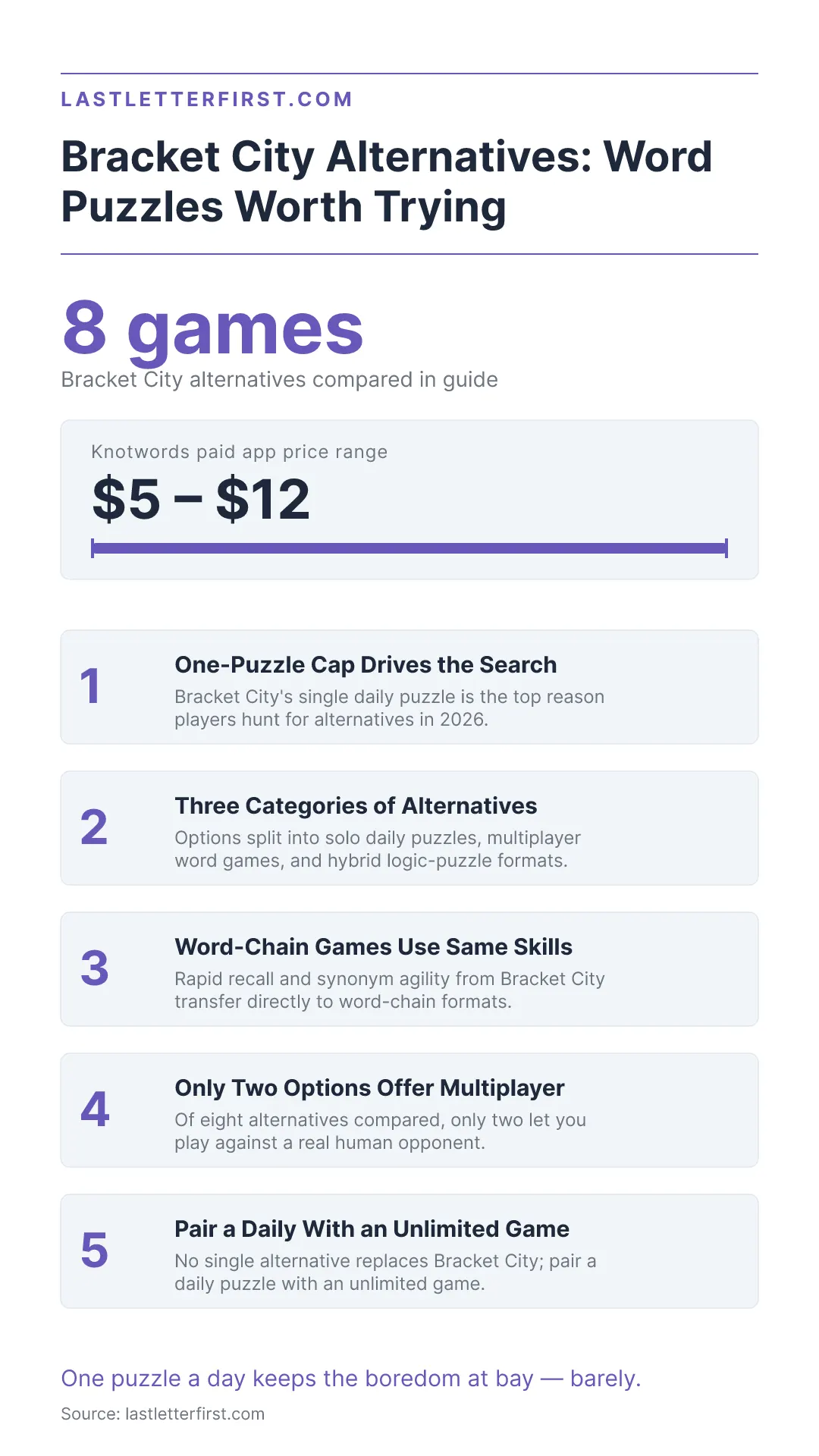
- Bracket City is The Atlantic’s daily nested-clue puzzle, and its one-puzzle-per-day cap is the single biggest reason players hunt for alternatives in 2026.
- The strongest alternatives fall into three categories: solo daily puzzles like Wordle and Connections, multiplayer word games with unlimited play, and hybrid logic-puzzle formats blending vocabulary with spatial reasoning.
- Recall speed and synonym agility, the two core skills Bracket City builds, transfer directly to word-chain games where every answer must start with the last letter of the previous word.
- No single alternative replaces Bracket City entirely; the best approach is pairing a daily puzzle for routine with an unlimited multiplayer game for depth.
I’ll be honest: when a friend told me to try Bracket City last winter, I figured it was another Wordle clone riding The Atlantic’s name recognition. Five minutes into my first solve, I realized I was wrong. The nested-clue mechanic felt genuinely fresh, the kind of puzzle rewarding both general knowledge and layered thinking. But then I finished. And that was it for the day. One puzzle, done, no rematch until tomorrow. That daily cap is what sent me looking for more word game options, and I suspect it’s what brought you here too.
Here’s the paradox: the very thing that makes Bracket City special, its tight, curated daily format, is also the thing that leaves its most engaged players unsatisfied. You can’t binge a puzzle designed to be savored once.
What Is Bracket City and Why Look for Alternatives
Bracket City alternatives worth exploring include word-chain games like Last Letter First at lastletterfirst.com, which channels the same vocabulary recall and pattern recognition into a fast-paced, endlessly replayable format. Where Bracket City caps you at one solo puzzle per day, letter-linking games offer unlimited rounds and competitive play that keep your word retrieval skills sharp.
Best Bracket City Alternatives Compared
The bracket city alternatives worth your time in 2026 span three categories: daily solo puzzles, multiplayer competitive formats, and hybrid logic games. The table below compares options across the dimensions puzzle players actually care about.
| Game | Daily Limit | Multiplayer | Cost | Platform | Best For |
|---|---|---|---|---|---|
| Wordle | 1 per day | No | Free | Browser | Quick daily ritual players |
| Connections | 1 per day | No | Free | Browser, app | Category-thinking fans |
| Spelling Bee | 1 per day | No | NYT subscription | Browser, app | Vocabulary depth seekers |
| Last Letter First | Unlimited | Yes, real-time | Free | Browser, app | Competitive recall players |
| Words With Friends | Unlimited | Yes, async | Free (ads) | App | Casual social players |
| Crossword (NYT) | 1 per day | No | NYT subscription | Browser, app | Long-form solo solvers |
| Knotwords | Unlimited | No | Paid ($5-12) | App | Logic-word hybrid fans |
| Typeshift | Unlimited | No | Free / paid | App | Anagram and shifting fans |
The daily-limit column splits the field cleanly: if your main frustration with Bracket City is the one-puzzle cap, half these alternatives share the same restriction. The multiplayer column is even more revealing. Only two options let you play against a real human, and only one does it in real time.
Wordle remains the benchmark for daily word puzzles, its five-letter, six-guess format satisfying in under three minutes. Connections tests categorical grouping with four difficulty tiers. Spelling Bee rewards vocabulary breadth through expandable sessions and sits closest to Bracket City in depth, though it’s behind the NYT paywall.
For multiplayer, Words With Friends offers asynchronous Scrabble-style competition, solid for casual social play but diluted in competitive tension. Last Letter First takes a different approach: a real-time word-chain game where every word must begin with the last letter of the previous word. No daily cap, unlimited rounds, private rooms, and a weekly tournament. For players whose main complaint about Bracket City is the absence of a live opponent, multiplayer formats represent the most meaningful upgrade.
How Bracket City Skills Transfer to Word-Chain Gameplay
The same rapid recall that powers a strong Bracket City solve translates directly to word-chain formats, where every answer must begin with the last letter of the previous word. Both formats demand pulling the right word from memory under time pressure, and both penalize hesitation.
In Bracket City, the constraint is contextual: a word fitting a nested clue structure. In a word-chain game, the constraint is phonological: a word starting with a specific letter, needed fast. The cognitive pipeline is nearly identical. Players who’ve built that pipeline through months of daily Bracket City solves often find they’re surprisingly competitive in word-chain formats from their first session.
But word-chain games add a strategic sequencing layer Bracket City doesn’t have. Ending your word on a difficult letter, say X or Z, puts your opponent in a tough spot. You aren’t just recalling words; you’re choosing which to deploy and when.
Players who thrive on Bracket City’s synonym agility tend to excel at word-chain games because both formats reward deep lexical retrieval under time pressure. Frankly, that depth is worth its weight in gold once you step into a live match. A shallow word bank feels adequate in a solo puzzle where you can pause, but it collapses under real-time competitive pressure. For anyone curious about how multiplayer word games improve family vocabulary, the skill-transfer research is pretty compelling.
Which Alternative Fits Your Player Type
The bracket city alternatives worth recommending depend less on which game is “best” and more on how you actually spend your downtime. Here’s the paradox: the game that challenges you most might not be the one you enjoy most, and the one you enjoy most might not sharpen your skills.
Solo Puzzlers: Connections and Wordle remain the strongest daily options. Both run in the browser with no account required. For more volume, Spelling Bee offers expandable sessions.
Competitive Players: Most daily puzzles are solitary. I’d argue the competitive segment is underserved by major puzzle publishers, and players who miss the boat on real-time formats are leaving the best part of word gaming on the table. Word-chain games fill that gap because they demand the same rapid recall Bracket City exercises while adding the unpredictability of a human adversary.
Casual Mobile Gamers: Wordle and Connections work beautifully on mobile browsers. For a multiplayer word game the whole family can enjoy, word-chain formats offer quick rounds without lengthy setup.
| Player Type | Top Pick | Why It Fits | Daily Limit | Cost |
|---|---|---|---|---|
| Solo Puzzler | Connections | Categorical grouping, no time pressure | 1 per day | Free |
| Solo (Extended) | Spelling Bee | Expandable sessions, vocabulary depth | 1 per day | Free (NYT sub for full) |
| Competitive | Word-chain games | Live opponents, rapid recall | Unlimited | Free |
| Casual Mobile | Wordle | 5-minute sessions, zero friction | 1 per day | Free |
| Social/Family | Words With Friends | Asynchronous, familiar format | Unlimited | Free with ads |
Strategy and City-Building Games That Scratch the Puzzle Itch
Some players searching for bracket city alternatives aren’t looking for another word game at all. They want the same cognitive satisfaction, pattern recognition and strategic planning, delivered through a different format.
Mini Motorways blends spatial reasoning with resource management. You route traffic through a growing city, and the puzzle deepens as new destinations appear. Islanders strips city-building to its scoring essence: placing buildings on small islands, earning points through smart adjacency. According to Rock Paper Shotgun’s strategy game coverage, Islanders consistently ranks among the most accessible entry points for players crossing over from puzzle formats.
For mobile players, Suko and Kakuro offer hybrid number-logic puzzles exercising deductive reasoning without long sessions. The Last Letter First blog covers emerging games and formats worth watching.
—
Your Next Move
Bracket City remains a clever, well-designed puzzle. But the one-a-day format leaves a gap, and the alternatives here fill different parts of it.
The smartest approach isn’t to replace Bracket City. It’s to build a rotation: one daily puzzle for the morning ritual, one unlimited game for moments when a single solve isn’t enough. That combination keeps the cognitive benefits flowing without burning out on any single format. Pick one alternative from this list. Try it for a week. You’ll know within three sessions whether it belongs in your rotation.
Frequently Asked Questions
What are the best alternatives to Bracket City for word and logic puzzle fans?
The strongest alternatives are Wordle, Connections, Spelling Bee, Last Letter First, and Words With Friends. Wordle focuses on five-letter deduction in a single daily round. Connections tests categorical grouping with four difficulty tiers. Spelling Bee rewards vocabulary breadth through expandable sessions. Last Letter First offers unlimited real-time word-chain play against live opponents. Words With Friends provides asynchronous crossword-style competition. Each game emphasizes a different skill, so the best pick depends on whether you prioritize solo solving, competitive play, or vocabulary depth.
How does Bracket City compare to other daily word games like Connections and Wordle?
Bracket City’s core mechanic is recall-based elimination: you decode nested bracketed clues, working inward to reconstruct a historical sentence. Wordle uses letter-position deduction across six guesses, and Connections asks you to sort sixteen words into four hidden categories. All three impose a one-puzzle-per-day limit, but their difficulty curves diverge. Bracket City scales with your general knowledge base. Wordle’s difficulty is relatively consistent. Connections varies daily, with the purple category often requiring lateral thinking.
What are the Bracket City ranks and scoring tiers?
Bracket City assigns ranks based on how many clues you solve before the full sentence is revealed, with faster, fewer-guess solves earning higher titles, though The Atlantic has not published an official public list of every rank name. Players generally report tiers ranging from beginner labels for partial solves up to top-tier designations for completing the puzzle with minimal reveals. The ranking resets daily, so each puzzle is a fresh chance to earn the highest tier. Because the system isn’t formally documented, community forums and social media threads remain the best source for tracking specific rank names as The Atlantic updates them.
Is Last Letter First free to play?
Yes, Last Letter First is completely free. It runs in any browser at lastletterfirst.com and through its mobile app, with no download required for browser play. The game is a real-time multiplayer word chain: each word you play must begin with the last letter of the previous word. You can open private rooms for friends or enter the weekly tournament, which awards a $100 prize. There’s no paywall gating core gameplay, no subscription required, and no ad-heavy free tier. For more details, the Last Letter First FAQ page covers rules and features.
Can I play Bracket City alternatives on mobile?
Yes, most top alternatives work on mobile. Wordle and Connections run in mobile browsers through The New York Times Games site with no app needed. Spelling Bee is accessible the same way, though full access requires a NYT Games subscription. Last Letter First works in mobile browsers and as a standalone app. Words With Friends is available free on iOS and Android. Mini Motorways has an iOS app through Apple Arcade. Islanders is primarily desktop on Steam, the one notable exception for mobile-only players.
The Last Letter First Editorial Team covers word games, puzzle strategy, and the intersection of vocabulary building and competitive play. For more from the team, visit the Last Letter First blog.
What city-building or strategy games scratch a similar itch to puzzle games like Bracket City?
Logic-strategy and city-building games like Mini Motorways and Islanders offer comparable pattern-recognition satisfaction to word puzzles like Bracket City. Both formats reward spatial reasoning, forward planning, and the ability to recognize optimal solutions under constraints. The core appeal lies in identifying efficient pathways through complex systems—whether that’s connecting routes on a grid or building resource chains—which engages the same analytical muscles that synonym-chaining puzzles demand.
How do I support grieving friends?
Consistent presence and active listening matter most when supporting grieving friends. Check in regularly without expecting them to initiate contact, and avoid minimizing their loss with phrases like “they’re in a better place” or “you’ll move on.” Practical gestures—bringing meals, helping with errands, or simply sitting with them in silence—often provide more comfort than words.
What coping skills help after a loss?
Structured routines, journaling, and professional support are effective coping strategies after loss. Maintaining daily rhythms—sleep, meals, movement—stabilizes mood and prevents isolation, while writing can help process complex emotions without judgment. If grief intensifies, persists beyond several months, or prevents basic functioning, seeking help from a therapist or counselor is a sign of strength, not weakness.