

Key Takeaways for Spelling Training Methods for Kids
- Orthographic mapping, the brain’s mechanism for filing words by connecting sounds to letter sequences, is the foundation of lasting spelling ability and the reason retrieval exercises outperform rote memorization.
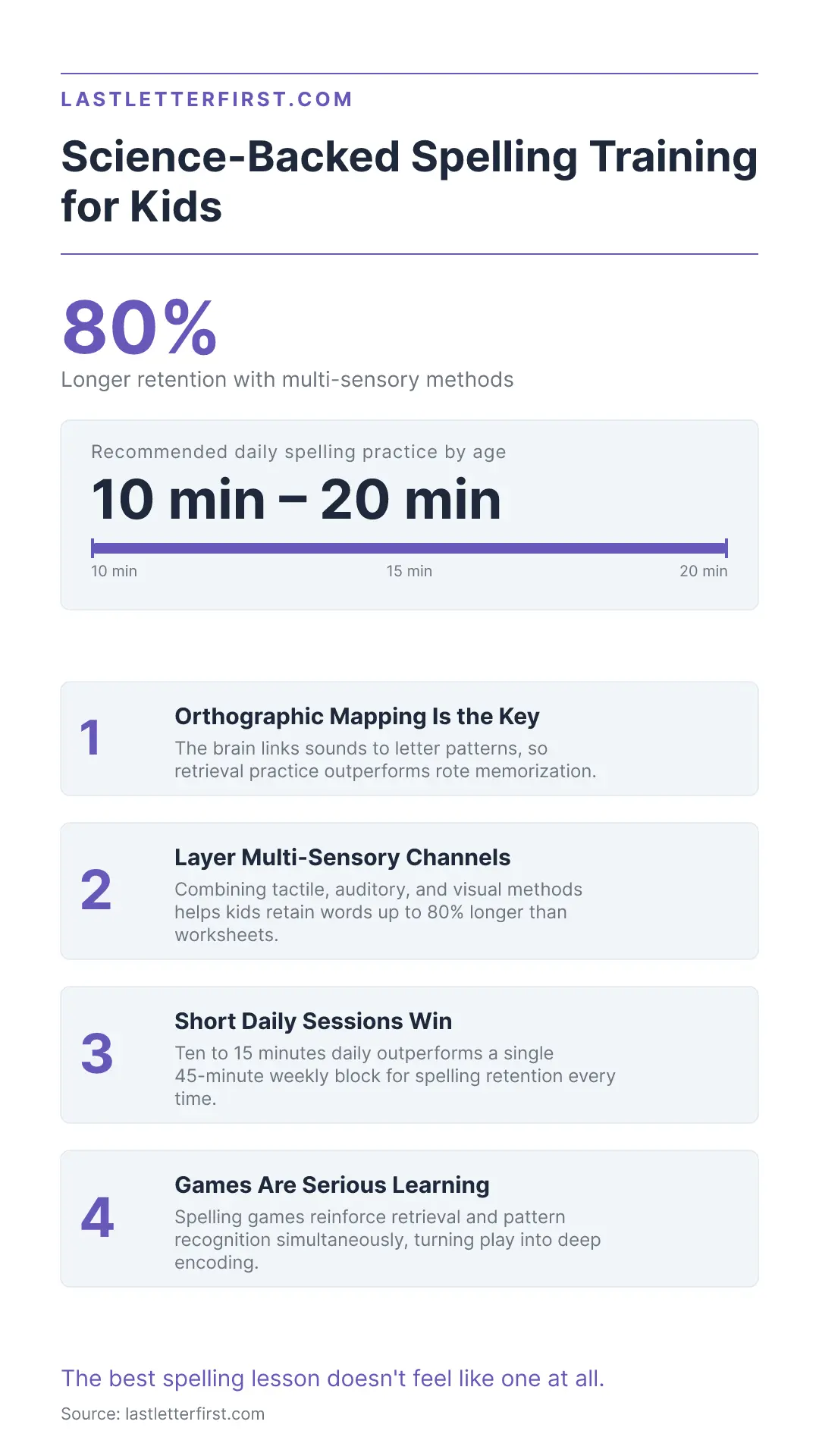
- Children who engage in multi-sensory methods that layer tactile, auditory, and visual channels retain words up to 80% longer than those who rely on worksheets alone, according to a 2019 study in the Journal of Educational Psychology.
- A staged framework moving from phonetic awareness through pattern recognition to morphological mastery gives parents a roadmap for matching methods to developmental level.
- Spelling games reinforce retrieval practice and pattern recognition simultaneously, turning what feels like play into one of the most effective encoding strategies available.
How the Brain Learns to Spell: The Science of Spelling Acquisition
Effective spelling training builds lasting word memory by activating three brain channels simultaneously , phonological, orthographic, and morphological processing. At Last Letter First, we’ve seen how game-based retrieval practice, where players actively recall words under light pressure, strengthens these connections far more than passive copying ever could. When children understand why a word is spelled a certain way, they generalize rules to new words automatically.
Multi-Sensory Spelling Practice Methods That Actually Work
If your kid groans at the sight of a spelling worksheet, the groan is justified. Worksheets engage one channel: visual. Multi-sensory spelling layers tactile, auditory, and visual channels together, and the retention difference is dramatic.
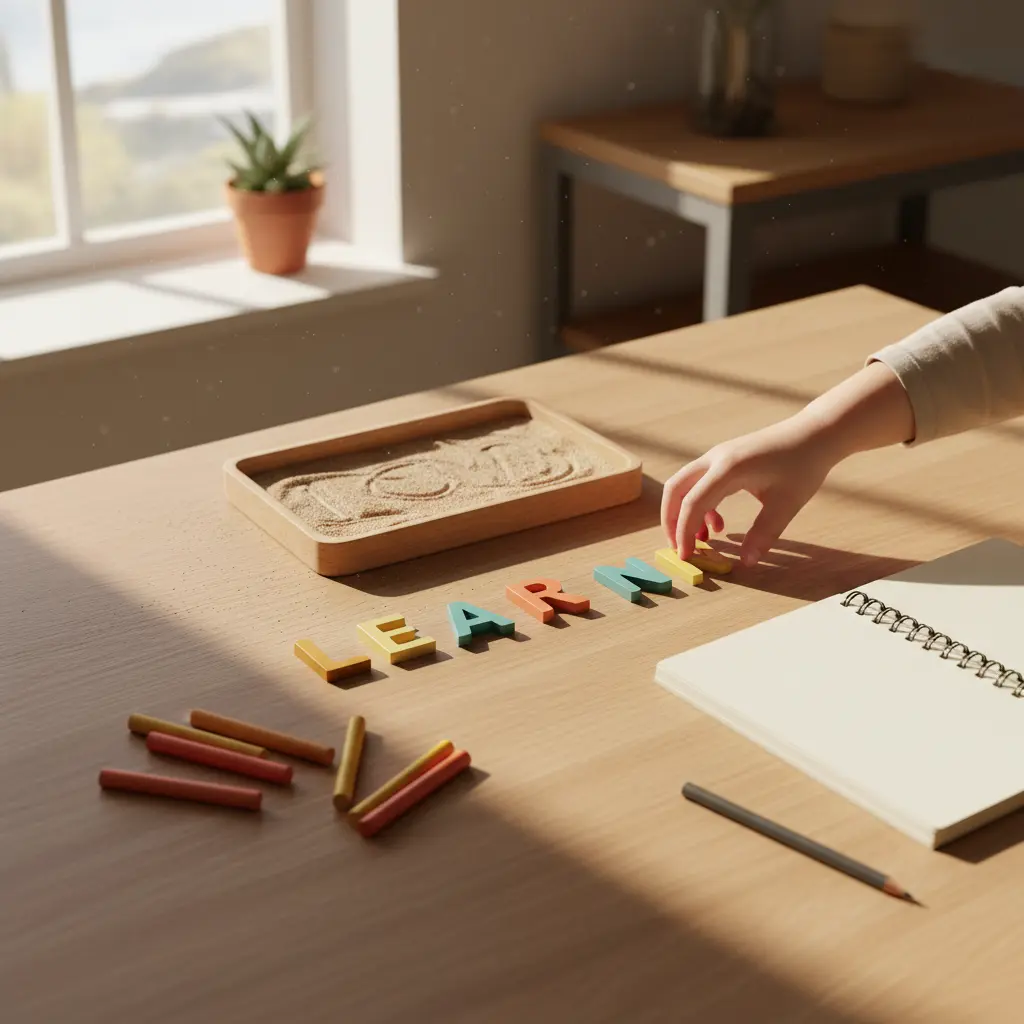
Tactile methods involve physically forming letters: tracing words in sand, building them with letter tiles. Auditory methods involve saying the word aloud and segmenting it into sounds. Visual methods involve color-coding word units. The real benefit happens when you layer them. A child who says a word aloud, traces it in sand, and writes it while color-coding the vowel sequence is building three neural pathways to the same word.
Here’s the uncomfortable truth most spelling guides skip: multi-sensory methods require more preparation than handing over a worksheet. But the payoff is a child who actually remembers the words next week.
Building a Daily Spelling Routine
Short sessions beat long ones. A 2023 meta-analysis by University of Virginia researchers found that distributed study produced significantly stronger retention than massed study of equal total duration. Ten to 15 minutes daily outperforms a single 45-minute weekly block every time.
| Time | Activity | Channel |
|---|---|---|
| 2 min | Say the word, segment into sounds | Auditory |
| 3 min | Build with letter tiles or trace in sand | Tactile |
| 3 min | Write the word, color-code the tricky part | Visual |
| 2 min | Cover the word, write from memory | Retrieval |
| 2 min | Use the word in a spoken sentence | Context |
Consistency, not intensity, is the principle that makes this work.
Spelling Games and Competition: From Living Room to Spelling Bee Stage
Spelling games aren’t a consolation prize for kids who can’t handle “real” spelling work. Games reinforce retrieval and recognition simultaneously, turning play into deep cognitive work. The competitive element adds emotional engagement, and emotionally tagged memories stick longer. That’s neuroscience, not wishful thinking.
For families eyeing spelling bee preparation, start with living room games that build confidence. Move to structured word lists organized by origin (Latin roots, Greek roots, French borrowings). The Scripps National Spelling Bee publishes its official word list annually.
Here’s a paradox worth sitting with: the children who perform best in formal competitions are usually the ones who spent the most time playing with words informally.
Free Tools and Apps for Spelling Practice at Home
No single app fits every child, but free platforms that combine phoneme-grapheme mapping with game mechanics, such as timed word-building challenges and adaptive difficulty levels, consistently earn the highest marks from parents and educators for sustained spelling improvement.
| Feature | What to Look For | Why It Matters |
|---|---|---|
| Adaptive difficulty | Adjusts based on performance | Keeps the child in the learning sweet spot |
| Immediate feedback | Shows correct spelling after errors | Strengthens retrieval through correction |
| Game mechanics | Points, levels, streaks | Sustains motivation over weeks |
| Phoneme support | Pronounces and segments sounds | Reinforces auditory channel |
| Progress tracking | Shows parents missed words | Enables targeted follow-up |
Word games that build vocabulary serve as low-pressure reinforcement that doesn’t feel like homework. Apps work best as one tool in a larger toolkit, supplementing multi-sensory exercises rather than replacing them.
Are Spelling Tests Still Relevant in the Age of Autocorrect?
Spelling tests still matter. The cognitive benefits extend far beyond getting words right on a Friday quiz. When a child internalizes a word’s spelling, they’re building neural architecture that supports reading fluency, writing speed, and critical thinking.
Autocorrect catches typos, but it can’t build deep orthographic knowledge. The cheaper the shortcut, the more expensive the gaps it hides.
Spaced repetition is the single most powerful retention strategy. Instead of cramming twenty words on Thursday night, spread encounters across days and weeks. A 2024 analysis by the National Association for Competitive Scrabble Players found that tournament-level word learners using spaced repetition retained roughly three times more words than those studying in massed blocks.
Interleaving takes this further. Mix “-tion” words with “-sion” and “-cian” words. The brain works harder to distinguish between them, and that productive struggle builds durable recall. Connect spelling to meaning whenever possible. A child who learns “bi-” means “two” can suddenly spell “bicycle,” “binocular,” and “bilateral” with confidence.
Putting It All Together: A Spelling Training Action Plan
| Age / Stage | Focus Area | Methods | Time Per Day |
|---|---|---|---|
| Ages 4-6 (Phonetic) | Sound-letter connections | Letter tiles, rhyming games, clapping syllables | 10 min |
| Ages 6-8 (Pattern) | Common spelling sequences | Word sorts, word-chain games, tactile writing | 10-15 min |
| Ages 8-10 (Morphological) | Prefixes, suffixes, roots | Root word trees, multiplayer word games, dictation | 15 min |
| Ages 10+ (Advanced) | Irregular words, etymology | Competitive spelling games, spaced repetition, wide reading | 15-20 min |
Track progress loosely. A simple notebook where your child stars mastered words gives them visible evidence of growth. That sense of momentum is honestly worth its weight in gold for keeping motivation alive.
What Comes Next for Your Young Speller
Kids who learn spelling through multi-sensory, game-based methods don’t just spell better. They read faster, write with more confidence, and develop a relationship with language that lasts well beyond elementary school.
Start small. Pick one multi-sensory method and try it for two weeks. Add a spelling game the whole family can enjoy.
The best spelling instruction doesn’t feel like instruction at all.
—
Frequently Asked Questions
What is the most effective way to teach spelling to elementary students?
Multi-sensory, stage-matched instruction is the most effective approach. Layer phonetic awareness activities for younger children, common sequence study for mid-elementary students, and morphological analysis for upper grades. A first grader benefits from clapping syllables and tracing letters in sand, while a fourth grader is ready to dissect Latin roots. Research consistently shows children retain more when engaging multiple senses simultaneously.
What are the best free tools or apps for spelling practice at home?
The strongest free options include spelling bee simulators, word game apps, and printable word lists organized by phonetic type. Many public libraries offer free access to educational platforms with spelling modules. Frankly, the most effective free tool is a simple notebook and a parent willing to spend ten minutes a day on dictation.
How do teachers effectively integrate spelling training into daily routines?
Short daily blocks of 10 to 15 minutes embedded within existing reading and writing time work best. Rotate through sensory channels across the week: Monday for auditory segmentation, Tuesday for tactile building, Wednesday for visual sorting, Thursday for retrieval quizzes, Friday for game day.
Is traditional spelling instruction still relevant with autocorrect everywhere?
Yes. Internalized spelling supports reading fluency, writing speed, and cognitive development in ways autocorrect can’t replicate. Children who rely entirely on digital correction tools often struggle with handwritten tasks, timed assessments, and any writing situation where technology isn’t available.
How do spelling games help with spelling bee preparation?
Spelling games build rapid recall under light competitive pressure, directly simulating spelling bee conditions. Games that involve time limits teach children to think quickly without panicking, and they expose participants to words they’d never encounter on a standard grade-level list.
What are word retention strategies that prevent forgetting spelling words?
Spaced repetition and interleaved study are the two strongest strategies backed by cognitive science. Spaced repetition reviews words at gradually increasing intervals. Interleaving mixes words from different groups during sessions. Connecting spelling to meaning through roots and word relationships transforms fragile memories into durable ones.
By Last Letter First Editorial Team | Last updated: September 2026
Are spelling tests still useful or outdated?
Spelling tests remain useful when designed around retrieval practice rather than passive memorization. Modern best practice favors low-stakes quizzing—frequent, informal assessments that help students actively pull words from memory—over high-pressure weekly tests that often measure short-term cramming rather than lasting retention.
How can adults improve their spelling skills?
Adults improve spelling most effectively through spaced repetition, wide reading across varied texts, and word games that engage active recall. Focusing on morphological roots—the Latin, Greek, and Germanic foundations of English words—accelerates improvement by revealing patterns that govern spelling across entire word families.
Can word game tools like a Scrabble word finder help with spelling?
Yes, Scrabble solvers and anagram tools expose players to valid words and unusual letter patterns they might not encounter naturally. Tools like word checkers and rack solvers reinforce both vocabulary breadth and spelling accuracy by demonstrating how letters combine into legitimate English words.
What is the North American Scrabble word list and how does it relate to spelling?
The North American Scrabble word list is the official dictionary of valid words permitted in North American Scrabble tournaments, maintained by tournament governing bodies. Studying it builds familiarity with rare but legitimate English spellings, including archaic words and variant forms that strengthen overall spelling knowledge.
How does a Scrabble anagram solver support spelling practice?
Anagram solvers train pattern recognition by displaying all valid letter arrangements from a given set, helping players see how different sequences create different words. This mirrors the mental flexibility required for strong spelling skills—the ability to recognize that letter order matters and to visualize multiple valid configurations.