

By Last Letter First Editorial Team | Last updated: November 2026

—
Key Takeaways
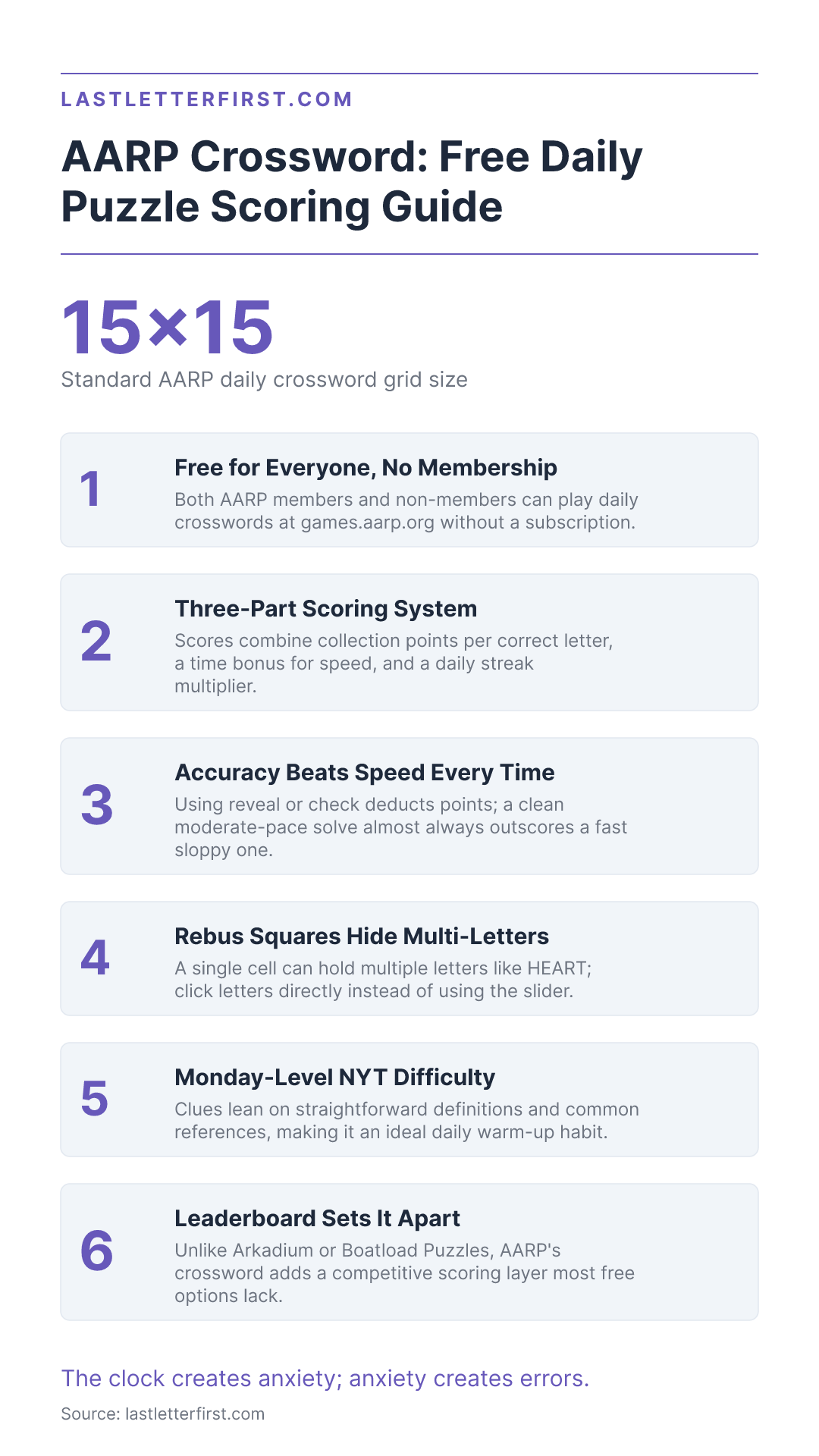
- The AARP crossword is a free daily crossword puzzle hosted on AARP’s website, and both AARP members and non-members can play it without a subscription.
- AARP crossword scores combine three components: collection points earned per correct letter, a time bonus for finishing quickly, and a daily bonus for consecutive-day streaks.
- A rebus square is a single crossword cell that requires more than one letter to complete the answer, and clicking letters directly often works better than using the slider control.
- The AARP daily crossword sits roughly at a Monday-level New York Times difficulty, making it an ideal warm-up or standalone daily habit for casual solvers.
- Playing daily word games, including crosswords and multiplayer word games that improve family vocabulary, reinforces vocabulary recall and pattern recognition over time.
—
What Is the AARP Crossword and Who Can Play?
It’s designed as a low-pressure cognitive exercise that reinforces vocabulary recall and pattern recognition, making it ideal for daily mental sharpness. If you enjoy word puzzles between solves, explore more wordplay challenges at Last Letter First.
How AARP Crossword Scoring and Leaderboards Work
AARP crossword scores combine three components: collection points earned per correct letter, a time bonus for finishing quickly, and a daily bonus for consecutive-day streaks. Understanding these pieces is the difference between casually completing a puzzle and climbing the leaderboard.
- Collection points. Every correct letter earns base points. Errors reduce your total.
- Time bonus. Faster completions earn a larger multiplier. The clock starts when you enter your first letter.
- Daily bonus. Consecutive-day streaks unlock multipliers. Miss a day, and the streak resets.
- Error penalty. Using “reveal” or “check” deducts points.
Accuracy matters more than speed. A clean, error-free solve at a moderate pace almost always outscores a fast solve riddled with corrections.
| Scoring Factor | Impact | Player Control |
|---|---|---|
| Correct letters | Base points per letter | High |
| Time bonus | Speed multiplier | Medium |
| Daily streak | Consecutive-day multiplier | High |
| Reveal/check usage | Point deduction | High |
| Puzzle difficulty | Not factored | None |
That last row deserves attention. The AARP crossword doesn’t appear to weight scores by difficulty. Consistency drives leaderboard position over time.
Tips for Improving Your Score
Prioritize accuracy before speed. Every “check” or “reveal” bleeds points. If you’re stuck, skip the clue and come back after crossing letters fill in.
Play daily. The daily bonus compounds. Missing one day resets your multiplier. No exceptions.
Work the crosses first. Fill in what you know from intersecting answers. Oldest trick in the playbook. Still the most reliable.
Avoid the timer trap. Watching the clock creates anxiety, and anxiety creates errors. Errors cost more than a few extra seconds ever will.
To expand your word bank beyond crosswords, free daily word games offer a different angle on the same skill.
Rebus Clues and Tricky Features Explained
A rebus square is a single crossword cell that requires more than one letter to complete the answer. If you’ve ever known the answer and couldn’t figure out how it fit, you were probably looking at a rebus.
Imagine the answer to an across clue is “HEARTBEAT” and the down clue crossing the same cell needs “REDHEART.” The shared cell might require “HEART” as a single unit. One cell, five letters.
The AARP daily crossword uses rebus squares occasionally, and nothing in the interface announces it. You just have to recognize the pattern. Here’s the paradox: the feature feels impossible until it clicks, and then you can’t unsee it.
Common rebus patterns include:
- Directional words crammed into one cell (NORTH, SOUTH, EAST, WEST)
- Short common words hidden inside longer answers (THE, AND, FOR)
- Thematic elements tied to the puzzle’s title
Beyond rebus squares, the AARP crossword occasionally features crossword-specific vocabulary like “ESNE” or “OAST.” The best approach is learning the repeat offenders, the 50 or so obscure words that appear in crosswords far more often than in real life.
One practical tip: when entering letters in a rebus square, clicking letters directly often works more smoothly than using the slider control. Direct input bypasses tablet friction entirely.
AARP Crossword Difficulty Compared to Other Puzzles
That’s not a knock. It’s a deliberate design choice, and frankly, it’s why so many solvers keep coming back.
Clues lean on straightforward definitions and common cultural references. Occasional niche entries still pop up, but they’re the exception.
The cheaper the tool, the more expensive the mistakes it hides. But with crosswords, the opposite applies: the easier the daily grid, the more durable the habit it builds.
| Feature | AARP Daily | NYT Monday | NYT Friday | Boatload Puzzles |
|---|---|---|---|---|
| Difficulty | Beginner-friendly | Easy | Hard | Easy to moderate |
| Cost | Free | Subscription | Subscription | Free |
| Grid size | 15×15 | 15×15 | 15×15 | Varies |
| Rebus squares | Occasional | Rare | Common | No |
| Leaderboard | Yes | No | No | No |
For solvers who want a daily ritual that’s satisfying without being punishing, the AARP crossword hits the nail on the head.
Platforms like Arkadium, Boatload Puzzles, and Pogo all offer free daily crosswords. Where they differ most is community features. The AARP crossword’s leaderboard gives solvers a competitive edge that alternatives don’t match. But for those wanting something beyond solo solving, multiplayer word games can improve family vocabulary in ways solo puzzles can’t replicate.
Common Usability Issues and How to Work Around Them
Every regular solver has hit at least one interface quirk. The most common complaint involves slider controls bouncing back to default. The workaround: make your adjustment, then click somewhere else on the page before navigating away.
Progress can also be unreliable. Some solvers report partially completed puzzles not saving if they close the browser mid-solve. Finish in one sitting when possible. If you must step away, minimize the tab rather than closing it.
Archive access is limited compared to the NYT, which lets subscribers scroll back through years. The AARP crossword typically offers only the current day’s puzzle and sometimes a short rolling window. If you’re struggling after a platform change, clearing your browser cache often resolves display glitches. For broader word-game troubleshooting, the Last Letter First support page covers common issues.
Frequently Asked Questions
Where can I play the AARP daily crossword online for free?
You can play at games.aarp.org, no membership required. Both the full-size daily crossword and the mini crossword are available to everyone. You don’t need an account to start solving, though logging in lets you track scores and appear on leaderboards. Puzzles refresh daily, so there’s always a new grid waiting. AARP’s print magazine has historically included crossword content as well, but the online version is where most solvers go.
Can non-AARP members play the AARP crossword puzzle?
Yes. AARP membership opens up other perks, but puzzle access isn’t gated behind that paywall. Creating a free online account lets you save scores and track streaks, which is worth doing if you’re competitive about leaderboard ranking.
Is the AARP crossword easier than the NYT crossword?
Generally yes. Solvers and creators compare it to a Monday-level NYT puzzle, the easiest day in the NYT’s weekly difficulty progression. Clues tend to be straightforward, vocabulary is common, and grid construction avoids tricky late-week wordplay. Think of it as a warm-up grid rather than a marathon.
How is the leaderboard score calculated?
Scores combine a collection score, a time bonus, and a daily bonus. Faster, error-free completions yield higher time bonuses, while the daily bonus incentivizes streaks. AARP hasn’t published the exact formula. What solvers know from experience: speed matters more than expected, and using hints reduces your final score significantly.
What is a rebus in the AARP crossword?
A rebus is a square that holds more than one letter, requiring solvers to type a multi-character string into a single cell. Both the across and down clues crossing that square use the full string. They can be confusing initially, but once you recognize the pattern, they become a fun twist rather than a roadblock.
Is the AARP crossword good for brain health?
Crossword puzzles are widely associated with cognitive engagement, though clinical proof of preventing decline varies across studies. Regularly solving crosswords exercises verbal recall, pattern recognition, and working memory. The key word is “consistent.” A daily habit keeps neural pathways active. For multiplayer variety, playing games when bored can keep things fresh.
How does the AARP crossword compare to other free online crosswords?
It sits on the easier end compared to platforms like Arkadium or Boatload Puzzles. Arkadium offers multiple difficulty tiers. Boatload keeps things simple with classic grids. The AARP crossword’s distinguishing feature is its leaderboard and scoring system, adding a competitive layer most free alternatives lack.
How do Scrabble dictionaries differ from crossword word lists?
The Official Scrabble Dictionary focuses on tournament-legal words approved by organizations like NASPA, excluding proper nouns and abbreviations. Crossword word lists include proper nouns, place names, and foreign phrases that would never fly in a Scrabble tournament. “OBAMA” or “UNESCO” appear in crossword grids but aren’t in any Scrabble dictionary.
Why did AARP change their crossword format?
AARP periodically updates its games platform, which can alter the interface and puzzle layout. These changes are made to improve user experience and add new features to the crossword game. Archive access and UI changes are common sources of player confusion when updates roll out. If you’re having trouble locating puzzles or navigating after an update, checking AARP’s games help section can clarify where features have moved.
Can I use a Scrabble word finder or solver for crossword help?
Yes, tools like Scrabble word finders and anagram solvers can help identify tricky crossword answers by generating word combinations based on available letters. However, dedicated crossword dictionaries may be more precise than Scrabble rack solvers, since crossword clues often require contextual knowledge beyond simple letter matching. For best results, combine word-finding tools with careful analysis of the clue’s wording and theme. Many solvers find that crossword-specific resources provide answers that align more closely with how crossword constructors think.
What Your Daily Grid Is Really Building
The AARP crossword isn’t going anywhere. The platform keeps its puzzles free, the difficulty stays welcoming, and the daily refresh gives solvers exactly what they want: a reliable ritual that quietly sharpens the mind.
What’s changing is the landscape around it. Free online word games are getting more social, more interactive, and more varied. The solvers who thrive won’t be the ones who stick to a single puzzle. They’ll be the ones who treat every word game as another rep for the brain.
Tomorrow morning, the grid resets. The question is whether you’ll stop there.
—
By Last Letter First Editorial Team | Last updated: November 2026
The Last Letter First Editorial Team covers word games, puzzle strategy, and vocabulary-building topics for players of all ages and skill levels. For questions or feedback, visit our support page.