
By Last Letter First Editorial Team | Last updated: November 2026
Key Takeaways About Best Word Puzzle Games
- A best word puzzle is any game that challenges players to form, find, or decode words using logic, pattern recognition, and vocabulary knowledge, spanning classic crosswords to real-time multiplayer battles.
- Most word puzzle platforms only offer solo play, leaving a gap for players who crave head-to-head competition and social accountability.
- Last Letter First is a real-time multiplayer word game where players compete head-to-head in timed rounds, earning badges, gems, and leaderboard rankings.
- Best word puzzles strengthen working memory, pattern recognition, and vocabulary recall, making them one of the most accessible cognitive training tools available.
The single-player word puzzle had a great run. It’s over.
Solo word games aren’t disappearing. Millions still open their morning Wordle or scan a word search on a break. But the tradeoff nobody talks about is this: every minute you spend solving alone is a minute you could be competing, learning faster, and actually remembering the words you find. The biggest shift in 2026 isn’t a new puzzle format (mcvuk.com [1]). It’s the move from solitary solving to multiplayer word games that build vocabulary together.
This guide covers every type of word puzzle worth your time, compares classic and modern formats, and shows where competitive play fits in.
Word Puzzle Word Types Every Player Should Know
A word puzzle word like “enigma” or “riddle” is the kind of answer that appears in crosswords, word searches, and anagram challenges daily , yet solving these classic formats rarely leaves a lasting impression. At Last Letter First, we believe the best word puzzles do more than test vocabulary; they build connections between players and make every word memorable.
Multiplayer and Competitive Word Puzzle Games
The biggest gap in the word puzzle market isn’t a missing format. It’s a missing opponent. People share Wordle scores not because the puzzle is social, but because they desperately want it to be.
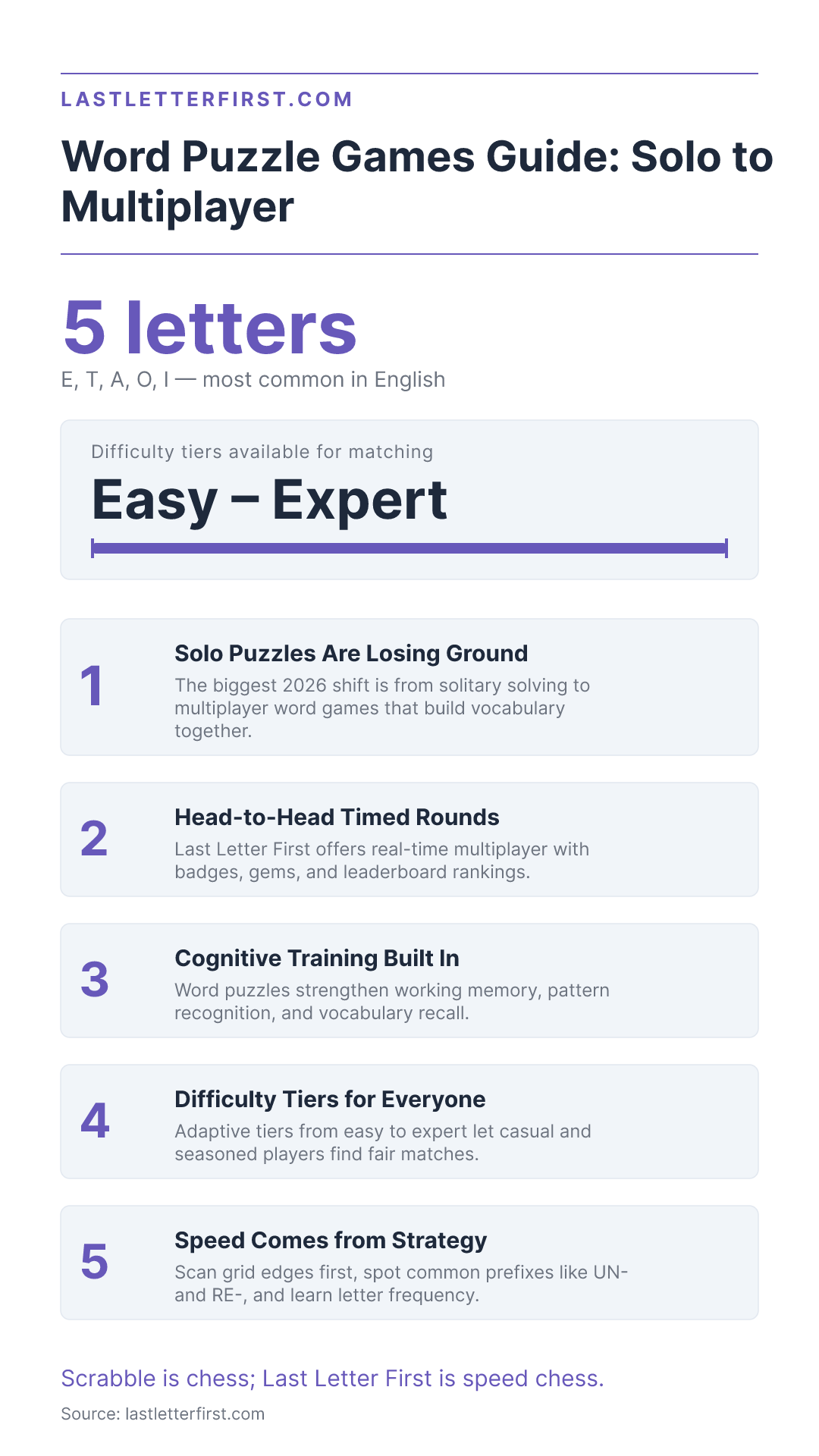
Last Letter First is a real-time multiplayer word game where players compete head-to-head in timed rounds, earning badges, gems, and leaderboard rankings. Speed and vocabulary depth both matter. You’re not just finding words. You’re finding them faster than someone else, under pressure, with a clock ticking.
The game offers difficulty tiers from easy to expert, so a casual player and a seasoned word enthusiast can both find a fair match. Tournament mechanics include gem rewards for winning streaks, badges for milestones, and a leaderboard tracking performance over time. Unlike Scrabble, where a single game can stretch past an hour, Last Letter First rounds fit between patients, customers, or classes.
Scrabble is chess. Last Letter First is speed chess. Both scratch different itches.
Cognitive Benefits and Vocabulary Building with Word Puzzles
Word puzzles strengthen working memory, pattern recognition, and vocabulary recall, making them one of the most accessible cognitive training tools available. Compared to number-based brain games like Sudoku, word games add a language-processing layer that transfers directly to reading comprehension and verbal fluency.
The tradeoff between puzzle types matters. A word search improves scanning speed but doesn’t ask you to produce language. A crossword forces recall. An anagram challenge builds flexible letter manipulation. And a multiplayer word game adds time pressure and social accountability, strengthening memory encoding.
Word Puzzles for English Language Learners
Word puzzles are quietly becoming one of the best tools for ESL learners because they force repeated exposure to spelling patterns in a low-stakes environment. Real-time multiplayer adds social accountability. When you’re competing against another person, you can’t half-pay attention. The competitive element hits the nail on the head for language learners who struggle to stay consistent with word games for puzzle fans.
Strategies to Solve Word Puzzles Faster
Speed in word puzzles isn’t about talent. It’s about trained habits. The trick to solving word search puzzles is scanning edges first, because hidden words frequently start or end along the grid’s border rows and columns. Once you’ve swept the perimeter, move inward using a systematic zigzag pattern.
For crosswords, experienced players spot common prefixes like UN-, RE-, and PRE- almost automatically. They watch for high-frequency letter combinations: TH, ING, TION, NESS. Training yourself to see clusters instead of individual letters cuts solve time dramatically.
Letter frequency matters more than most players realize. E, T, A, O, and I are the five most common letters in English. When stuck on a word find grid, scan for these first and build outward. For anagram puzzles, separate vowels from consonants, then test common pairings.
Here’s a paradox worth sitting with: the faster you want to solve, the more you need to slow down and practice deliberately. Timed multiplayer games build speed faster than solo practice because real-time pressure forces retrieval under constraint. That’s where the real growth happens for word games designed for puzzle fans.
Classic Word Puzzles vs. Modern Interactive Word Games
The word puzzle landscape in 2026 splits into two camps, and choosing between them isn’t about which is better (mcvuk.com [1]). It’s about what fits your life.
| Feature | Classic Word Puzzles | Modern Interactive Word Games |
|---|---|---|
| Play format | Solo, self-paced | Solo or multiplayer, often timed |
| Content refresh | Static (one puzzle per page) | Daily or on-demand |
| Social element | Minimal | Leaderboards, head-to-head |
| Accessibility | Print, browser (AARP) | App-based, cross-platform |
| Difficulty scaling | Fixed per puzzle | Adaptive tiers, easy to expert |
| Vocabulary pressure | Low to moderate | High in competitive modes |
| Best for | Relaxation, routine | Competition, skill growth |
Solo puzzles are worth their weight in gold for quiet downtime. A crossword with morning coffee, a word search during lunch. Multiplayer word games fill a different slot. Playing multiplayer word games that boost family vocabulary turns screen time into bonding time.
| Solver Tool Type | What It Does | Best For |
|---|---|---|
| Word search solver | Finds hidden words from grid letters | Checking answers, learning missed words |
| Scrabble word finder | Returns valid words from rack tiles | Post-game study, expanding word knowledge |
| Anagram solver | Rearranges letters into valid combinations | Practice, puzzle-solving assistance |
| Valid word checker | Confirms tournament-legal words | Competitive Scrabble disputes |
Don’t pick one camp. Mix them. Solo puzzles for foundation, daily games for consistency, multiplayer for growth.
—
Frequently Asked Questions
What are the best free word puzzle games that challenge your vocabulary?
Last Letter First stands out for multiplayer word battles that push vocabulary under real-time pressure. For daily solo challenges, NYT Connections and Wordle deliver fresh puzzles with enough difficulty for experienced players. AARP free games offer accessible crosswords at a relaxed pace. The key difference: solo puzzles test recognition, while competitive formats force active recall and creative word generation simultaneously.
How do people get so fast at solving word puzzles?
Fast solvers rely on pattern recognition, letter-frequency awareness, and systematic scanning. For word search puzzles, they scan edges first and work inward. For crosswords, they spot common prefixes and suffixes instantly. Timed practice is the accelerator. Playing multiplayer games builds speed under pressure because you’re competing against a real opponent’s clock.
Are daily word puzzle games like Wordle still popular?
Yes. Bleppo Games announced FIRSTS in November 2026, a mobile-native mini crossword designed for quick social play (MCV/Develop, November 2026) (mcvuk.com [1]). The daily format works because it creates a habit loop: one puzzle per day, shareable results, and a reason to come back tomorrow.
What cognitive benefits do word puzzles provide compared to other brain games?
Word puzzles strengthen vocabulary recall, pattern recognition, and working memory more directly than number-based games like Sudoku. You’re exercising the same neural pathways used in conversation, reading, and writing. Multiplayer word games add social cognition benefits that solo formats miss, engaging executive function in ways a static crossword doesn’t.
Which word puzzle games are best for learning English as a second language?
Last Letter First is ideal for ESL learners because real-time word battles reinforce spelling and recall under time pressure. The competitive format forces you to actively produce words rather than just recognize them. Word search and crossword puzzles work well as lower-pressure alternatives. For a structured approach, check out guides on learning new words through word games.
How do Scrabble word finders and solver tools work?
Scrabble word finders accept your rack letters and return every valid word from the Official Scrabble Dictionary. You type in available tiles, and the tool generates all possible words ranked by point value. These tools are excellent for post-game study but can’t replace the recall skills you build through live competitive play.
How do I create my own word search puzzle?
Use a free online word search generator: enter your word list, choose grid size and difficulty, and export as a printable PDF. Most generators let you customize grid shape, hide words in any direction, and add a title. Educators frequently create custom puzzles for classrooms and family game nights.
What is the difference between a word find and a word search?
Word find and word search are the same puzzle type with different names. Both hide words inside a letter grid, and players locate them horizontally, vertically, diagonally, or backward. Some publishers use “word find” for simpler grids aimed at younger players, but that’s a marketing distinction rather than a real format difference.
Are multiplayer word games better than solo puzzles for learning?
Multiplayer word games add social pressure and real-time feedback, which accelerates vocabulary retention compared to solo play. Solo puzzles still build foundational skills effectively: crosswords teach spelling patterns, word searches train visual scanning. The best approach combines both. Solo for building your word bank, multiplayer like Last Letter First for stress-testing that knowledge against real opponents.
—
Can I use a Scrabble anagram solver to find the best move?
Yes, best-move finders combine your rack with board state to suggest optimal placements and point values. However, tournament rules prohibit solver use during live play, so practicing recall speed in real-time games like Last Letter First builds the pattern recognition and vocabulary skills that solvers cannot replace. Using solvers as a training tool between matches helps you internalize high-value words, but competitive play demands the cognitive agility that comes only from unassisted practice.
What’s Next for Word Puzzle Players
The word puzzle category isn’t slowing down. New formats keep launching, daily puzzle habits keep growing, and the shift from solo to competitive play is picking up momentum heading into 2027 (mcvuk.com [1]).
If you’ve been playing the same crossword for years and wondering why it doesn’t feel as satisfying, that’s your sign. Static puzzles build a foundation, but they plateau. The next step is testing your skills against someone trying just as hard as you are.
Start with what you know. Keep your daily Wordle streak. But add a competitive layer. Try a head-to-head word battle, climb a leaderboard, or jump into a tournament where your vocabulary actually matters under pressure.
Explore free daily word games to find your next favorite puzzle, or dive straight into a match on Last Letter First and see how your word skills hold up when someone’s playing back.
Your move.
—
By the Last Letter First Editorial Team | Last updated: November 2026
About the Last Letter First Editorial Team: The Last Letter First Editorial Team covers word games, vocabulary building, and competitive puzzle strategy. The team draws on experience in game design, language education, and community-driven word play to create guides that help players of all skill levels sharpen their skills. Learn more at Last Letter First.
References
[1] mcvuk.com. Industry news Creators of Hit Game ‘Word Salad’ Announce ‘FIRSTS’. Published November 4, 2026. https://mcvuk.com/business-news/industry-news-creators-of-hit-game-word-salad-announce-firsts/