
Key Takeaways
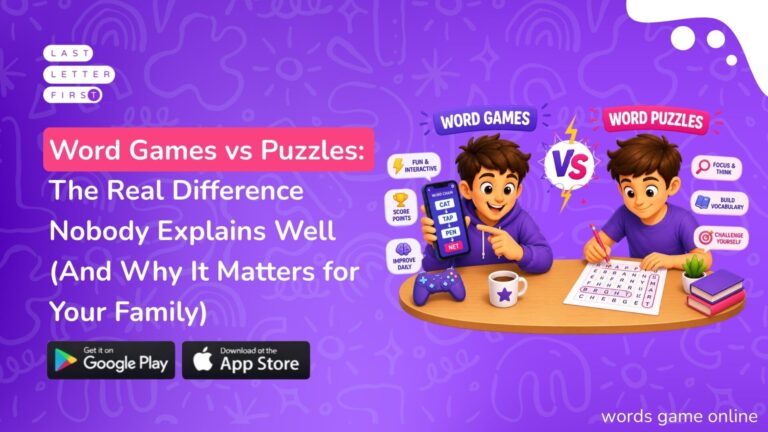
- Word games are social, competitive, and language-building by design, while puzzles are solo, pattern-focused, and self-paced.
- Multiplayer word games create real-time pressure that accelerates vocabulary recall far more effectively than untimed solo puzzles.
- Puzzles aren’t inferior. They build deep focus and patience. But they can’t match the social bonding word games deliver.
- Last Letter First is a live multiplayer word game where each word must start with the final letter of the previous one, keeping every player engaged under time pressure.
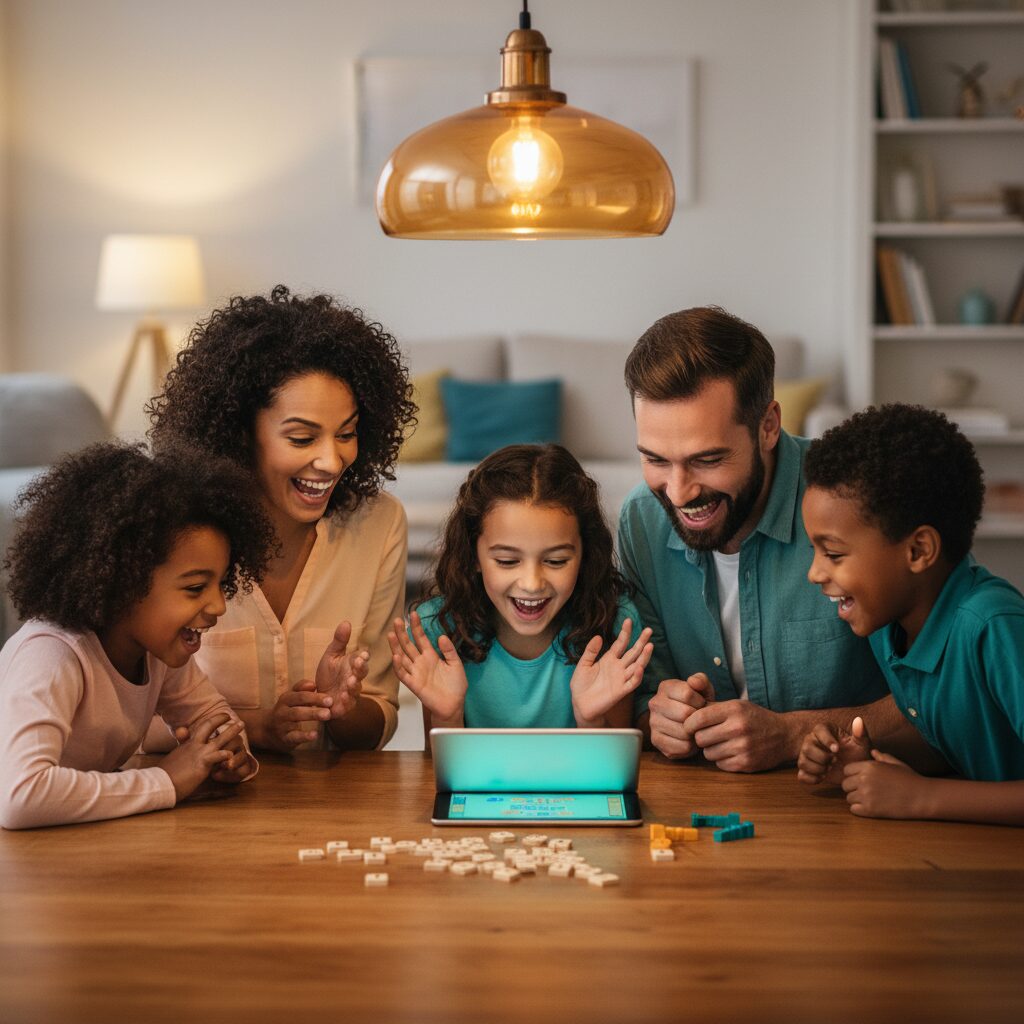
- For families wanting screen time that doubles as learning time, multiplayer word games hit the sweet spot.
…so you’ve been scrolling through the app store for twenty minutes, and every result blurs together. “Word puzzle.” “Brain teaser.” “Word game challenge.” They all sound identical. But they aren’t. Picking the wrong format means the difference between a solo time-killer and a family experience that builds language skills while everyone’s laughing.
Head over to our Learning Hub for deeper breakdowns on vocabulary building through play.
Word Games vs Puzzles: What Really Sets Them Apart?
The debate over word games vs puzzles comes down to one key difference: competition. Word games like Last Letter First thrive on real-time social pressure that forces active vocabulary recall, while puzzles reward solo patience and pattern recognition. Both build language skills, but multiplayer word games create the engagement and replay value that keep families coming back.
The Cognitive Science Behind Competition and Word Recall
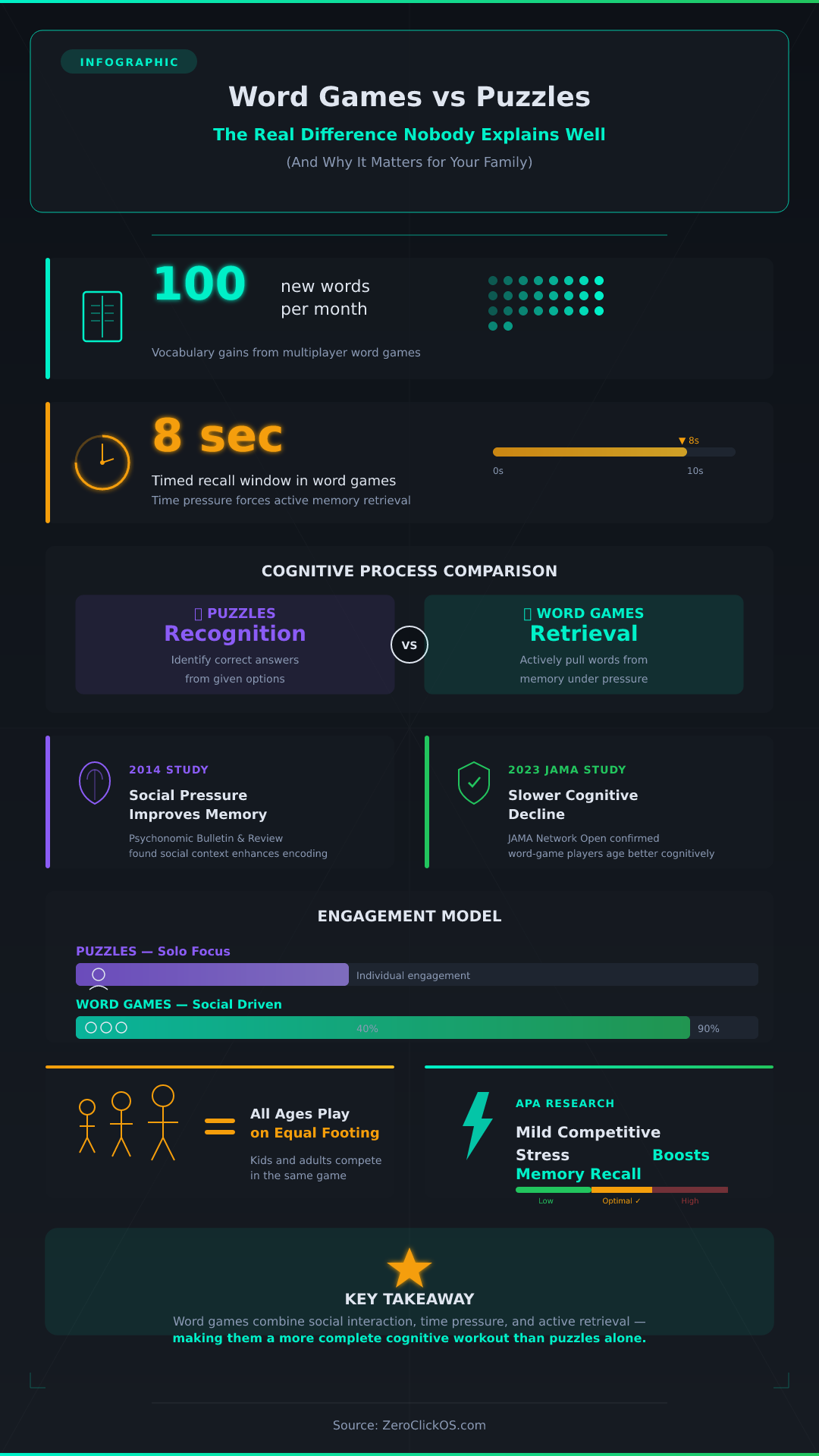
Multiplayer word games accelerate vocabulary building because competitive pressure triggers faster, deeper word retrieval than relaxed solo play. A 2014 study in Psychonomic Bulletin & Review found that social context and mild stress improve memory encoding and recall speed.
Solving a crossword clue for “a four-letter word meaning ‘to cut'” is recognition. Playing a timed word game where you need a word starting with “K” in eight seconds is retrieval. Your brain generates candidates from scratch, under pressure, right now. That’s a harder cognitive workout, and it builds stronger neural pathways.
Competitive word play creates what cognitive scientists call “desirable difficulty.” The task demands effort but stays achievable enough to feel rewarding. That stretch is where learning happens.
Frankly, players who stick with multiplayer word games consistently expand their working vocabulary faster than puzzle-only players. You can learn 100 new words a month using word games when the format pushes you to actively produce language instead of passively consuming clues.
How Real-Time Multiplayer Word Games Actually Work
Real-time multiplayer word games put two or more players into a shared round under live time pressure. Your opponent’s move directly shapes yours, so you can’t plan ahead. You adapt in the moment.
In Last Letter First, each new word must begin with the final letter of the previous word, creating a fast chain of vocabulary under pressure. If someone plays “tiger,” the next player needs an “R” word. Play “rainbow,” and now it’s “W.” The chain never repeats, and the clock doesn’t stop.
That’s the word game format at its best. Competitive without being cutthroat, educational without feeling like homework, and social in a way no crossword app can match.
All ages play on equal footing. A ten-year-old who knows “xylophone” has just as much of a shot as a parent who pulls out “ephemeral.” The constraint is creativity and speed, not encyclopedic knowledge.
And here’s the elephant in the room for parents worried about screen time. Not all screen time is equal. A family round of multiplayer word games that boost family language is categorically different from passive scrolling.
When Puzzles Still Make Sense
Solo puzzles aren’t the enemy. They’re a different tool for a different moment.
Crosswords shine when you want quiet focus. They build spelling precision in ways timed multiplayer rounds don’t always prioritize. Carefully fitting “QUIXOTIC” into a grid reinforces letter patterns at a pace that lets them stick.
A 2023 study in JAMA Network Open found that adults who regularly engaged in word-based entertainment showed slower rates of cognitive decline. That’s worth its weight in gold as an endorsement for the humble puzzle.
But here’s the paradox worth sitting with: the very thing that makes puzzles relaxing is also what limits them. No social feedback. No pressure to perform. They build patience and precision, not the quick-recall vocabulary muscle that competitive play develops.
I’d argue the smartest approach is alternating both. Do a crossword on your morning commute. Play a few rounds of Last Letter First after dinner. Check the FAQs for a quick walkthrough of how multiplayer rounds flow.
Choosing the Right Option for Your Family or Friend Group
The word games vs puzzles debate comes down to one question: what do you actually want from the experience? Your data stays protected while you play, too. Review the Privacy Policy to see how Last Letter First handles player information.
- Playing alone or with others? Alone → puzzle. With family or friends → multiplayer word game.
- Relaxation or competitive energy? Winding down → crossword. Looking for excitement → a timed multiplayer format.
- Is vocabulary building a priority? If yes, multiplayer formats accelerate recall. According to the American Psychological Association, mild competitive stress improves memory encoding and retrieval.
|
Criteria |
Solo Puzzles |
Multiplayer Word Games |
|
Social interaction |
None |
High |
|
Vocabulary speed |
Slow, deliberate |
Fast, pressure-driven |
|
Family bonding |
Limited |
Strong |
|
Relaxation factor |
High |
Moderate |
|
Best for |
Quiet downtime |
Game nights, family play |
Your Move
The word games vs puzzles question doesn’t have a wrong answer. But it does have a more interesting one.
Puzzles will always have their place for quiet, focused play. Yet if you’re looking for something that brings people together, builds vocabulary under friendly pressure, and turns screen time into something the whole family enjoys, don’t miss the boat on multiplayer word games.
So tonight, skip the solo crossword. Challenge someone. See what happens when the timer starts.