

Key Takeaways
- The real vocabulary problem isn’t learning new words, it’s failing to use the ones you already know in conversation and writing.
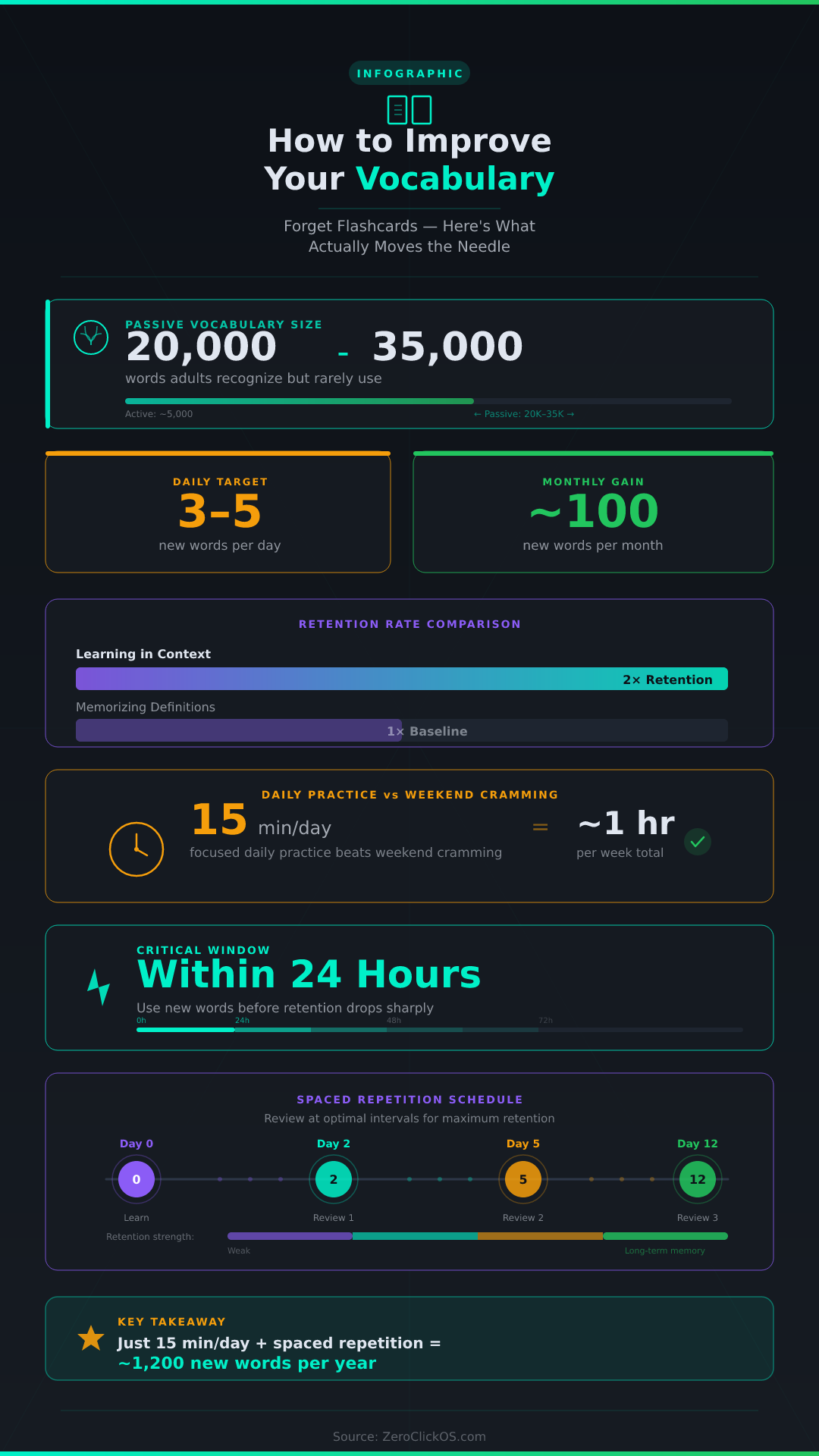
- Adults recognize roughly 20,000 to 35,000 words but actively use only a fraction, creating a massive gap between recognition and real use.
- Spaced repetition and contextual learning lock new words into long-term memory far more effectively than cramming.
- Gamified word play, especially multiplayer formats, is the most underrated vocabulary strategy available to busy adults in 2025.
- Building vocabulary isn’t about sounding smarter on a test. It’s about feeling confident every time you open your mouth.

Here’s a contrarian thought: you don’t have a small vocabulary. You probably recognize thousands of words you never actually use. The gap between the words sitting in your head and the words that come out of your mouth? That’s the real problem.
Most guides treat vocabulary improvement like test prep. Memorize a list, quiz yourself, repeat. But if you’re a working adult who wants to sound more articulate in professional and social settings, rote memorization won’t cut it. You need strategies that bridge recognition and confident daily use.
How to Improve Your Vocabulary When Growth Feels Stuck
Learning how to improve your vocabulary starts with activating the words you already know — not memorizing new ones from a list. Most adults have a massive passive vocabulary but reach for the same handful of words instinctively. Tools like Last Letter First build a better retrieval system by putting words into active, playful context so they’re ready when you need them.
Proven Methods to Build Your Vocab Daily
Contextual learning beats rote memorization every time. When you encounter a word inside a story or real conversation, your brain encodes it with meaning, emotion, and associations. On a flashcard? You encode the flashcard.
Reading widely remains the single best way to build passive vocabulary. But reading alone won’t push words into active use. Pair it with deliberate practice: writing sentences with new words, speaking them aloud, testing yourself in low-pressure settings. Even fifteen minutes of focused daily practice compounds faster than a two-hour weekend session you abandon after three weeks.
Spaced Repetition for Long-Term Retention
Spaced repetition is a science-backed study method that schedules word reviews at gradually increasing intervals to move new vocabulary from short-term memory into long-term recall. Instead of reviewing a word ten times today and forgetting it by Friday, you review it today, then in two days, then five, then twelve.
Apps like Anki and Quizlet are solid tools for the self-disciplined learner. But honestly, flashcard apps feel isolating, and many adults abandon them within weeks. Spaced repetition as a principle is powerful. The delivery method matters just as much.
Using Dictionary Sites and Vocab Resources
Sites like vocabulary.com offer structured word lists, adaptive quizzes, and contextual sentences showing not just what a word means but how it gets used. The key is active engagement: read the examples, say the word aloud, write your own sentence. That thirty-second investment turns a lookup into a learning moment.
Gamification: The Overlooked Vocabulary Strategy
Word games turn repetitive vocabulary practice into genuine fun by adding competition, scoring, and social pressure that trigger deeper cognitive engagement than solo flashcard sessions. And yet, most vocabulary guides don’t mention them.
That’s a massive missed opportunity. A 2020 meta-analysis in Educational Research Review found that gamified learning environments consistently improved motivation and outcomes across age groups. You won’t grind through vocabulary drills after a long workday. But you’ll absolutely play a word game for twenty minutes while waiting for dinner.
The assumption that word games are “for kids” is flat-out wrong. Games remove the pressure of formal study. You’re willing to experiment with words you’d never risk in a work email. That experimentation is exactly how words you recognize become words you use. Frankly, the best vocabulary session most adults could have this week involves a word game and someone to play it with.
A 2024 report from the National Literacy Trust found that families who played word games together reported stronger vocabulary confidence and more frequent daily use of new words. Nobody wants to lose to their cousin. That friendly rivalry is motivation no flashcard app can manufacture, and it’s the kind of social word play that boosts family language skills while feeling like pure entertainment.
Connecting Vocabulary to Grammar and Communication
Learning new words without understanding how they function in sentences is like collecting tools you never take out of the box. A word only becomes useful when you can deploy it correctly.
Here’s the paradox: the more words you know, the easier grammar becomes, and the better your grammar gets, the faster you absorb new vocabulary. A 2023 study from Cambridge University Press confirmed that learners who studied words within grammatical contexts retained them at nearly double the rate of those who memorized definitions alone.
Stop learning words as dictionary entries. Start learning them as sentence components. When you encounter a new word, write three sentences using it. Try to use new words within 24 hours of learning them. After that window, retention drops sharply.
Build a Sustainable Vocabulary Routine
Consistency matters more than volume. Three words practiced daily will outperform twenty words crammed on a Sunday. Combine reading, games, and review for balanced growth. And don’t underestimate the social angle: research on how multiplayer word games improve family vocabulary shows social play creates natural word discussions solo study can’t replicate.
|
Day |
Activity |
Time |
|
Monday |
Read an article in your field, highlight 3 new words |
10 min |
|
Tuesday |
Write sentences using Monday’s words |
5 min |
|
Wednesday |
Play a word game (solo or with someone) |
15 min |
|
Thursday |
Read something outside your usual genre, collect 3 words |
10 min |
|
Friday |
Use Thursday’s words in emails or conversation |
5 min |
|
Saturday |
Review the week’s words, quiz yourself |
10 min |
|
Sunday |
Rest or play a casual word game with family |
Optional |
The whole routine takes roughly an hour across seven days. You don’t need a study block. You need pockets of purposeful practice. For a structured monthly target, the guide to learning 100 new words a month breaks this down further.
Frequently Asked Questions
Your Vocabulary, One Week From Now
Forget the idea that vocabulary building requires discipline and suffering. It requires consistency and a little bit of fun. The strategies that work, contextual reading, sentence-level practice, game-based repetition, social play, aren’t complicated. They’re just underused.
Pick one thing from this article and do it tonight. Play a word game with someone you live with. Write three sentences with a word you learned this week. A year from now, you won’t remember the moment you decided to hit the ground running with your vocabulary. But everyone around you will notice the difference.
By the Last Letter First Editorial Team | Last updated: May 2026
The Last Letter First Editorial Team covers vocabulary building, word games, and language learning strategies. Our contributors bring backgrounds in linguistics, education, and game design to create practical, research-backed content for adults who want to communicate with more confidence. Learn more about our partners and collaborators.