
Key Takeaways About Waffle Games
- The Waffle game is a free, browser-based daily word puzzle played on a 5×5 waffle-shaped grid containing six intersecting five-letter words, where all 21 letters are visible from the start and players swap them pairwise to reach the correct positions within 15 moves.
- Each additional swap beyond that minimum costs you one star.
- You don’t need to pre-solve every word on paper; a two-rule approach produces consistent 5-star results.
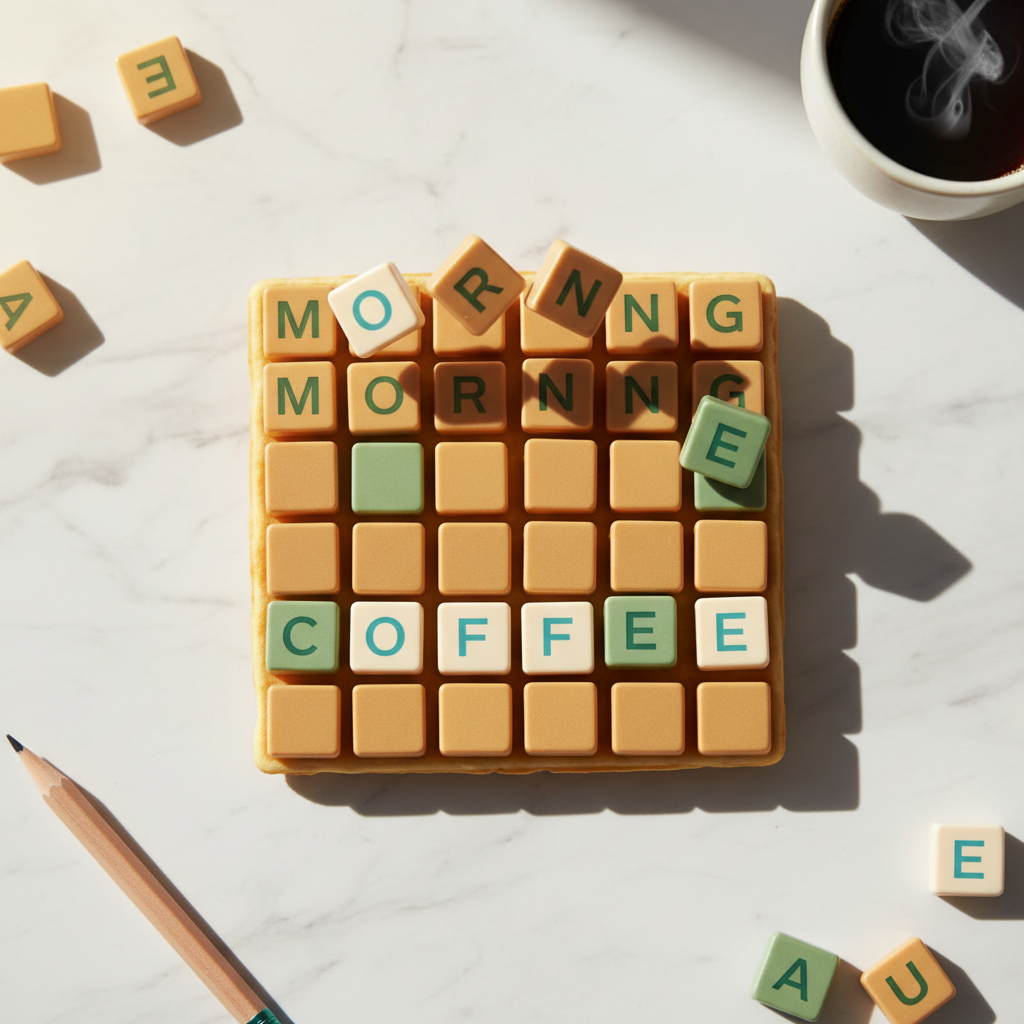
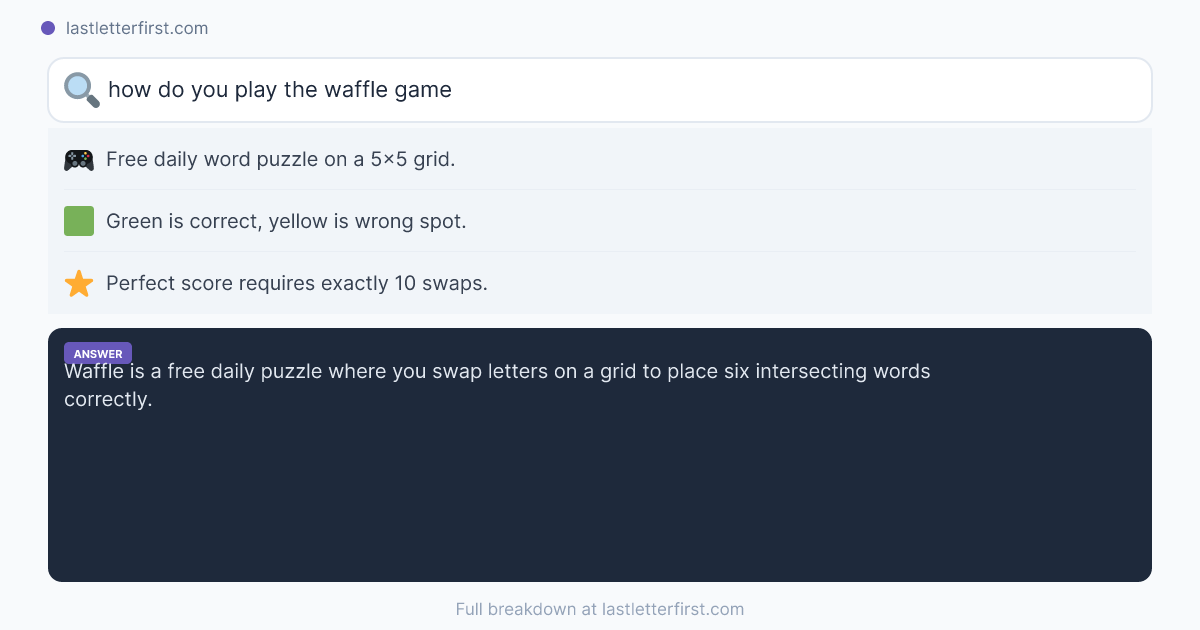
The Waffle game is a daily word puzzle that arranges six intersecting five-letter words on a waffle-shaped grid and asks you to rearrange scrambled letters into their correct positions. It’s free, runs in your browser, and doesn’t require an account. But overcomplicated strategy advice, confusing color signals, and an opaque scoring system trip up a surprising number of players.
One daily puzzle not enough? Multiplayer word games that sharpen vocabulary offer the same letter-pattern thinking with no daily cap.
Why complex strategy guides miss the point of the waffle game
A reliable two-rule approach, only swap when both letters land as confirmed green matches, and only move a letter when it’s the last movable instance on the board, keeps solves efficient without requiring pen-and-paper planning. Variants like Waffle Royale, Deluxe Waffle, Number Waffle, and Waffle Unlimited expand the format, and players looking for a live, multiplayer word challenge can try Last Letter First for head-to-head wordplay with friends.
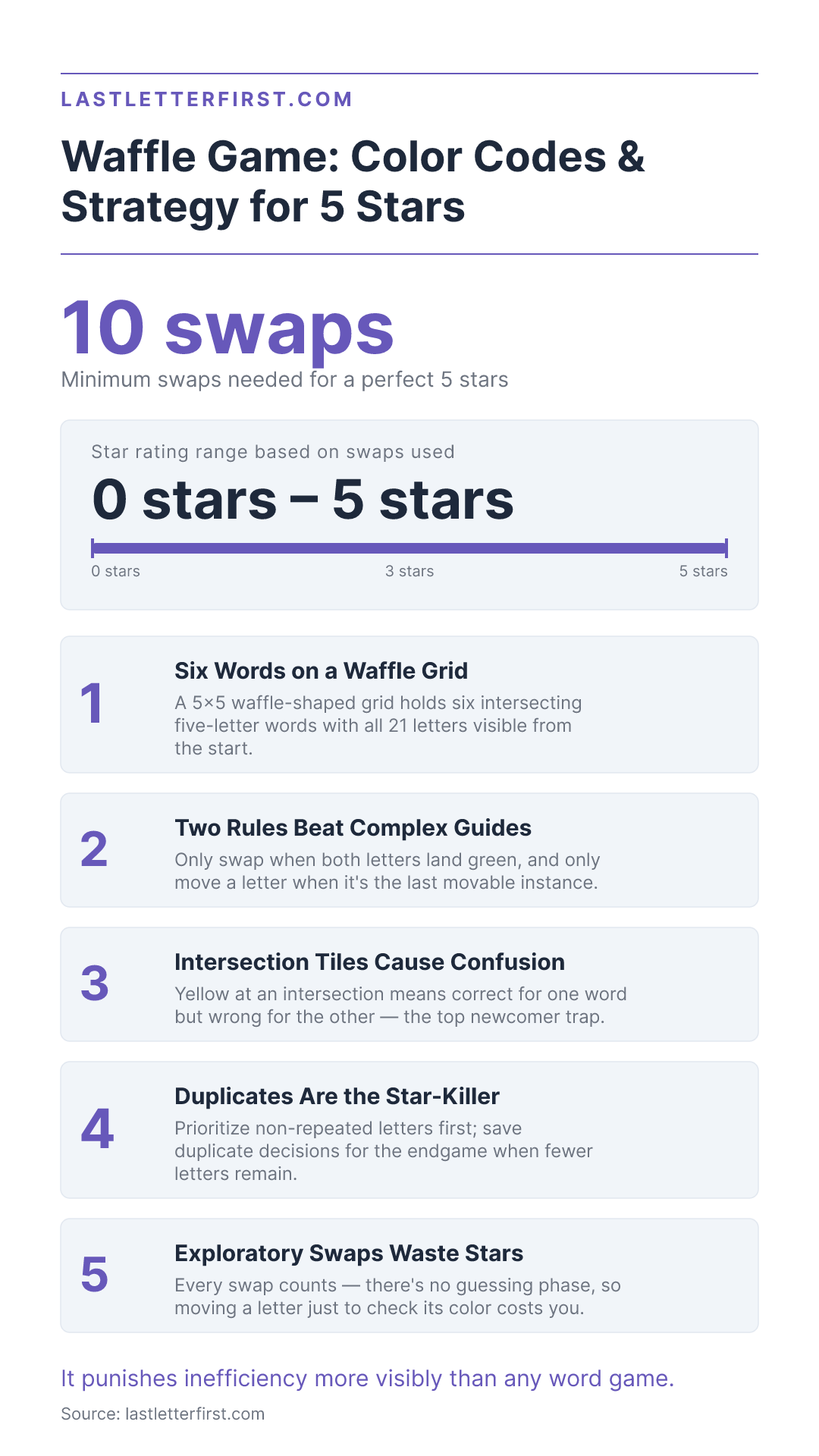
Color-coding rules (green, yellow, white) and edge cases, such as a yellow letter sitting at the intersection of two words, or duplicate letters with different colors,add confusion for newcomers.
Simple enough, until you hit an intersection tile.
In Wordle, each letter belongs to one word. In Waffle, letters sit at the crossing point of two words. A yellow tile at an intersection can mean the letter is right for one word but wrong for the other. That’s the edge case that trips up newcomers most. Green at an intersection means correct for both words. White means it doesn’t belong in either.
Duplicate letters add another layer. You might see the same letter twice with different colors: one green (locked) and one yellow (needs to move). The two-rule strategy handles this: only move a letter when it’s the last movable instance on the board.
Deluxe Waffle expands the standard grid into a larger layout with more intersecting words, but the core color-coding rules and swap mechanics stay identical to the original. The game was created in 2022 by James Jessian and has maintained this consistent color system since launch, according to Arkadium’s Waffle puzzle page.
| Color | Meaning | What to Do |
|---|---|---|
| Green | Correct word, correct position | Leave it alone |
| Yellow | Correct word, wrong position | Swap within the same word |
| White/Grey | Belongs in a different word | Swap to another word on the grid |
Players frequently struggle to achieve a perfect 5-star score, often plateauing at 3 or 4 stars despite understanding the basic mechanics. Multiple commenters report watching strategy videos repeatedly without consistent improvement.
Each additional swap beyond that minimum costs you one star. The bottleneck isn’t vocabulary. It’s swap efficiency.
The most common plateau happens because players make “exploratory” swaps, moving a letter to see what color it turns. Every swap counts. There’s no guessing phase. Players who watch strategy videos without improvement are usually applying the two-rule approach for the first few swaps, then panicking mid-grid and guessing. Consistency matters more than knowledge.
| Swaps Used | Stars Earned |
|---|---|
| 10 (minimum) | ⭐⭐⭐⭐⭐ |
| 11 | ⭐⭐⭐⭐ |
| 12 | ⭐⭐⭐ |
| 13 | ⭐⭐ |
| 14 | ⭐ |
| 15 | 0 (solved, no stars) |
But the game isn’t harder than other word puzzles. It just punishes inefficiency more visibly.
Duplicate or repeated letters in the puzzle grid create confusion about which instance to move, leading to sub-optimal swaps and lost stars even when players believe they are following the correct strategy.
Duplicate letters are the single biggest star-killer in the Waffle game. When the same letter appears in multiple grid positions, picking the wrong instance to move first cascades into extra swaps.
Prioritize non-repeated letters first. If a letter appears only once in the entire grid, move it into position before touching any duplicates. This eliminates ambiguity early and leaves duplicate decisions for the endgame, when fewer remaining letters make the correct choice obvious. The safe rule: when only four letters remain and they form two matching pairs, that’s the only scenario where moving a duplicate is reliably safe.
| Scenario | Safe to Move? | Action |
|---|---|---|
| 4 letters left, two matching pairs | Yes | Swap freely |
| One duplicate is green | No | Move only the non-green instance |
| Both duplicates are yellow | Risky | Solve surrounding unique letters first |
| Early in the puzzle (8+ swaps left) | Avoid | Focus on single-occurrence letters |
Once you’ve mastered the daily Waffle, word game tournaments with weekly prizes keep that competitive edge sharp without waiting for tomorrow’s grid.
Frequently Asked Questions
Does the Waffle game have a mobile app?
The web version at wafflegame.net remains the most commonly referenced access point. Available evidence doesn’t confirm whether the app and web versions share identical daily puzzles.
Why is the Waffle game not working?
Multiple Waffle-branded sites now exist beyond the original at wafflegame.net, so a bookmarked site that stopped loading may simply be the wrong URL or a retired mirror. Try navigating directly to wafflegame.net. Clearing your browser cache or switching from an ad-blocker-heavy browser can also resolve loading issues, since the game runs entirely in-browser.
What is today’s Waffle game answer?
The Waffle game generates a new puzzle every 24 hours, so there’s no single permanent answer; dedicated spoiler sites post each day’s solution shortly after the puzzle goes live (nhl.com [1]). This guide focuses on strategy rather than daily spoilers, because learning the two-rule swap method produces better long-term results than looking up answers.
How does the Waffle game make money?
The Waffle game is free to play in its daily web format and listed as free on both major app stores, though its specific monetization model isn’t publicly documented. Whether revenue comes from ads, optional in-app purchases, or sponsorships isn’t confirmed in available sources.
How is Waffle different from the Pancake game?
Waffle and Pancake are unrelated games; Waffle is a letter-swap word puzzle on a grid, while Pancake is a sorting game where you flip stacks into the correct order. They share a breakfast name but no mechanics. Waffle tests vocabulary and swap efficiency; Pancake tests sequential logic.
When multiple valid words could fit a row, how do you choose?
Check the intersecting words first. When two valid words could fit, the letters at intersection points constrain your options. A green letter at an intersection confirms that character for both the row and column simultaneously, which usually eliminates the ambiguity.
Does the Waffle Game have any official mobile app, or is it exclusively a web-based experience at wafflegame.net?
The Waffle Game is exclusively web-based and does not have an official mobile app; it is played through wafflegame.net in a browser. Available evidence from video sources indicates the game’s primary distribution method, though this does not preclude future app development or third-party mobile adaptations.
When multiple valid English words could fit a row or column (e.g., ‘chess’ vs. ‘cress’), what heuristics help players choose correctly before committing a swap?
When multiple valid words fit a row or column, players must evaluate context clues from intersecting words and letter frequency patterns to make an informed choice before committing a swap. YouTube comments from experienced players suggest this decision-making relies on puzzle-solving intuition rather than a formulaic heuristic, though systematic testing of adjacent intersections can narrow possibilities.
How large is the active Waffle Game player base, and what is the average star rating players achieve per daily puzzle?
Specific data on the active player base and average star ratings per puzzle are not publicly disclosed by the Waffle Game developers. Available video sources do not contain verified statistics on these metrics, making independent verification impossible.
Are there plans for additional Waffle Game variants beyond the standard and Deluxe word versions and the Number Waffle?
Current confirmed variants include the standard Waffle, Waffle Deluxe, and Number Waffle; plans for additional variants have not been officially announced in available sources. Video evidence does not detail future development roadmap beyond existing game modes.
What monetization or sponsorship model sustains the Waffle Game, and does it collect any user data beyond gameplay stats?
The Waffle Game’s monetization model and data collection practices are not fully detailed in available public sources. Video documentation does not provide comprehensive information about sponsorship arrangements or the scope of user data retention beyond gameplay statistics.
How should players handle duplicate letters when deciding which instance to swap, to avoid wasting moves and losing stars?
When duplicate letters appear in a grid, players should identify which instance belongs in the correct position by cross-referencing intersecting word constraints before swapping. YouTube comments from players suggest tracking each duplicate’s potential positions across intersecting words minimizes wasted moves, though the optimal approach depends on the specific puzzle configuration.
Is there an adapted or extended strategy specifically for Waffle Royale and Deluxe Waffle variants?
Waffle Royale and Deluxe variants follow the same core swap-optimization principles as the standard game, with strategy adjustments based on variant-specific rule changes. Community comments indicate that players adapt their approach to each variant’s unique constraints, though a comprehensive strategy guide specific to each mode is not documented in available sources.
Are there known flawed or unsolvable Waffle Royale puzzles, and is there an official channel for reporting them?
Unsolvable or flawed Waffle Royale puzzles may occur, but an official reporting channel or public documentation of known issues is not confirmed in available sources. Players encountering problematic puzzles should contact the developers directly through the game’s website for support.
Does the Number Waffle variant follow the same swap-optimization principles as the word version, and how do grid changes (e.g., removed greens) affect strategy?
The Number Waffle variant applies the same swap-optimization principles as the word version, with strategy adjustments for numerical constraints and grid changes such as removed greens. Community discussion suggests that players must recalibrate their approach based on how grid modifications affect the intersection logic, though detailed variant-specific strategy documentation is limited.
What is the ‘Funky Dingo’ rule referenced by a commenter, where two yellow letters of the same type refer to a single shared crossroad square?
The ‘Funky Dingo’ rule, referenced in player comments, describes a scenario where two yellow letters of the same type indicate a single shared crossroad square rather than two separate positions. This rule helps players avoid redundant swaps and optimize their move count, though its formal status as an official game mechanic is not confirmed in developer documentation.
Is there an accessible archive for Waffle Royale puzzles so players can practice and verify past solutions?
A comprehensive public archive for Waffle Royale puzzles is not confirmed to exist in available sources. Players interested in practicing past puzzles should check the official Waffle Game website or community forums for any available puzzle history or replay features.
Was the query intended to reference a specific cybersecurity tool, threat actor, vulnerability, or malware campaign associated with the name ‘waffle’? Clarifying the intended security context would help surface relevant results.
This FAQ addresses the Waffle Game, a daily word puzzle, not cybersecurity tools, threat actors, vulnerabilities, or malware campaigns. If a security-related query was intended, clarification of the specific security context would be necessary to provide relevant information.
Waffle Royale (the larger variant) is perceived as significantly harder, with players requesting dedicated strategies. The creator of the strategy video acknowledged it has ‘too much going on’ to confidently plan ahead.
The Waffle game’s biggest strength is also its biggest limitation. One puzzle per day, roughly a minute of solving, then you wait. That daily cap keeps the game special, but it leaves a lot of letter-pattern energy with nowhere to go.
The same deduction skill that makes Waffle satisfying, reading color clues, eliminating impossible placements, finding the optimal swap path, transfers directly to multiplayer word formats. Playing word games with friends through Last Letter First gives you an opponent and unlimited rounds, with no daily cap holding you back. Players seeking free daily word games that test similar thinking will find multiplayer options fill that gap nicely.
The next step isn’t another Wordle spin-off. It’s finding a format where letter-pattern thinking compounds, round after round.
References
Louis Blues. Published October 23, 2026. https://www.nhl.com/blues/news/blues-chick-fil-a-st-louis-announce-free-waffle-fry-promotion