
Key Takeaways About Word Wipe Game
- Word Wipe is a free, timed word-search puzzle developed by Arkadium where players drag across adjacent letters to form words and clear rows before the clock hits zero.
- Bonus bombs aren’t random. They’re earned by submitting valid words after you’ve already hit a round’s minimum word goal.
- The fastest path to a clean board isn’t finding the longest word first. It’s dismantling the corners and edges before touching the center.
- High scorers don’t just find more words; they find longer words early, because words of five letters or more trigger power-ups and score multipliers that shorter words can’t match.
- Solo grid-clearing and live-opponent word games build different skills, and knowing the difference helps you pick the right format.
Most guides on Word Wipe stop at “find words, clear rows.” This guide covers the real rules, bonus-bomb mechanics most players miss, and a board-clearing strategy built from tactics experienced players actually use. For anyone exploring free daily word games to sharpen vocabulary, Word Wipe is a strong starting point.
What Is Word Wipe and How Do You Play It
Word Wipe is a free, timed word-search puzzle by Arkadium in which players connect adjacent letter tiles to form words and clear rows before the clock runs out. The core strategy centers not on finding the longest word but on eliminating entire rows , three quick three-letter words that wipe a full row often outperform a single flashy seven-letter find. Available with no download on sites like USA TODAY, AARP, and Dictionary.com, Word Wipe rewards pattern recognition, spatial awareness, and fast decision-making in equal measure.
Step-by-Step Strategy for Clearing Entire Boards
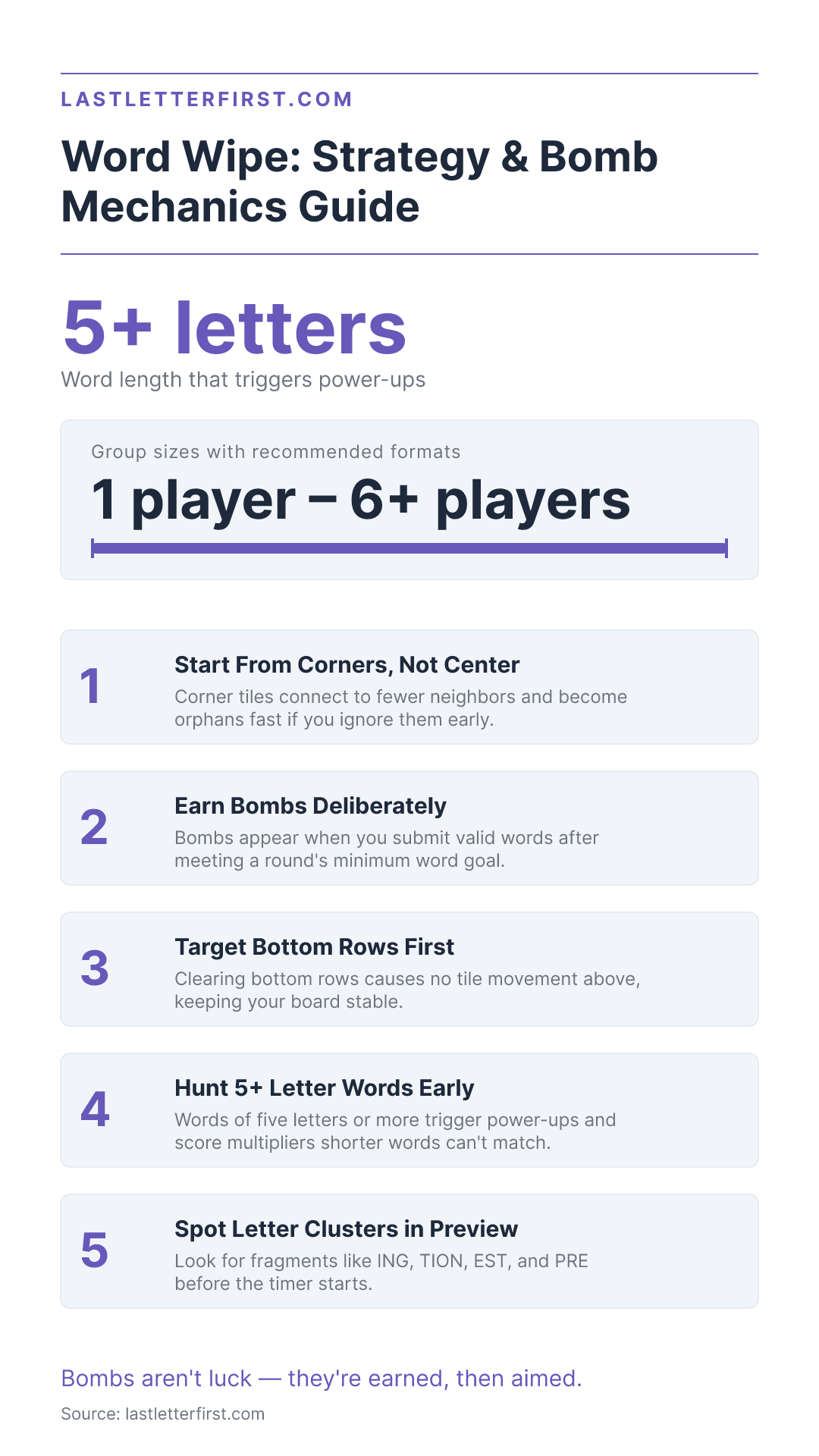
The fastest path to a clean board isn’t finding the longest word first. It’s dismantling the corners. Start every round at the corners and edges of the grid, not the center, because corner tiles connect to fewer neighbors and become orphans fast if you ignore them.
- Scan corners first. Can any corner tile begin or end a three-letter word with its neighbors? Clear those immediately.
- Work edges inward. Edge tiles have fewer connection options than center tiles, so they become problems faster.
- Target bottom rows. Clearing a bottom row causes no tile movement above, keeping your board stable.
- Use short words surgically. A well-placed “THE” can remove exactly the tiles blocking a full row clear.
- Save long words for scoring. Once the board is stable, hunt five- and six-letter words for points and power-ups.
Bonus-Bomb Mechanics
Bombs don’t appear randomly. They’re earned by submitting valid words after you’ve already met a round’s minimum word goal. Include a bomb tile in your next word and it detonates, destroying surrounding tiles.
This is the mechanic most players miss. You control when bombs appear.
- Don’t detonate immediately. Let a bomb sit near a stubborn cluster you can’t otherwise clear.
- Chain reactions matter. A bomb blast that causes tiles to drop and complete another row triggers a cascade clear with bonus time.
| Bomb Mechanic | Detail |
|---|---|
| How earned | Submit words after meeting the round’s minimum goal |
| Blast radius | Destroys a cluster of surrounding tiles |
| Trigger | Include the bomb tile in any valid word |
| Strategic value | Eliminates orphan tiles and stubborn clusters |
Understanding this system transforms bombs from a pleasant surprise into a deliberate tool.
Pattern Spotting Under Time Pressure
High scorers don’t just find more words; they find longer words early, because words of five letters or more trigger power-ups and score multipliers that shorter words can’t match. But spotting long words on a randomized grid while a timer counts down is a skill, not a gift.
Most versions show the board briefly before the timer begins. Use that preview. Don’t look for specific words. Instead, look for common letter clusters: “ING,” “TION,” “EST,” “PRE.” These fragments are building blocks, and spotting them early gives you a mental map of where high-value plays live.
Resist grabbing the first three-letter word you see. A player who finds “RESTING” in the first ten seconds will outscore a player who submits “REST,” “STING,” and “TIN” separately. Speed comes from recognition, not reaction. The more you play, the faster your brain identifies common letter patterns. That’s the real training loop.
Solo Grid-Clearing vs. Live-Opponent Word Games
Word Wipe is popular among seniors precisely because it offers low-pressure vocabulary practice at a self-directed pace, and it’s one of the most-played titles on AARP free online games portals. The game rewards consistency: learn the grid patterns, earn bonus bombs, clear rows, repeat.
But a timer doesn’t adapt. It doesn’t surprise you with an unexpected word that forces you to rethink.
Multiplayer word games add human unpredictability a solo timer can’t replicate. When another person builds words from the same mental dictionary, every round becomes a vocabulary test and a speed contest at once. The social element also builds language skills faster because you encounter words you wouldn’t have found alone. That’s why multiplayer word games improve family vocabulary in measurable ways.
| Feature | Solo Grid-Clearing (Word Wipe) | Live-Opponent Word Games |
|---|---|---|
| Pacing | Timer-driven, self-directed | Opponent-driven, reactive |
| Vocabulary growth | Reinforces known words | Introduces unfamiliar words through social play |
| Social element | None | Real-time interaction |
| Skill emphasis | Pattern recognition, speed | Recall speed, adaptability, strategy |
| Best for | Solo practice, relaxation | Competitive play, group bonding |
Choosing the Right Word Game for Your Group
The best word game depends on who’s playing. Word Wipe suits solo practice when you want to sharpen pattern recognition without coordinating schedules. It’s free, browser-based, and a round takes under five minutes.
Small groups benefit from cooperative formats. For families and friend groups, live multiplayer apps combine Word Wipe’s vocabulary recall with the social dimension of board games.
| Group Size | Recommended Format | Why It Works |
|---|---|---|
| Solo | Browser word puzzles (Word Wipe) | Self-paced, no coordination needed |
| 2 players | Live-opponent word apps | Competitive, fast rounds |
| 3-6 players | Cooperative card word games | Shared timer, collaborative energy |
| 6+ players | Team-based word games | Scales without slowing down |
Anyone exploring free daily word games beyond Word Wipe should start with one question: play alone or with someone?
Frequently Asked Questions
What is Word Wipe and how do you play it?
Word Wipe is a free, timed word puzzle developed by Arkadium [1] where players drag across adjacent letters to form words of three or more letters. Each valid word clears those tiles, and the goal is to eliminate entire rows before the countdown expires. In game terms, “wipe out” means to clear every tile from the board, sometimes called a full board clear or a total sweep. It’s available on browser portals like AARP, USA TODAY, and Dictionary.com with no download required.
How do you get bonus bombs in Word Wipe?
Bonus bombs are earned by submitting words after you’ve met a round’s minimum word goal. Once a bomb appears, including it in any valid word detonates surrounding tiles. Save your bomb for a stubborn corner or column gap rather than wasting it on tiles you could clear manually. A well-placed bomb clears an entire cluster that manual word-building can’t reach, making bombs the single most important mechanic for advancing past mid-rounds.
Is Word Wipe a good party game for large groups?
The browser version is solo, so it isn’t ideal for large groups. One person plays while everyone else watches. Multiplayer word-game apps with real-time opponents let everyone play simultaneously from their own devices, which works much better for parties. Look for formats that let multiple people participate at once rather than taking turns on a single screen.
How does Word Wipe compare to Scrabble?
Word Wipe is a timed grid-clearing game; Scrabble is a turn-based board game with strategic tile placement. Word Wipe gives you seconds to find words, while Scrabble gives you minutes to plan optimal moves. Scoring differs too: Scrabble assigns point values per letter with board multipliers, while Word Wipe scores based on word length and row clears. Resources like the North American Scrabble Players Association dictionary help players learn valid words that transfer to faster Word Wipe grid scanning.
Is Word Wipe free to play?
Yes. Word Wipe is completely free in any modern web browser without a download or account. It’s available on AARP’s portal, USA TODAY’s game section, Dictionary.com, the Daily Mail games page, and directly on Arkadium’s site. No subscription or in-app purchases required.
What skills does Word Wipe build?
Word Wipe builds vocabulary recall, pattern recognition, and decision-making under time pressure. Those three skills reinforce each other: the more words you recognize instantly, the faster you spot patterns, and the better your split-second decisions become. The time-pressure element trains your brain to perform under a deadline, a skill that extends well beyond the game board.
How does Word Wipe compare to other cooperative word games?
Word Wipe online is a competitive, solo puzzle game where one player races against the clock to clear a grid—fundamentally different from cooperative word games where players work together toward a shared goal. The AEG card version of Word Wipe supports multiple players and emphasizes collaborative play, whereas browser-based Word Wipe focuses on individual performance and speed. Other cooperative word games like Codenames or Wavelength require group discussion and shared reasoning, whereas Word Wipe’s solo format prioritizes timed execution and pattern recognition.
Can Word Wipe work well as a two-player game?
The browser version of Word Wipe is designed for single-player gameplay only and does not support two-player modes. The AEG card game version, however, accommodates two or more players and is structured for multiplayer interaction. Players seeking live two-player word competition can explore dedicated word-game apps that feature real-time opponent matching.
Can Scrabble word finders help with Word Wipe?
Scrabble word finders and anagram solvers build vocabulary and letter-pattern recognition that transfer directly to Word Wipe gameplay. However, Word Wipe rewards speed and spatial awareness more heavily than optimal scoring strategies, since the goal is board clearance within a time limit rather than point maximization. Practicing with anagram tools strengthens word recall, but success in Word Wipe depends equally on quick decision-making and identifying high-impact letter combinations.
What are the best fast-paced word games for parties?
Cooperative and multiplayer word games with short, timed rounds work best for party settings because they keep energy high and engagement broad. Real-time card games, live-opponent mobile word apps, and turn-based group word challenges all suit social play by balancing competition with accessibility and allowing multiple participants to engage simultaneously or in quick succession.
What Happens When the Grid Isn’t Enough
Word Wipe does one thing exceptionally well: it trains your brain to find words fast under pressure. That skill shows up in every conversation where you reach for the right word and find it instantly.
Solo grid-clearing sharpens the blade. Playing against another person tests whether it’s actually sharp. If questions come up about any word-game platform, the Last Letter First support page is a good starting point.
The best word-game players aren’t the ones who memorized the most obscure seven-letter words. They’re the ones who practiced under pressure until fast recall became automatic.
Start with the grid. Then find an opponent.
References
[1] arkadium.com. Word Wipe: Play for Free & Online Arkadium Original Game. https://www.arkadium.com/games/word-wipe/