
Key Takeaways
- English does contain words ending in Q, mostly loanwords from Arabic, Hebrew, or clipped slang.
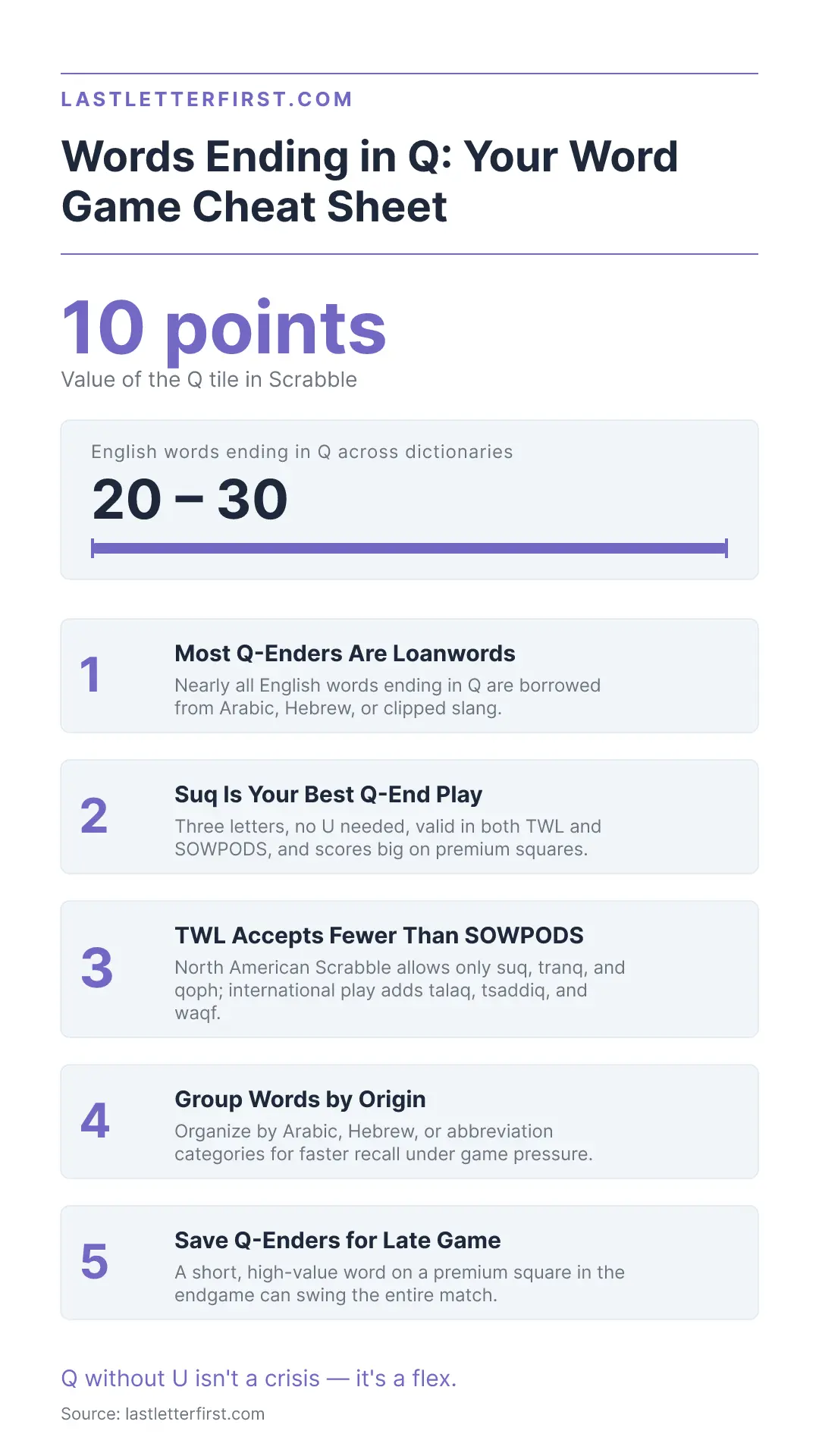
- Suq, tranq, and qoph are the most commonly played Q-ending words in competitive Scrabble in 2026.
- TWL (North American dictionary) accepts fewer Q-ending words than SOWPODS (international), so validity depends on your ruleset.
You’re staring at a tile rack with a lonely Q and no U in sight. That blank panic costs players real points every game.
Here’s the paradox: Q is one of the highest-scoring tiles in Scrabble, yet most players treat it like a liability. The problem isn’t the letter. It’s a vocabulary gap. If you’re building your word game vocabulary, Q-ending words deserve a permanent spot in memory.
Why Words Ending in Q Matter in Word Games
Words ending in Q catch opponents off guard because almost nobody studies them. I’d argue that’s precisely what makes them powerful.
The Q tile is worth 10 points. Most players hold it like a hot potato, desperate for a U. But players who’ve memorized even five Q-ending words flip that dynamic entirely. They aren’t scrambling. They’re waiting for the right board position. Knowing these words also protects you during challenges, and confidence backed by knowledge is pretty hard to argue with.
The Complete List of Words Ending in Q
Most English words ending in Q are loanwords from Arabic or Hebrew, not native English formations. They entered English through trade and religious scholarship, carrying original spellings intact.
Honestly, the list is shorter than people expect. Common examples: suq (an open-air market), tranq (short for tranquilizer), qoph (the nineteenth Hebrew letter). Less familiar entries like talaq (an Islamic divorce declaration) and tsaddiq (a righteous person in Jewish tradition) round out the set.
Arabic loanwords dominate: suq, talaq, waqf (a charitable endowment). Hebrew contributions include qoph (/koʊf/) and tsaddiq (/tsɑːˈdiːk/). Abbreviations give us tranq (/træŋk/).
|
Word |
Pronunciation |
Meaning |
|
suq |
“sook” |
Open-air marketplace |
|
tranq |
“trank” |
Tranquilizer (informal) |
|
qoph |
“kofe” |
Hebrew letter |
|
talaq |
“tah-LAHK” |
Islamic divorce |
|
tsaddiq |
“tsah-DEEK” |
Righteous person |
|
waqf |
“wahkf” |
Charitable endowment |
Frankly, most players skip pronunciation. That’s a mistake. Saying a word out loud anchors it in memory far more effectively than reading silently.
TWL vs SOWPODS: Which Q-Ending Words Are Valid?
TWL accepts fewer Q-ending words than SOWPODS. Always check validity before playing, because an invalid word costs your turn and the points. North American Scrabble uses TWL; international play uses SOWPODS.
|
Word |
TWL (North America) |
SOWPODS (International) |
|
suq |
✅ |
✅ |
|
tranq |
✅ |
✅ |
|
qoph |
✅ |
✅ |
|
talaq |
❌ |
✅ |
|
tsaddiq |
❌ |
✅ |
|
waqf |
❌ |
✅ |
So under TWL rules, your safe bets are suq, tranq, and qoph. SOWPODS players get a broader toolkit. Memorizing which words belong to which dictionary is worth its weight in gold during tournament play.
Looking for words ending in Q?
While words that end with the letter Q are extremely rare in English, they can be useful to know for word games, puzzles, and vocabulary challenges. Explore examples, meanings, and helpful word lists to improve your vocabulary and find the right answer when you encounter a tricky Q-ending word.
Q Without U: Breaking the Biggest Rule in English
Knowing these words is one thing. Deploying them at the right moment is another. Let’s be real: they’re your ace in the hole.
Save them for late-game situations. By the endgame, a short, high-value word on a premium square can swing the match. A well-placed suq on a triple-letter tile outscores most five-letter words. The biggest mistake? Panicking when you draw Q without U. Don’t miss the boat on easy points.
Group words by origin for faster recall: Arabic (suq, waqf, talaq), Hebrew (qoph, tsaddiq), abbreviations (tranq). You’re pulling from structured mental categories, not scanning a random list. The Last Letter First Learning Hub covers more unusual letter patterns worth exploring.