
Key Takeaways
- Solo puzzles like Wordle sharpen pattern recognition but cap daily word exposure at a single puzzle.
- Multiplayer vocabulary games create emotional stakes that lock new words into long-term memory far more effectively than solo play.
- Last Letter First turns every round into active recall under competitive time pressure, making it a strong pick for families and classrooms alike.
- The biggest mistake teachers and parents make isn’t choosing the wrong game. It’s assuming any game labeled “educational” will automatically improve retention.

A fourth-grade teacher in Austin swapped vocabulary flashcards for a competitive multiplayer word game. Kids who hadn’t voluntarily used “reluctant” all semester were shouting it across the room to score points. That contrast, between a tool that teaches and a format that sticks, is what most vocabulary game roundups get wrong.
Here’s the uncomfortable truth: the market is flooded with products that feel fun but don’t move the needle on retention. Whether you’re a teacher hunting for classroom-tested strategies or a parent trying to make game night genuinely educational, the format you pick matters more than the specific game.
Vocabulary Games are an engaging and effective way to improve language skills while making learning enjoyable for children and adults alike. These interactive games help expand vocabulary, enhance spelling, strengthen reading comprehension, and boost communication skills through fun challenges, quizzes, word puzzles, and educational activities.
Whether used in classrooms, homeschooling, or self-study, vocabulary games encourage active learning and long-term word retention. From crossword puzzles and word searches to digital learning apps and multiplayer word challenges, there are countless options to suit every age and skill level. By practicing regularly with vocabulary games, learners can build confidence, improve academic performance, and develop stronger language proficiency in an entertaining and motivating way.
Why Vocabulary Games Matter for All Ages
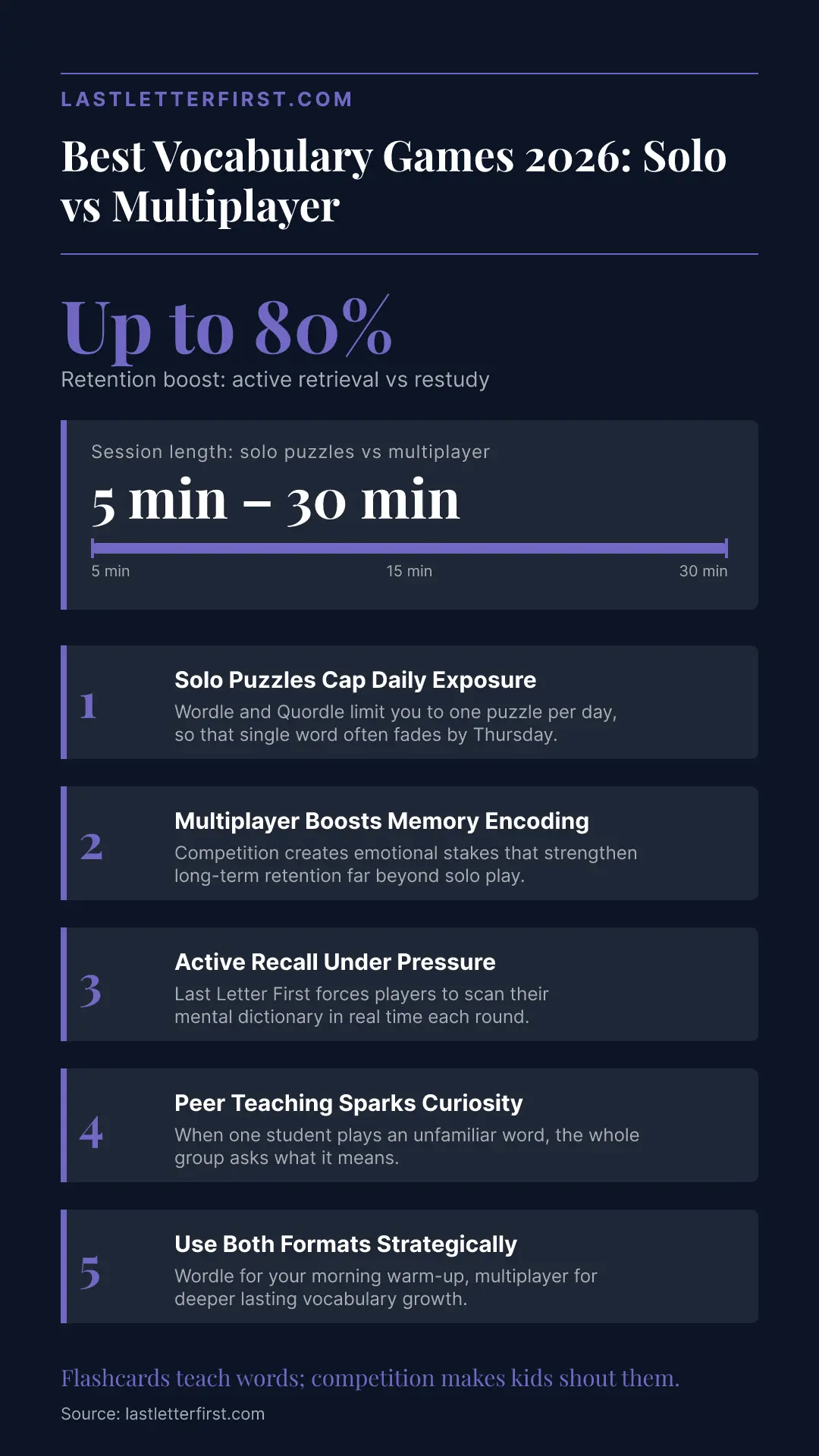
Vocabulary games that demand effortful recall , not passive recognition , are the ones that build lasting language skills. Research shows active retrieval can improve long-term retention by up to 80% compared to restudying, and multiplayer formats like Last Letter First amplify this effect by layering social reinforcement on top of cognitive effort. You don’t just learn a word; you learn it while someone’s watching.
Solo Word Puzzles: When Wordle and Quordle Shine
Wordle and Quordle build pattern recognition by forcing you to deduce words through elimination. Solo play suits anyone wanting a quick daily session without coordinating schedules.
The limit is exposure. One puzzle per day means one word per day. Without social reinforcement, that word often fades by Thursday.
Multiplayer Vocabulary Games: The Retention Advantage
Multiplayer vocabulary games outperform solo puzzles for long-term word retention because competition creates emotional stakes that strengthen memory encoding. You can’t coast against real people in real time.
Last Letter First turns every round into active vocabulary recall by forcing players to think fast under pressure. Each word must start with the last letter of the previous player’s word, so you’re constantly scanning your mental dictionary. Discover how multiplayer word games boost family language skills for a deeper look.
In classrooms, group rounds spark peer teaching. When one student plays an unfamiliar word, the whole group asks what it means. That spontaneous curiosity is worth its weight in gold compared to worksheet exercises.
Vocabulary Games for Families Outside the Classroom
So which format should you choose? Frankly, you probably need both. Treating them as interchangeable is where most people drop the ball.
| Feature | Solo (Wordle, Quordle) | Multiplayer (Last Letter First) |
| Best for | Daily warm-ups, commutes | Deep learning, classrooms, families |
| Time per session | 5-10 minutes | 15-30 minutes |
| Retention strength | Moderate (pattern-based) | High (social reinforcement) |
| Age range | Teens and adults | Ages 8 and up |
| Setup required | App download | None, play free online |
Use Wordle for your morning warm-up. But for lasting vocabulary growth, multiplayer formats consistently win. That’s the sweet spot.
Solo vs. Multiplayer: Picking the Right Game for Your Goal
Here’s the paradox: the less structured you make vocabulary play, the more learning actually happens. Pick your format. And don’t underestimate what fifteen minutes of competitive word play can do for a brain that’s been stuck on the same 500 words for years.
Jump in free at Last Letter First, or visit the Learning Hub for guides and category ideas.