
Key Takeaways For Play Word Games
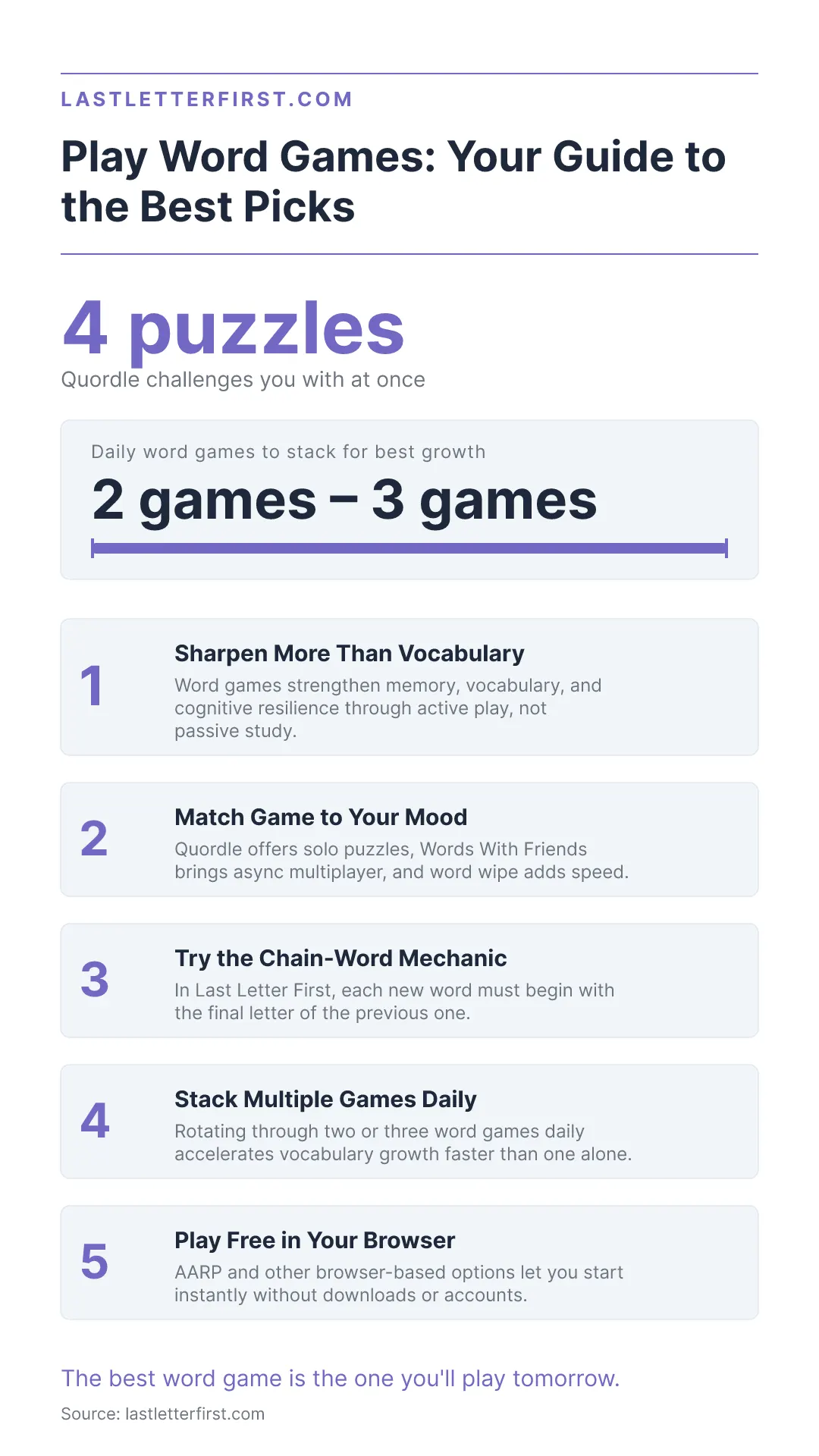
- Word games strengthen vocabulary, memory, and reasoning through active play, not passive study.
- Popular options like Quordle, Words With Friends, and Word Wipe each serve different play styles.
- The “last letter first” chain-word mechanic is an underserved category no other platform has built a dedicated experience around.
- Stacking two or three different word games daily accelerates language learning faster than playing just one.
- Free, browser-based word games make it easy to start right now without downloading anything.

Why Choosing to Play Word Games Goes Beyond Fun
When you play word games regularly, you’re not just passing time; you’re sharpening memory, expanding vocabulary, and building cognitive resilience that compounds over time. Rotating through different formats like Last Letter First accelerates this growth by forcing your brain to adapt to new rule sets. The simplest word games often deliver the deepest rewards, turning idle moments into genuine mental workouts.
Popular Word Games Everyone Loves
Not every word game scratches the same itch. The trick is matching the right game to your mood.
Quordle challenges you with four puzzles at once across nine guesses. Words With Friends brings asynchronous multiplayer to your phone, letting you trade turns across hours. Word search offers solo relaxation with no timer or opponent. Word wipe adds speed, with falling letters and a ticking clock mixing puzzle-solving with reflexes.
AARP games and AARP free games offer accessible, browser-based fun without downloads or accounts. Clean interfaces, gentle difficulty curves, everything right in your browser.
The Last Letter First Mechanic: A Unique Word Game Category
Most word games ask you to find words in a grid or guess a hidden answer. Last Letter First flips that formula entirely.
Last Letter First is the only dedicated platform built around the chain-word mechanic, where each new word must begin with the final letter of the previous one. “Tiger” ends in R, so the next word might be “rocket”. “Rocket” ends in T, so you’d follow with “table”.
Kids pick it up in seconds. Adults find the strategic depth surprisingly addictive. You can play solo or challenge friends in multiplayer mode, racing actual people instead of an algorithm.
How to Choose the Right Word Game for You
Picking the right word game comes down to two questions: who’s playing, and what do you want out of it?
|
Play Style |
Best For |
Top Pick |
|
Solo daily puzzle |
Individual skill-building |
Quordle |
|
Head-to-head |
Two players, remote |
Words With Friends |
|
Family game night |
Groups of 3+, mixed ages |
Last Letter First |
|
Party and social |
Large groups, laughs |
Imposter word game |
But here’s the paradox: games you play alone often make you better at the ones you play together. The chain-word mechanic in Last Letter First forces you to think on your feet while everyone watches. That pressure is half the fun.
Don’t pick one. Stack them. Quordle in the morning, Last Letter First with your crew in the evening.
Play Word Games to challenge your mind, improve your vocabulary, and enjoy hours of fun with friends, family, or players from around the world. Word games combine entertainment with learning by encouraging quick thinking, creative word building, and better spelling skills. Whether you enjoy casual puzzles or competitive challenges, there is always a new opportunity to test your knowledge and earn rewards.
Many modern word game apps also feature daily challenges, multiplayer matches, leaderboards, and weekly tournaments that keep the excitement going. If you’re looking for a relaxing yet mentally stimulating activity, it’s time to Play Word Games and discover how enjoyable learning new words can be.
Start Playing Word Games Today
The best word game is the one you’ll actually play tomorrow. Pick one from this guide, try it tonight, and pay attention to what happens. You’ll laugh more than you expected and learn words you didn’t know you needed.
That’s the whole point.
By Last Letter First Editorial Team | Last updated: July 2026