
Key Takeaways
- Word game tournaments are structured competitive events with brackets, scoring systems, and clear rules that transform casual play into head-to-head matchups.
- In 2026, competitive word gaming is growing fast thanks to mobile apps that make organized play accessible to anyone with a phone.
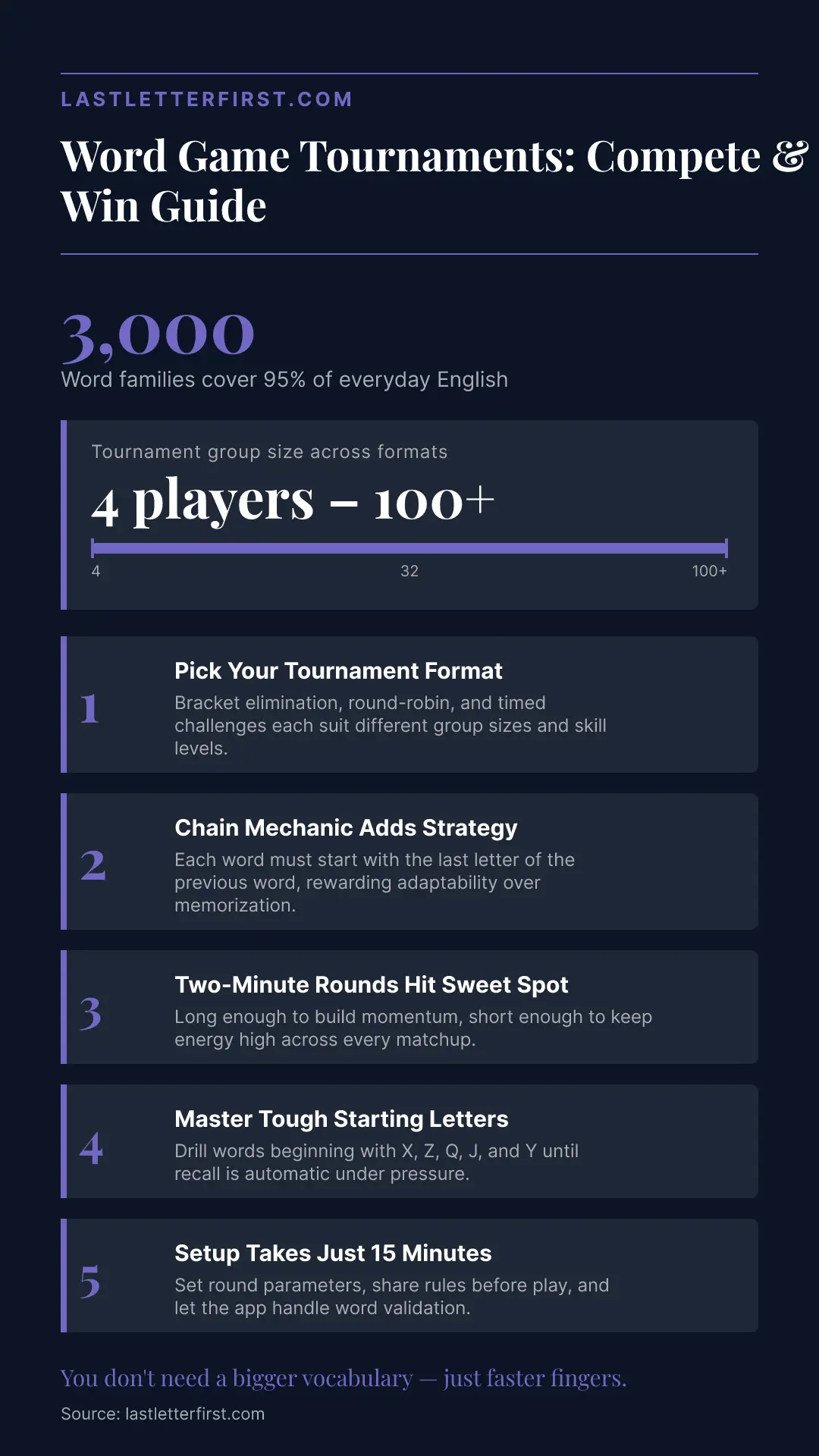
- The three most common formats are bracket elimination, round-robin, and timed challenges, each suited to different group sizes.
- Last Letter First’s chain mechanic, where each word must start with the last letter of the previous word, creates uniquely strategic rounds rewarding quick thinking over memorization.
- You don’t need to be a vocabulary genius. Tournament success depends more on speed, strategy, and pattern recognition than on knowing obscure words.

Word game tournaments aren’t just for Scrabble veterans who’ve memorized every two-letter word in the official dictionary. Structured competitive word gaming has never been more accessible than it is in 2026. And you don’t need formal training to jump in.
If you’ve played a round of multiplayer word games that improve family vocabulary at the dinner table and felt that spark of rivalry, you already have what it takes. The gap between casual player and tournament competitor is really just a question of structure.
What Are Word Game Tournaments?
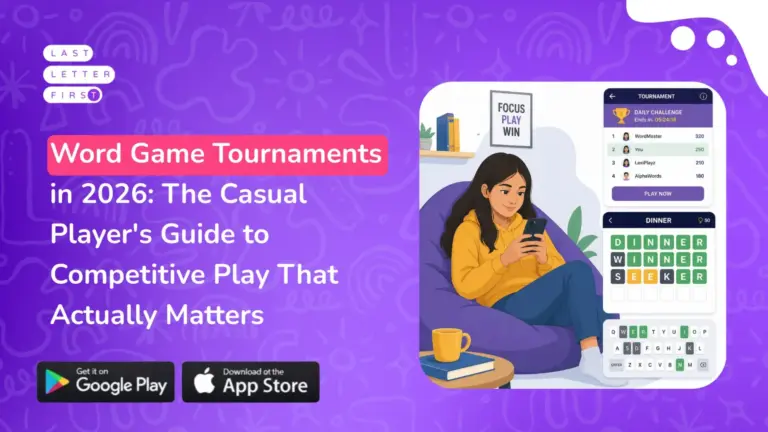
Word game tournaments thrive when structure meets creativity , and apps like Last Letter First prove it. The chain mechanic, where each word must start with the last letter of the previous one, adds strategic depth purpose-built for competitive play. Whether you’re hosting a casual bracket or joining a large-scale online event at lastletterfirst.com, the format rewards risk-takers who dig deeper under pressure.
Popular Tournament Formats for Word Games
Three tournament formats dominate competitive word gaming, and each creates a completely different experience. Bracket elimination is the most dramatic. Round-robin is the most fair. Timed challenges are the most chaotic.
Bracket elimination works like March Madness. Players are seeded, paired, and the loser goes home. It’s fast, unforgiving, and creates genuine tension. For Last Letter First, single-elimination brackets can run a 16-player tournament in under an hour.
Round-robin gives every player a matchup against every other player. Points accumulate, and the strongest overall record wins.
Timed challenges throw everyone into the same pool simultaneously. Highest score when time expires takes the crown. This format scales beautifully for large groups.
|
Format |
Best Group Size |
Time Required |
Skill Bias |
Drama Level |
|
Bracket elimination |
8-32 players |
45-90 min |
High |
Very high |
|
Round-robin |
4-12 players |
60-120 min |
Moderate |
Moderate |
|
Timed challenge |
10-100+ players |
15-30 min |
Low |
Moderate |
|
Swiss system |
16-64 players |
90-150 min |
High |
High |
Round-robin formats work best for casual gatherings because every player gets equal matchups regardless of skill level. For groups with a wide skill gap, timed challenges level the playing field. A beginner might not beat an expert head-to-head, but they can still post a respectable score against the clock.
How to Run a Last Letter First Tournament
Running a Last Letter First tournament takes about 15 minutes of setup and zero prior organizing experience. The chain mechanic creates a natural competitive structure that practically runs itself. Every round is a strategic sprint where players think two moves ahead.
For groups under 12, round-robin keeps everyone engaged. For larger groups, bracket elimination with seeding based on a qualifying timed round works brilliantly. Set your round parameters (time limits, minimum word length, proper noun rules) and communicate them before the first matchup. Ambiguity breeds arguments, and arguments kill momentum.
You can’t just memorize a word list and coast. You’re reacting in real time to whatever letter your opponent leaves you, which rewards adaptability over raw vocabulary size. That’s exactly why beginners can compete from day one.
Two-minute rounds are the sweet spot: long enough to build momentum, short enough to keep energy high. For scoring, point accumulation (points per valid word, bonuses for length) feels fairer for mixed-skill groups, while elimination scoring cranks up intensity. Let the app handle word validation. No debates, no hard feelings.
Prepare a simple bracket or standings sheet. A shared Google Sheet works for virtual tournaments. For in-person events, a whiteboard with bracket lines adds a satisfying visual element players love.
Tips to Win Your Next Word Game Tournament
Winning a word game tournament isn’t about memorizing the dictionary. It’s about recalling the right word at the right moment, under pressure, faster than your opponent. That distinction is worth its weight in gold.
Here’s the paradox: players who practice the most casually often struggle the most competitively. Casual play builds comfort. Tournament play demands discomfort. You need to train under conditions that mirror real competition.
Start with letter patterns. Common endings like “-tion,” “-ness,” and “-ment” give you reliable options when you’re stuck. According to Oxford University Press research on English word frequency, just 3,000 word families cover roughly 95% of everyday English text. You don’t need obscure words. You need fast access to common ones.
Build a “pressure vocabulary.” Pick 20 difficult starting letters (X, Z, Q, J, Y) and drill words that begin with them until they’re automatic.
Practice daily. Even 10 minutes of Last Letter First during your commute builds the lateral thinking tournaments reward. The chain mechanic keeps pushing you into unfamiliar territory. Challenge friends to keep sessions competitive, because head-to-head play builds the mental toughness that separates casual players from contenders.
Track your progress. Note which starting letters trip you up. Improvement you can’t measure is improvement you can’t replicate. Exploring how multiplayer word games improve family vocabulary can also give you fresh strategies for building recall speed.
From Casual Gamer to Tournament Competitor
Every tournament competitor started as a casual player. The North American Scrabble Players Association reports that most new tournament entrants come directly from casual app play, not academic word study. The myth that you need to be “good enough” before entering? Completely false. Tournaments have skill divisions for a reason.
Shift your mindset. Casual play is about fun. Competitive play is about fun and growth.
Find your community. Discord servers and Reddit communities dedicated to competitive word gaming are solid starting points. If you can’t find a tournament, start one.
Pick the right game. Last Letter First’s chain mechanic creates naturally tense, quick matchups that work beautifully in both elimination and round-robin brackets. Explore the full platform at Last Letter First.
Commit to a timeline. Give yourself 30 days of daily practice before your first event. That’s enough to hit the ground running.
Honestly, the hardest part isn’t skill. It’s showing up.
Your First Tournament Is Closer Than You Think
Word game tournaments aren’t reserved for elite players with encyclopedic vocabularies. They’re for anyone who loves words, enjoys competitive pressure, and wants to connect with people who share that energy.
The competitive word gaming scene in 2026 is growing, fueled by remote play, accessible apps, and communities hungry for structured fun. Pick a format, gather your people, and play.
If you’re looking for the fastest path from casual rounds to real competition, Last Letter First’s learning hub has the resources to get you tournament-ready.