

Key Takeaways for How to Win in Words with Friends
- Winning Words with Friends is less about knowing obscure words and more about controlling premium squares and managing your rack.
- Your opening move sets the tone for the entire game, and placing it wrong hands your opponent free access to triple-word squares.
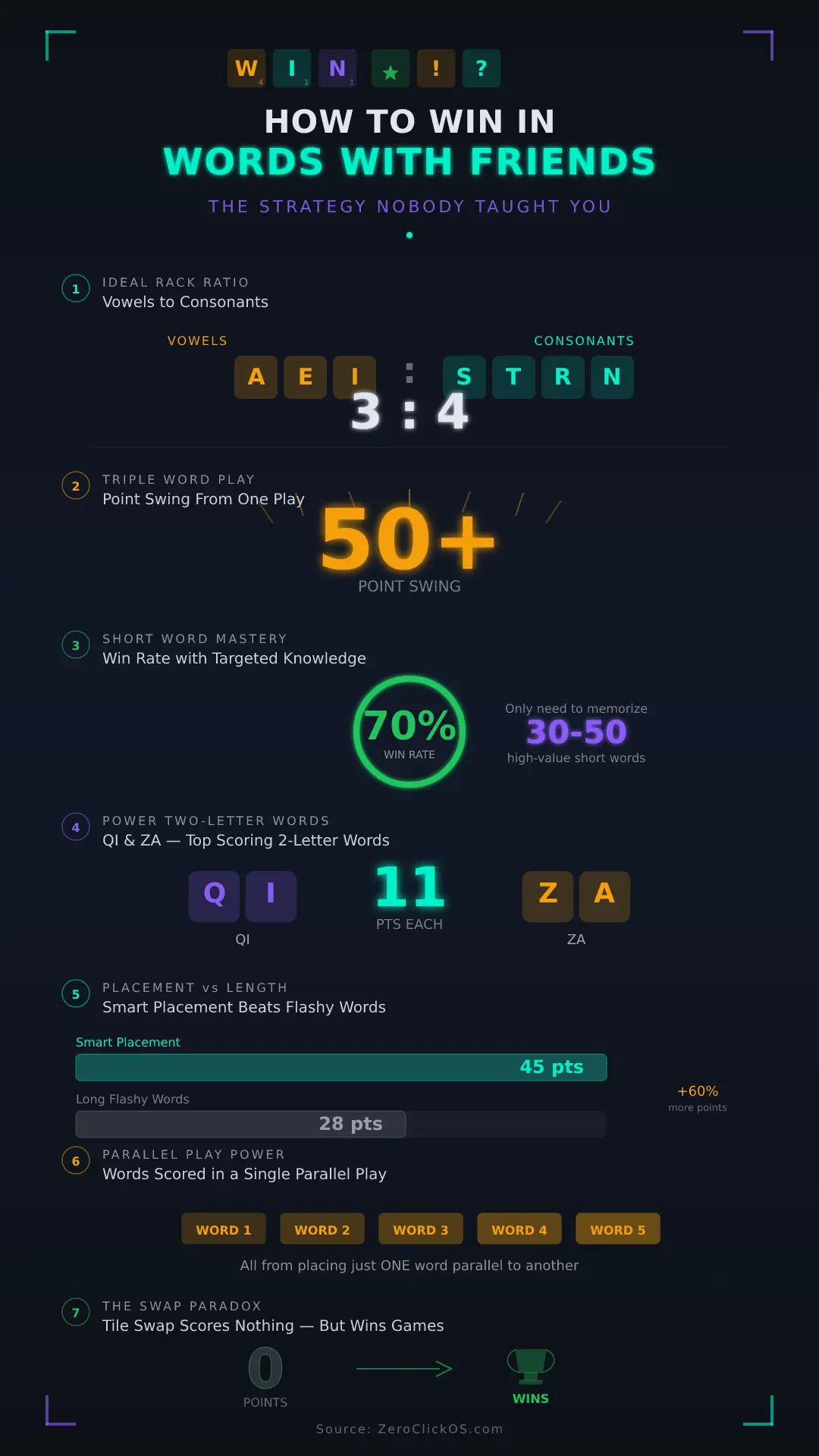
- A balanced rack with roughly three vowels and four consonants gives you playable options on almost every turn.
- Swapping tiles when your rack is unplayable isn’t giving up a turn, it’s investing in a better one.
- Board control and defensive tile placement beat a massive vocabulary in competitive play nearly every time.

So you just lost your fifth game in a row, and the person who beat you played words you’ve never heard of. But your opponent probably isn’t smarter than you. They’re playing a completely different game. While you hunt for the longest word, they’re locking down premium squares and keeping you boxed in.
That’s the paradox of Words with Friends. The player chasing the biggest word usually loses to the player making the smartest placement. If you’ve been treating this like a vocabulary contest, you’ve been playing it wrong. And honestly, that’s good news, because learning new words through word games is only half the equation. The other half is pure positional strategy.
How to Win in Words With Friends by Thinking Strategically
Learning how to win in Words with Friends starts with one shift in mindset: treat the board as territory, not a spelling bee. The strongest players prioritize board control over flashy word length, dropping a three-letter word on a triple-word square for 45 points instead of burning premium tiles on a seven-letter play worth 28. Tools like Last Letter First can sharpen your vocabulary instincts, but strategic tile placement is what separates consistent winners from lucky ones.
Master Premium Squares and Board Control
Premium squares are where games are won and lost. A single triple-word square play can swing a game by 50+ points, often the margin between victory and defeat. Controlling access to these squares is the core of any serious words with friends strategy.
Double-letter squares are minor. Double-word squares matter. Triple-word squares are everything. Your job on every turn: land on premium squares when you can, block your opponent from reaching them when you can’t.
Keep play tight and clustered near the center early. Every word stretching toward the edges opens a path to triple-word squares along the perimeter. A word cheat tool might find a high-scoring word, but it won’t teach you where to place it. Placement separates players who win occasionally from players who win consistently across multiplayer word games.
Lock the board down when you’re ahead. Play short words in crowded areas. But when you’re behind? Crack it open. Place a word that creates access to a triple-word square you can hit next turn. It’s a calculated risk, and it’s how comebacks happen.
Rack Management and Tile Swap Strategy
Your rack is your arsenal, and a messy arsenal loses fights. Keep a balanced ratio of vowels to consonants at roughly 3:4. When your rack drifts from that balance, playable options shrink fast. Five consonants and two vowels? You’re stuck.
Here’s the second paradox casual players struggle with: sometimes the smartest move scores zero points. Swap when you’re holding duplicate vowels, tough consonants like Q without a U, or a V with no setup. Keep your best consonants (S, R, T, N, L) and trade the dead weight. You’ll lose one turn but gain two or three stronger ones.
Parallel Plays and Hook Words Explained
Parallel plays are the single highest-value move most casual players never learn. You lay a word directly beside an existing word so every adjacent tile forms a valid two-letter combination, scoring across multiple rows simultaneously.
Picture RATE on the board. Place LION directly below it. If each vertical pair forms a valid two-letter word, you score for LION plus every two-letter combo. That’s four or five words in a single turn. This is why two-letter words matter. Memorize QI, ZA, JO, XI, and XU. Here’s the paradox: the smallest words often produce the biggest scores.
A hook word adds a single letter to an existing word to create a new one. Opponent plays LOCK? Drop a B for BLOCK. Hooks let you reach premium squares without opening new lanes. The best hook plays hit the nail on the head: they score well, block your opponent, and keep the board tight.
Build Your Word Arsenal for Consistent Wins
You don’t need a massive vocabulary. You need a targeted one. The difference between a casual player and someone who wins 70% of their games often comes down to knowing 30 to 50 high-value short words cold.
Here is the information neatly formatted as a table for you:
|
Word |
Points |
Why It Matters |
|
QI |
11 |
Highest-scoring two-letter word; no U needed |
|
ZA |
11 |
Flexible Z placement on tight boards |
|
JO |
9 |
Opens J plays without needing long words |
|
XI |
9 |
X flexibility for parallel setups |
|
XU |
9 |
Pairs well with vowel-heavy racks |
Layer in three-letter words that deploy J, X, and Z: JOE, ZAP, AXE, ZIT, JAB. If you miss the boat on learning these early, you’ll keep losing to opponents who already have them memorized. Explore Last Letter First’s vocabulary guide, the official Words with Friends support page, or the Last Letter First FAQ for more.
Your Next Move Starts Before the Board Does
Winning more games isn’t about downloading a bigger dictionary. It’s about seeing the board differently. Pick one strategy from this guide, use it for your next five games, then add another.