

Key Focus for Know Longest Word in English
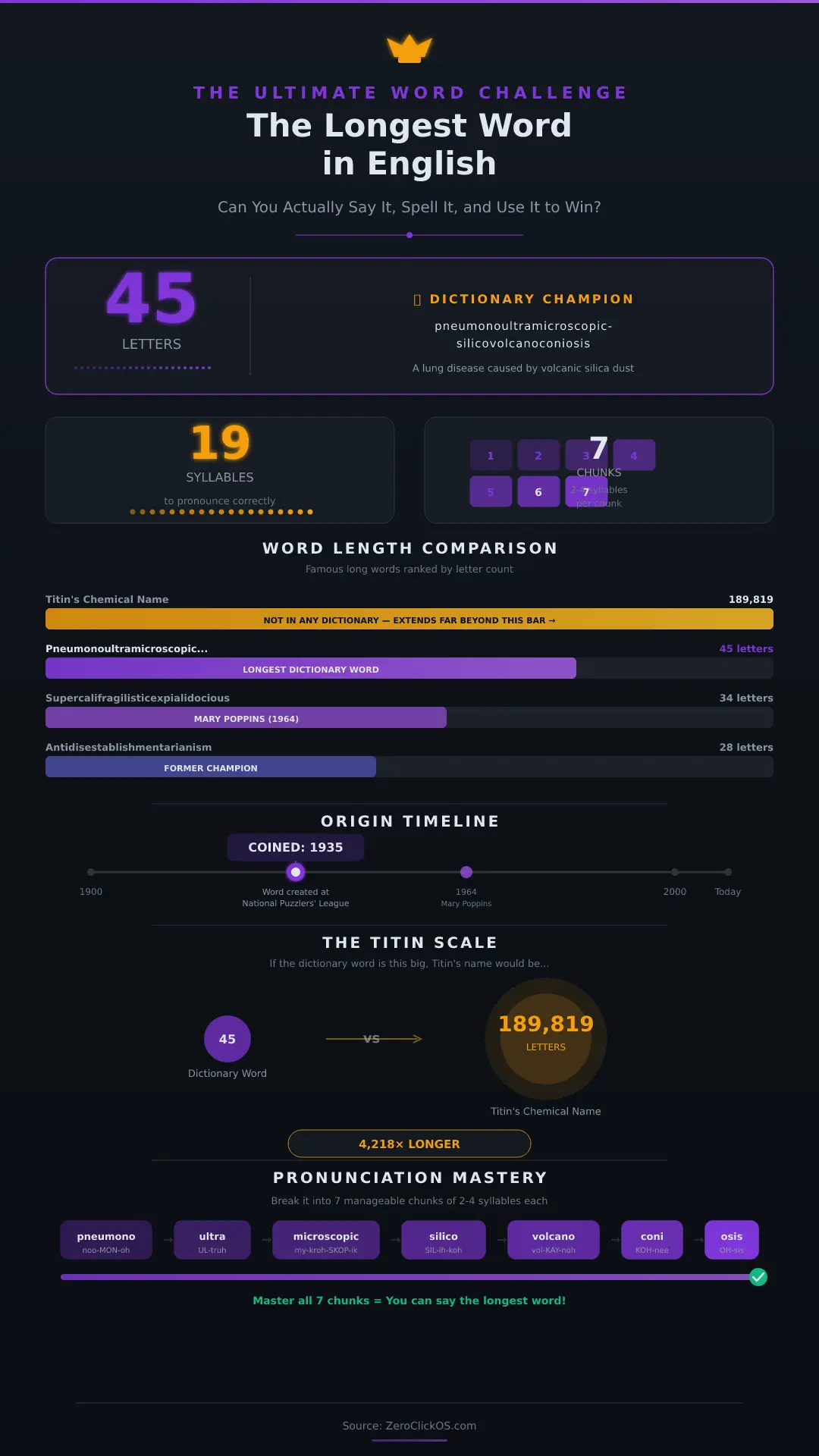
- Pneumonoultramicroscopicsilicovolcanoconiosis is the longest word in a major English dictionary, spanning 45 letters and 19 syllables.
- A word’s legitimacy depends on dictionary inclusion, not sheer length, which is why titin’s 189,819-letter chemical name doesn’t count.
- Breaking lengthy words into syllable chunks of two to four makes pronunciation surprisingly manageable.
- Long words aren’t just trivia. Their roots create real strategic advantages in vocabulary-building word games.

What Is the Longest Word in English?
The longest word in English found in a major dictionary is pneumonoultramicroscopicsilicovolcanoconiosis , a 45-letter term for a lung disease caused by inhaling fine silica dust. Coined in 1935 as a deliberate stunt, it was nonetheless adopted into legitimate medical and lexicographic use. For word lovers at Last Letter First, it’s the ultimate chain-ending challenge: good luck finding a word that starts with S and tops that.
Other Famously Long Words Worth Knowing
Beyond the 45-letter champion, English has a strong roster of long words people have argued about, sung about, and dropped into conversations to learn new vocabulary.
Antidisestablishmentarianism (28 letters) held the “longest word” crown for decades. It refers to opposition to withdrawing state support from an established church, rooted in Victorian-era debates. Its length is a byproduct of English’s love for stacking prefixes and suffixes.
Supercalifragilisticexpialidocious (34 letters) is pop culture’s favorite, thanks to the 1964 Disney film Mary Poppins. The Sherman Brothers built it from pseudo-Latin fragments to sound impressive while meaning almost nothing. And yet it stuck.
How to Pronounce the Longest Words Syllable by Syllable
Breaking any long word into groups of two to four syllables turns an impossible spelling challenge into a manageable rhythm exercise. Nobody reads 45 letters cold. You chunk them.
|
Chunk |
Syllables |
Sounds Like |
|
Pneumono |
new-MOH-no |
“Pneumonia” without the “ia” |
|
ultra |
UL-truh |
Same as “ultraviolet” |
|
micro |
MY-kro |
Same as “microscope” |
|
scopic |
SKOP-ik |
End of “microscopic” |
|
silico |
SIL-ih-ko |
“Silicon” with an “oh” |
|
volcano |
vol-KAY-no |
Exactly like the mountain |
|
coniosis |
koh-nee-OH-sis |
Rhymes with “diagnosis” |
Full pronunciation: new-MOH-no-UL-truh-MY-kro-SKOP-ik-SIL-ih-ko-vol-KAY-no-koh-nee-OH-sis. That’s 19 syllables, but none are hard alone. Try it three times. By the third attempt, the rhythm locks in.
Using Long Words as a Word Game Strategy
Knowing the longest word in English isn’t just a party trick. It’s a legitimate competitive advantage in games rewarding vocabulary depth.
The cheapest-looking strategy is actually the most expensive to ignore: memorizing massive words you’ll rarely use in conversation makes you better at finding common words faster. Long words train your brain to spot smaller words hiding inside them. “Pneumonoultramicroscopicsilicovolcanoconiosis” contains fragments like “micro,” “scope,” “volcano,” and “icon.” Each fragment becomes ammunition in fast-paced word games.
In chain-style games like Last Letter First, first and last letters determine your next move. “Antidisestablishmentarianism” ends in M, opening dozens of follow-ups. But it starts with A, one of the easiest letters to counter. Missing the boat on that calculation costs you the turn.
|
Strategy Element |
Casual Player |
Strategic Player |
|
Word selection |
First word that comes to mind |
Chooses words ending in difficult letters |
|
Letter awareness |
Focuses on meaning |
Focuses on first and last letter pairings |
|
Long word use |
Avoids them |
Deploys them to force tough starting letters |
|
Vocabulary building |
Random exposure |
Deliberate study of uncommon endings |
Players who memorise uncommon endings, like words ending in X or J, can corner opponents into positions with no viable response. You aren’t collecting trivia. You’re building a strategic toolkit. Playing multiplayer word games with family is one of the fastest ways to pressure-test these strategies.
Keep Exploring: Build Your Vocabulary Beyond Trivia
The longest words in English aren’t curiosities in dusty dictionaries. They’re tools for sharpening pattern recognition and building strategic depth in word games.
So the question isn’t whether you can pronounce pneumonoultramicroscopicsilicovolcanoconiosis. It’s whether you can use what you’ve learned here the next time you play.
The Last Letter First Editorial Team covers word games, vocabulary strategy, and language learning. Explore more at lastletterfirst.com/learning-hub.