

Key Takeaways
- Family word games are structured language activities designed for two or more players across multiple age groups, building vocabulary and social connection simultaneously.
- Multiplayer word games create shared moments that solo puzzles simply can’t replicate, turning passive screen time into active, laughing-together time.
- The right word game depends on age: kids ages 5 to 8 thrive with simple spoken rounds and picture clues, while teens, adults, and grandparents prefer strategic board games and fast-paced verbal challenges.
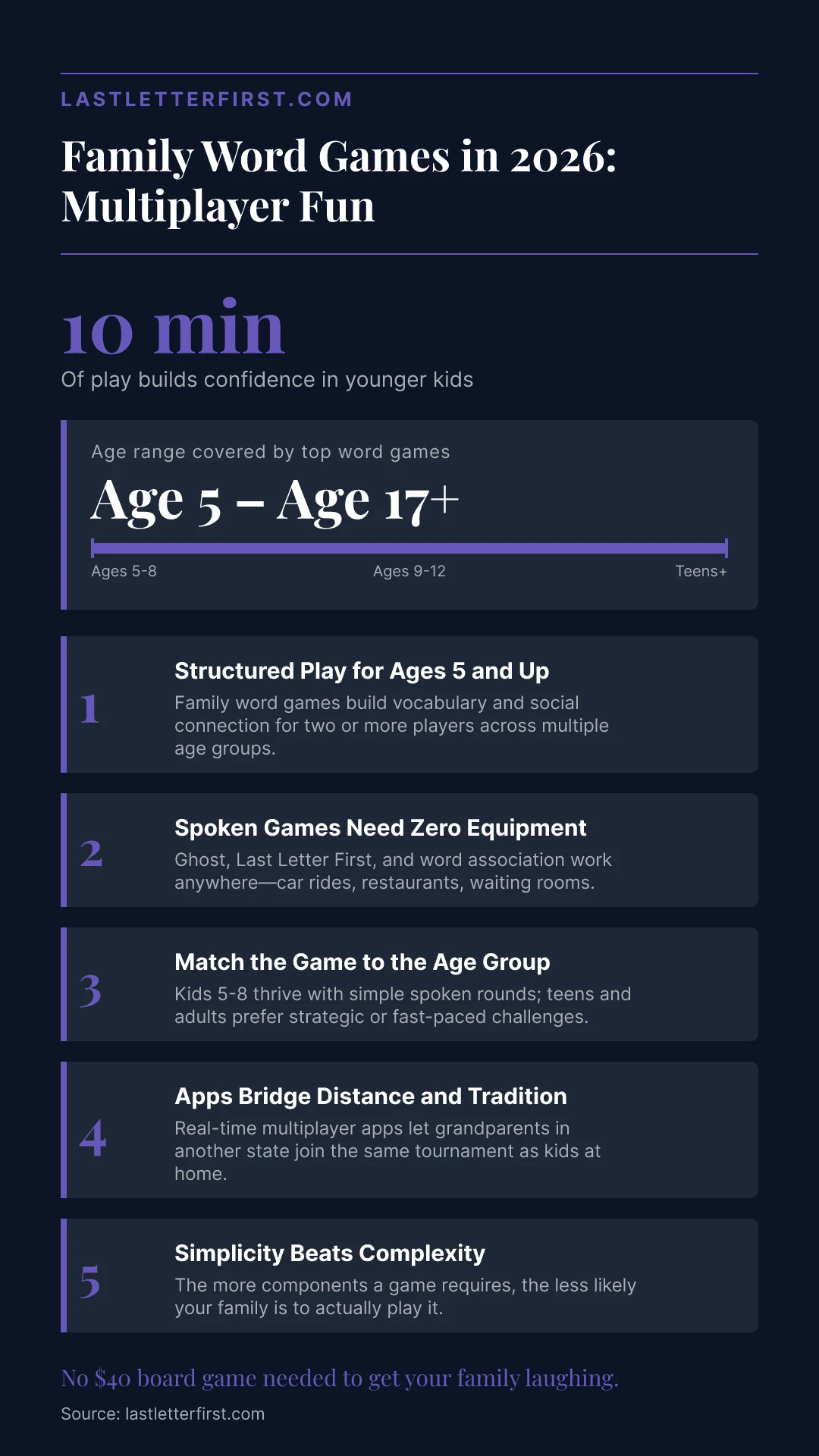
- Spoken word games like Ghost, Last Letter First, and word association require zero equipment and work anywhere, from car rides to restaurant waits.
- In 2026, apps like Last Letter First bridge classic verbal traditions and modern mobile play, offering real-time multiplayer tournaments the whole family can join.

What Are Family Word Games and Why They Matter
Family word games like Last Letter First turn idle moments , car rides, dinner tables, waiting rooms , into shared vocabulary-building experiences that solo puzzles simply can’t replicate. With adjustable difficulty for ages five and up and no equipment required for verbal rounds, they give every family member a reason to engage. Even ten minutes of play builds confidence in younger kids while keeping adults genuinely challenged.
Best Family Word Games by Age Group
The right word game depends on age: kids ages 5 to 8 thrive with simple spoken rounds and picture clues, while teens, adults, and grandparents prefer strategic board games and fast-paced verbal challenges. Getting this match wrong is the fastest way to kill game night before it starts.
| Game | Ages 5-8 | Ages 9-12 | Teens (13-17) | Adults & Grandparents | Equipment Needed |
|---|---|---|---|---|---|
| Last Letter First (app) | ✅ | ✅ | ✅ | ✅ | Phone (free app) |
| Last Letter First (verbal) | ✅ | ✅ | ✅ | ✅ | None |
| Ghost | ❌ | ✅ | ✅ | ✅ | None |
| Word Association | ✅ | ✅ | ✅ | ✅ | None |
| Scrabble | ❌ | ✅ (with help) | ✅ | ✅ | Board game |
| Bananagrams | ❌ | ✅ | ✅ | ✅ | Tile set |
| Boggle | ❌ | ✅ | ✅ | ✅ | Board game |
| 20 Questions | ✅ | ✅ | ✅ | ✅ | None |
Games that work across every age group tend to be spoken, equipment-free, and multiplayer. That’s not a coincidence.
Word Games for Young Kids (Ages 5 to 8)
Young kids need short rounds, clear rules, and the thrill of shouting an answer first. Word association is an easy starting point: one person says “dog,” the next says “bone,” the next says “skeleton.” No winners, no losers, just a chain that often goes hilariously sideways. Rhyme battles work similarly: pick a word, go around the circle, whoever can’t find a rhyme sits out.
For more structure, the Last Letter First app offers adjustable difficulty and real-time multiplayer that keeps younger players engaged without feeling like homework.
Word Games for Teens, Adults, and Grandparents
Older players want stakes. They want strategy.
Board games like Scrabble and Bananagrams deliver depth, but they require setup time and a flat surface, ruling them out for car rides and holiday gatherings. Ghost rewards deep vocabulary and bluffing in equal measure. Merriam-Webster’s free online word games appeal to mixed-age groups where grandparents and teens can compete without anyone feeling patronized.
Frankly, the best multigenerational word games are the ones where nobody has to explain the rules for more than 30 seconds. If the explanation takes longer than the first round, you’ve already lost half the table.
Spoken Word Games You Can Play Without Any Materials
Spoken word games like Ghost, Last Letter First, and word association require zero equipment and work anywhere, from car rides to restaurant waits. No setup, no cleanup, no lost pieces found under the couch three weeks later.
How Ghost and Other Spoken Letter Games Work
Ghost challenges players to add letters without completing a word. Each player adds one letter to a growing string, and finishing a word earns you a letter (G-H-O-S-T). Five strikes and you’re out. Here’s the catch: you must have a real word in mind. If someone challenges you and you can’t name one, you lose the round. It’s equal parts vocabulary test and poker game.
Similar games include Shiritori, a Japanese word game where each word begins with the last syllable of the previous one, and category chains, where players name items within a category starting with the last letter of the previous answer.
Group-Friendly Verbal Word Games
For larger groups, 20 Questions works beautifully because everyone guesses simultaneously. Word chains keep the pace moving: each person has five seconds to say a word starting with the last letter of the previous word, and hesitation means you’re out.
Rhyme battles are worth their weight in gold at holiday gatherings. One Word Story is gaining traction too: each player contributes exactly one word to build a story collaboratively, and the results are almost always absurd. More spoken game ideas appear on the Last Letter First blog.
The uncomfortable truth about verbal word games is that the simplest ones often produce the most memorable moments. You don’t need a $40 board game to get your family laughing together.
Word Board Games and Digital Options Beyond Scrabble
Scrabble dominated family word nights for decades, but it isn’t the only option. If your family has ever abandoned a Scrabble session because someone got stuck with a rack of vowels, you already know the problem.
Bananagrams strips away the board entirely. Players race to build crossword grids from a shared tile pool, and rounds move fast enough for younger kids. Boggle works well for smaller groups since everyone searches the same letter grid simultaneously. Codenames takes a different approach: it’s about word association and clue-giving, so players who struggle with spelling still contribute.
For families who can’t always be in the same room, the Last Letter First app lets members compete in real-time from separate devices. Grandparents in another state can jump into the same tournament as the kids in your living room.
| Game | Players | Age Range | Setup Time | Best Setting |
|---|---|---|---|---|
| Bananagrams | 2-8 | 7+ | Under 1 min | Kitchen table, holidays |
| Boggle | 2-6 | 8+ | Under 1 min | Couples, small groups |
| Codenames | 4-8 | 10+ | 2-3 min | Parties, game nights |
| Scrabble | 2-4 | 10+ | 5+ min | Patient, competitive families |
| Last Letter First (app) | 2+ | 5+ | Instant | Anywhere, any distance |
Here’s the paradox with word board games: the more components a game requires, the less likely your family is to actually play it. Simplicity wins.
How to Choose the Right Word Game for Your Family
Picking the right family word games comes down to knowing your group. Ask three questions:
- How much setup can you tolerate? If “basically none,” spoken games and apps like Last Letter First beat anything with tiles or cards.
- How many players show up? Boggle caps at six. Last Letter First scales to larger groups with built-in tournament brackets.
- Competitive or cooperative? Word association leans cooperative. Elimination games like Ghost lean competitive.
So don’t overthink it. The best word games are the ones your family actually plays more than once. You can download Last Letter First and test a few rounds before dinner tonight.
Frequently Asked Questions
What are good word games beyond Scrabble for families?
Bananagrams, Codenames, Boggle, and Last Letter First are all solid alternatives. Bananagrams works best for quick, competitive rounds. Codenames suits families who prefer team-based clue-giving over individual spelling. Last Letter First stands out for real-time multiplayer across devices, so families don’t need to be in the same room. Each removes one of Scrabble’s common friction points: long waits, complex scoring, or requiring everyone physically present.
What verbal word games need no materials?
Ghost, word chains, 20 Questions, and Last Letter First are top picks. Ghost has players add one letter at a time, avoiding completing a word. Word chains require each player to say a word starting with the last letter of the previous one. These games work in cars, waiting rooms, and around the dinner table with zero prep.
How does Ghost work?
In Ghost, players take turns adding a single letter to a growing string, avoiding being the person who completes a real word. Finishing a word of four or more letters earns a letter toward G-H-O-S-T, and five strikes means elimination. Similar games include Superghost, where players add letters to either end, and Shiritori, a Japanese word chain game. All three require nothing but players and a decent vocabulary.
What spoken word games work for large groups?
Word association, category games, rhyme battles, and Last Letter First all work for four or more players. Word association keeps things moving because there’s no wrong answer, just slow ones. Rhyme battles bring out the competitive side and usually generate the biggest laughs. Last Letter First’s tournament mode handles bigger groups by organizing players into brackets.
Are solo word games like Wordle good for families?
Wordle builds individual vocabulary and pattern recognition, which is genuinely valuable. But it doesn’t create shared memories, inside jokes, or the kind of “remember when Grandma guessed THAT word” stories families retell for years. You can’t trash talk a browser tab. Use Wordle for your morning brain warmup. Save multiplayer for the moments that matter.
What word games work for 5-year-olds?
Simple rhyming games, I Spy with letters, and picture-word matching work best. Rules need to be short enough to explain in one sentence, and rounds should last under two minutes. “I Spy something that starts with B” is a solid go-to for car rides. The Last Letter First app works for younger players when paired with an older sibling or parent who can help with spelling.
Can word games help kids build vocabulary?
Yes. A 2019 study published by the American Academy of Pediatrics found children who engage in regular verbal play show stronger language retention than those learning through rote memorization alone. Kids learn words faster when they hear them used by siblings, parents, or grandparents in a competitive context. Spoken word games are especially effective because children must retrieve words under time pressure, strengthening recall pathways.
What is Last Letter First and how do you play it?
Last Letter First is a multiplayer word game where each new word must start with the last letter of the previous word. If someone says “elephant,” the next player needs a word starting with “t,” like “tiger.” The rules take ten seconds to explain, making it accessible for players as young as five. The Last Letter First app adds real-time multiplayer, built-in tournaments, and cross-device play so families don’t need to be in the same room.
—
What are good spoken word games to play with groups of people?
Word association, category games, rhyme battles, and Last Letter First all work well for groups of four or more, as they keep multiple players engaged simultaneously. Larger groups benefit especially from elimination-style rounds, where players are progressively removed for incorrect answers or rule violations, maintaining momentum and ensuring everyone stays invested until a winner emerges.
How does the game Ghost work and what similar spoken letter games exist?
In Ghost, players take turns adding a single letter to build toward a word, with the goal of avoiding completing a real word—whoever finishes a valid word is eliminated. Similar spoken letter games include Superghost, where players can add letters to either end of the growing sequence, and Shiritori, a Japanese game where each new word must start with the last letter of the previous word.
Your Family’s Next Game Night Starts With One Word
Pick a game. Say the first word. Whether you start with Ghost on your next road trip, pull out Bananagrams at Thanksgiving, or fire up Last Letter First while Grandma plays from three states away, words bring people together in ways screens alone can’t.
You might be surprised how quickly “just one round” turns into an hour of laughing, arguing over whether “qi” counts, and discovering your eight-year-old knows words you’ve never heard. Start playing.