
Key Takeaways
- Word games are strategy contests disguised as vocabulary exercises, and in 2026 they range from classic board games like Boggle and Scrabble to fast-paced multiplayer formats like Last Letter First that you can play with any group size, anywhere.
- Every word game covered here can be learned in under two minutes, and none of them require a large vocabulary to start playing.
- Multiplayer word games boost family language skills by turning vocabulary practice into a competitive, social experience that kids and adults enjoy equally.
- The best word game for your group depends on three factors: player count, energy level, and whether you’re playing online or face-to-face.
- Last Letter First is the only word game platform in 2026 offering live tournaments, combining casual play with real competitive stakes.
Understanding How to Play Word Games and Why They Matter
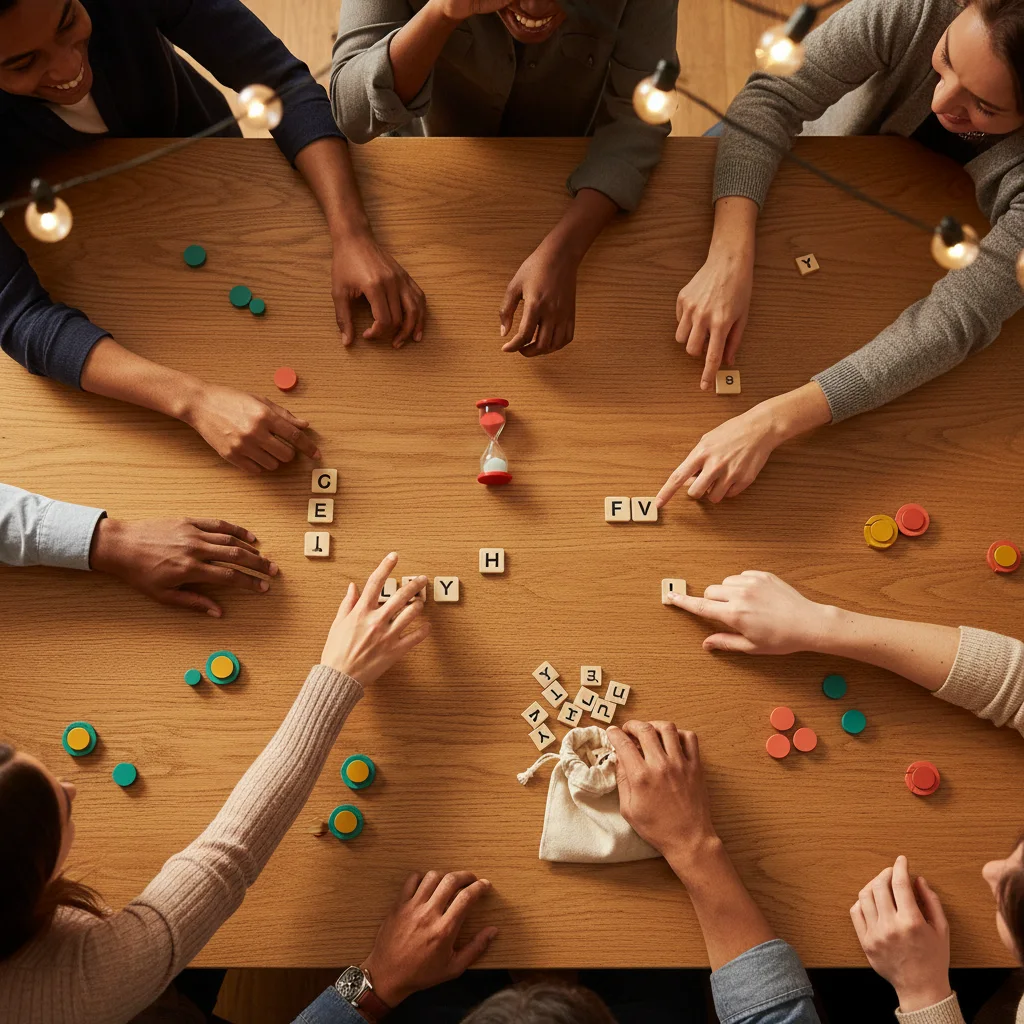
Learning how to play word games starts with picking the right format for the moment , solo puzzles like Wordle for sharpening pattern recognition, or multiplayer games like Last Letter First for real-time interaction and friendly rivalry. The simplest word games often demand the sharpest thinking: pattern recognition, mental speed, and the ability to anticipate your opponent’s next move. At lastletterfirst.com, players of any age can jump into competitive wordplay that turns vocabulary into strategy.
Step-by-Step Rules for Popular Word Games
Every game below can be taught in under two minutes. One of the biggest reasons people avoid word games is assuming rules are complicated or that you need a massive vocabulary. Neither is true. These games reward quick thinking and clever strategy far more than knowing obscure seven-letter words.
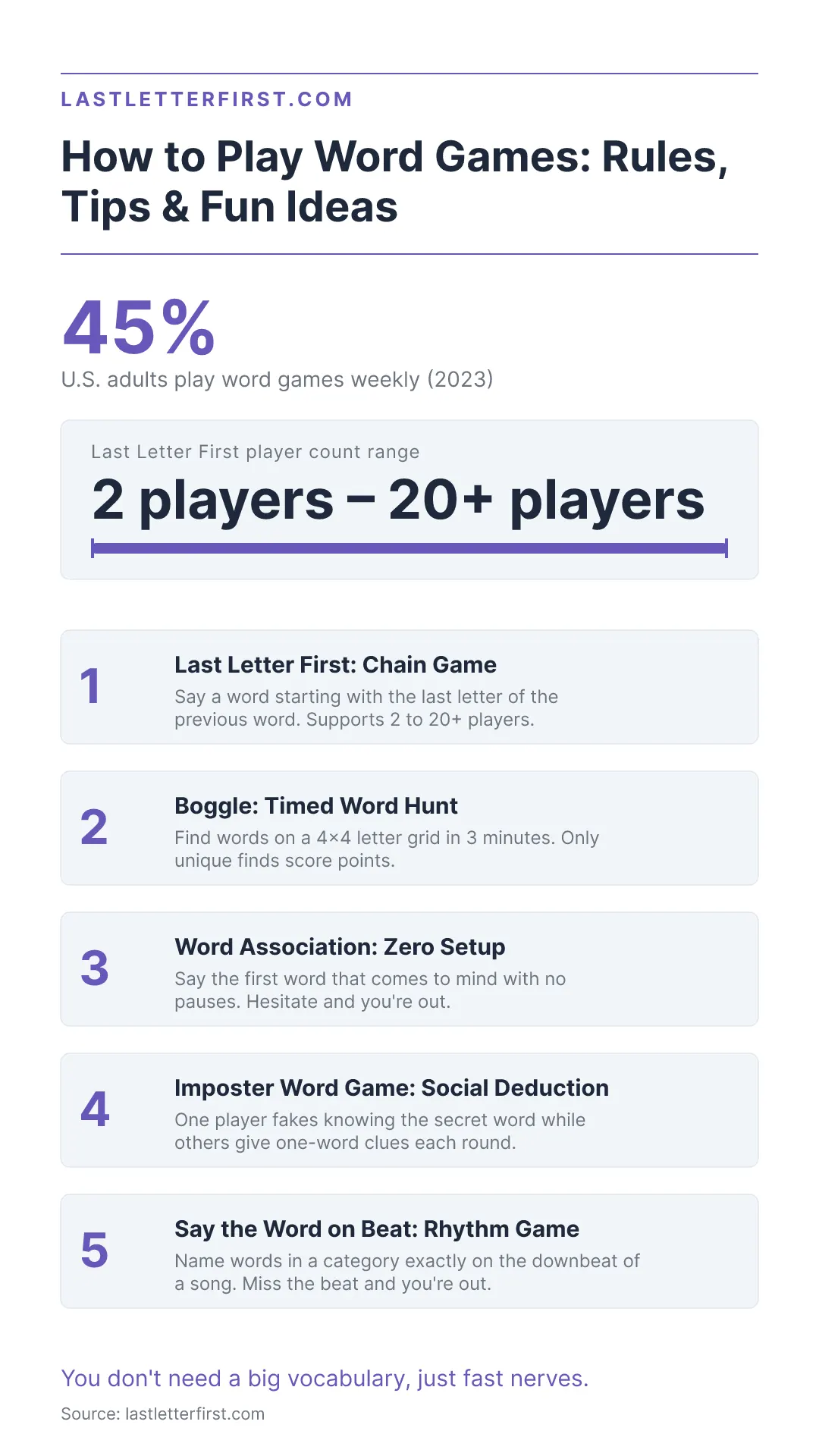
How to Play Last Letter First, Boggle, and Word Association
Last Letter First
Last Letter First requires each player to say a word that begins with the final letter of the previous player’s word, and hesitating too long or repeating a word already used means elimination.
- Players: 2 or more (best with 4 to 8).
- Setup: No equipment needed. Players sit in a circle. Choose a starting player.
- How to play: The first player says any word. The next player must say a word starting with the last letter. If Player 1 says “tiger,” Player 2 needs a word starting with “R,” like “rainbow.”
- Losing a round: You’re out if you hesitate beyond the time limit (usually 5 seconds), repeat a word, or use the wrong starting letter.
- How to win: Last player standing wins.
No boards, no dice, no downloads for the basic version. And if you want structured competition, you can play Last Letter First online with live tournaments that add brackets and real-time scoring.
Boggle
- Players: 2 to 4.
- Setup: Shake the 16-dice grid and set the 3-minute timer.
- How to play: Each player privately writes down every word found by connecting adjacent letters. Each die used once per word.
- Scoring: 3-4 letters = 1 point, 5 = 2, 6 = 3, 7 = 5, 8+ = 11. Words found by multiple players get crossed off for everyone.
- How to win: Highest score after the agreed number of rounds.
Word Association Game
- Players: 2 or more.
- Setup: None.
- How to play: The first player says a word. The next immediately says the first connected word that comes to mind. “Ocean” leads to “wave,” then “surfboard,” then “California.”
- Losing a round: You’re out if you pause too long, repeat a word, or say something with no logical connection (group votes on disputes).
- How to win: Last player remaining.
Pure mental agility. The fastest word game to teach and the hardest to master at speed.
How to Play Imposter Word Game and Say the Word on Beat
Imposter Word Game
- Players: 4 or more (best with 6 to 10).
- Setup: One host picks a secret word and whispers it to all players except the “imposter.”
- How to play: Players take turns giving one-word clues related to the secret word. The imposter bluffs. After set rounds, everyone votes on who the imposter is.
- The imposter’s goal: Avoid detection and, if caught, guess the secret word to steal the win.
Say the Word on Beat
- Players: 2 or more.
- Setup: Play a song with a steady beat. Pick a category (animals, foods, countries).
- How to play: Players say a word from the category exactly on the beat. Not before. Not after.
- Losing a round: Miss the beat, repeat a word, or go outside the category and you’re out.
Your brain wants to rush or lag, and fighting that impulse is half the fun.
Word Game Comparison: Difficulty, Players, and Setting
For groups of four or more, Last Letter First and Word Association deliver the fastest setup and highest energy, while Boggle works best with smaller clusters of two to four players who prefer quiet concentration.
Quick-Reference Comparison Table
| Game | Difficulty | Players | Online/Offline | Best Setting |
|---|---|---|---|---|
| Last Letter First | Easy | 2 to 20+ | Both (live tournaments online) | Parties, family nights, classrooms |
| Boggle | Medium | 2 to 4 | Offline (apps available) | Quiet game nights, small groups |
| Word Association | Easy | 2 to 10+ | Both | Icebreakers, car rides, parties |
| Imposter Word Game | Medium | 4 to 10 | Offline | Parties, social gatherings |
| Say the Word on Beat | Medium | 2 to 8 | Offline | Parties, music lovers’ hangouts |
| Scrabble | Hard | 2 to 4 | Both | Dedicated game nights, competitive play |
| Wordle | Easy | 1 (solo) | Online only | Daily solo practice |
The easiest games also have the widest player-count ranges, making them the safest picks when you’re not sure how many people you’ll have. The biggest differentiator in 2026 is the online tournament option. Last Letter First is the only game here offering structured, live competitive play online. For more ideas, check the Last Letter First blog for updated strategy breakdowns.
Winning Strategies and Vocabulary-Building Tips
The fastest way to improve at any word game isn’t memorizing the dictionary. It’s learning patterns. Players who consistently win share one habit: they study letter combinations, not individual words.
Here’s the paradox: the more words you know, the harder it can be to choose the right one under pressure. Strategy beats vocabulary size almost every time. A player who knows 500 high-value two-letter Scrabble words will outscore someone with a 50,000-word vocabulary who doesn’t know where to place them.
For Wordle, open with a vowel-rich word like “RAISE” to eliminate the most letters in one guess, then switch to consonant-heavy guesses. For Scrabble, memorize two-letter words. “QI,” “ZA,” “XI,” and “JO” score disproportionately high and fit tight board positions. Learn the official Scrabble Players Dictionary list and you’ll spot plays others miss.
And don’t overlook live competition. Playing against real opponents in timed formats forces faster thinking than any solo app. That’s where Last Letter First shines: the tournament format pushes you to recall words under genuine pressure. Explore the Last Letter First blog for tips beyond the basics.
How to Expand Your Vocabulary for Competitive Play
Reading widely remains the single most effective long-term vocabulary strategy. But reading alone is passive. Pair it with active recall: flashcard apps focused on uncommon short words, reviewed in five-minute daily sessions.
Daily puzzle games build pattern recognition. Playing Wordle every morning trains your brain to spot common letter clusters (TH, SH, -TION, -IGHT) without conscious effort. Over weeks, you solve faster not because you learned new words, but because your brain processes familiar patterns more quickly.
Reading for breadth, flashcards for retention, daily puzzles for speed. That combination works whether you’re casual or competitive.
Choosing the Right Word Game for Your Group
Picking the right word game isn’t about finding the “best” one. It’s about matching the game to your group’s age range, energy level, and occasion. Arguably, that’s the skill most hosts miss the boat on: they pick the game they like instead of the game the room needs.
Best Word Games by Occasion
| Occasion | Best Games | Why |
|---|---|---|
| Family night | Last Letter First, Boggle | Simple rules kids grasp in minutes; naturally improve family vocabulary |
| Parties | Imposter Word Game, Say the Word on Beat | High energy, no equipment, instant engagement |
| Road trips / classrooms | Word Association | Zero equipment, flexible player count, rounds lasting thirty seconds or thirty minutes |
| Competitive play | Last Letter First (online), Scrabble | Structured tournaments or deep strategic depth |
If you want to try any of these now, play Last Letter First online with friends and see how the tournament format adds stakes classic word games don’t offer. It’s worth its weight in gold as a no-prep party starter.
Frequently Asked Questions
What are the best strategies for consistently winning word games like Scrabble or Wordle?
Memorize high-value letter combinations rather than entire dictionaries. For Scrabble, focus on two-letter words like “QI” and “ZA” that let you score on multiple rows simultaneously. For Wordle, open with a vowel-rich word like “RAISE” to eliminate the most letters in one guess. Consistency comes from pattern recognition, not obscure words. Players who practice elimination logic for even two weeks notice measurable improvement.
How do you play Last Letter First?
Players take turns saying a word that starts with the last letter of the previous word. If someone says “elephant,” the next player needs a word starting with “T,” like “tiger.” Hesitating too long or repeating a word means you’re out. The game works with any number of players and requires zero equipment. What makes it hit the ground running as a group activity is the chain mechanic: every turn depends on the previous player’s choice. You can play Last Letter First online for free.
What word games are best for families with kids?
Last Letter First, Boggle, and Word Association are ideal. All three share key family-friendly traits: simple rules kids grasp in under two minutes, no expensive equipment, and gameplay that naturally builds vocabulary without feeling like a lesson. Last Letter First’s chain format keeps younger players engaged because they’re always listening for the last letter. These games scale with age, so a seven-year-old and a teenager can play the same round and both stay challenged.
What is the Imposter Word Game and how do you play it?
The Imposter Word Game gives all players a secret word except one imposter who must fake it. Players take turns giving one-word clues related to the secret word, trying to prove they know it without making the clue obvious enough for the imposter to guess. After set rounds, everyone votes on who the imposter is. The imposter wins by staying hidden or correctly guessing the secret word when accused. It works best with five or more players and needs no equipment beyond a way to secretly assign the imposter role.
Are there apps or tools that help you practice word games more effectively?
Yes. Wordle develops focused elimination logic with its single daily puzzle. Quordle trains multitasking with four simultaneous puzzles. Vocabulary apps like Anki let you drill uncommon words during spare moments. For multiplayer practice, Last Letter First’s live tournament format adds competitive pressure solo tools can’t match. The best approach combines several tools rather than relying on one.
—
How do you expand your vocabulary specifically for competitive word games?
Start by reading diverse material—novels, news, technical writing—and use dedicated word-list apps daily to build recognition of less common terms. Study official Scrabble dictionaries to learn valid competitive words, practice with anagram solvers to see how letters combine in unexpected ways, and play daily puzzles like Quordle to reinforce pattern recognition under time pressure. This combination of passive learning and active problem-solving creates the vocabulary depth competitive players need.
What tips help you improve at word games like Quordle and find all the words?
Focus on eliminating common consonants and vowels early in each guess to narrow the solution space quickly. Scan the grid systematically from left to right and top to bottom so you don’t miss letter placements, stay aware of letter frequency in English (E, A, R, O appear most often), and practice timed sessions to build speed without sacrificing accuracy. Consistency matters more than brilliance—steady elimination beats random guessing every time.
Is there a systematic approach to solving multi-word puzzle games efficiently?
Yes—start by identifying shared letters across all puzzles, then eliminate systematically by testing letters that appear in multiple words. Work from the most-constrained words first (those with fewer possible solutions) rather than easier ones, since solving tight spots often unlocks adjacent puzzles through shared letters. This top-down approach reduces dead ends and keeps momentum on your side.
How does Say the Word on Beat work?
Players must say a valid word exactly on a musical beat or they’re eliminated from the round. The game builds rhythm and vocabulary simultaneously, forcing players to think quickly while staying synchronized with the music, which makes it perfect for parties and energetic groups where traditional turn-based games feel too slow.
Your Next Word Game Night Starts Now
Word games in 2026 aren’t what they were five years ago. The post-Wordle era pushed the category forward, and the games that survived the hype cycle reward strategy, speed, and social connection, not just knowing big words.
Pick one game from this guide. Teach it to your group tonight.
The players who improve fastest aren’t the ones with the biggest vocabularies. They’re the ones who play the most rounds.
The Last Letter First Editorial Team covers word game strategy, rules, and competitive play across formats. For more guides and tournament updates, visit lastletterfirst.com.