
Key Takeaways
- Word games for kids develop phonics, spelling, and vocabulary faster than drills because children practice willingly and repeatedly.
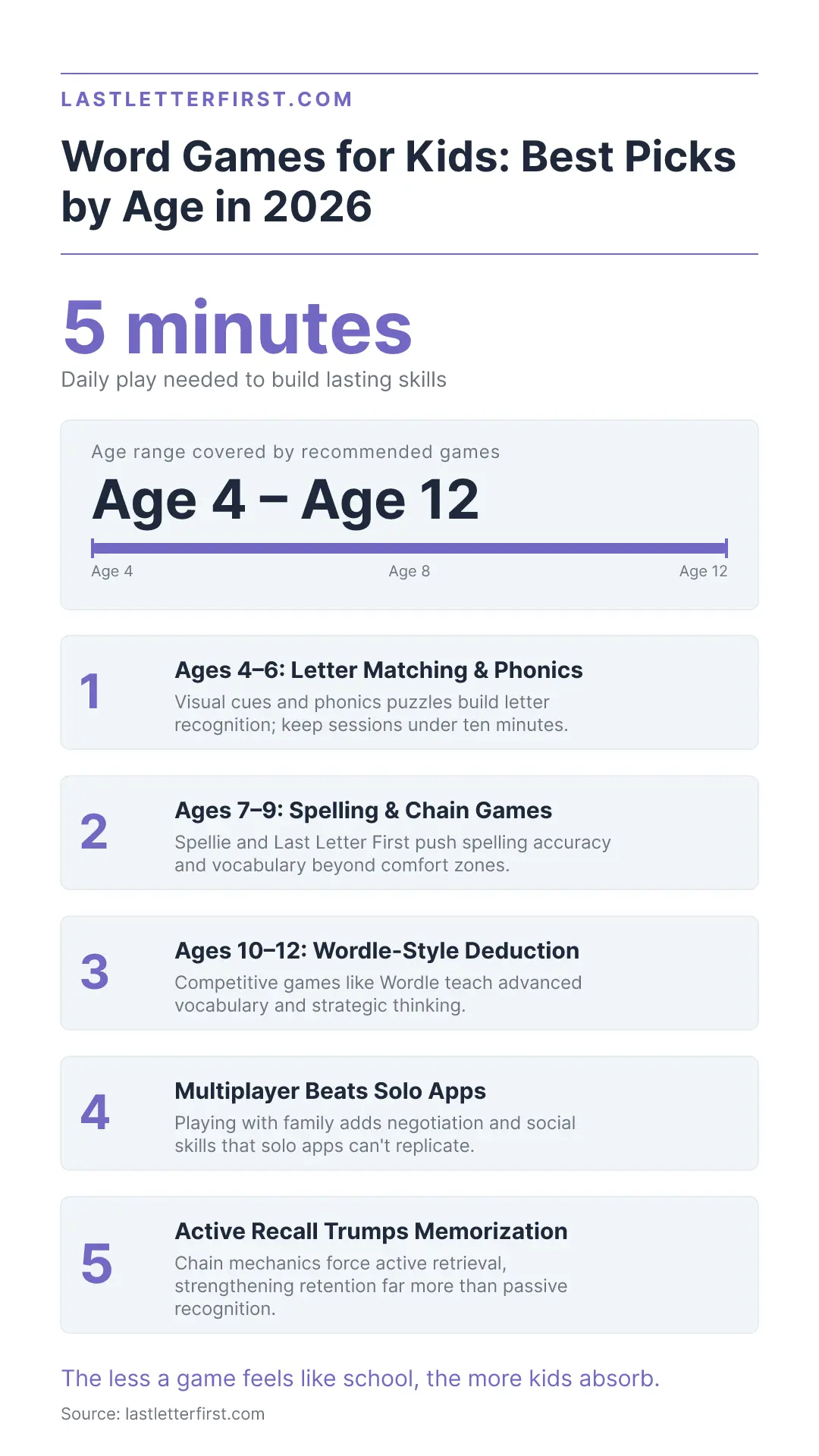
- The top word games in 2026 match reading level: letter matching for ages 4 to 6, Spellie for 7 to 9, and Wordle-type challenges for 10 to 12.
- Multiplayer word games like Last Letter First add social skills solo apps can’t replicate.
- Free word games make daily vocabulary practice accessible to every family and classroom.

Here’s a contrarian take: the “educational” word games marketed to kids are often the least effective. The games that actually build vocabulary? They’re the ones kids beg to play again. That’s the paradox of learning through play. The less a game feels like school, the more a child absorbs.
In 2026, parents have more options than ever, but more options don’t mean better choices. So the real question isn’t “which word game?” It’s “which game fits my child’s age and the skill they need now?” Explore the Learning Hub to go deeper.
Why Word Games Matter for Growing Minds
Word games for kids strengthen spelling, phonics, and vocabulary through playful repetition rather than rote memorization. Short daily sessions , even five minutes with a game like Last Letter First , build more lasting skills than occasional long study blocks. Consistency and fun are the real drivers of language growth.
Best Word Games for Kids by Age Group
The right game depends on reading level, not just birthday. A sharp six-year-old might thrive with a game designed for seven-year-olds, while a struggling nine-year-old might need something simpler.
|
Age Group |
Best Game Types |
Key Skills |
Examples |
|
4 to 6 |
Letter matching, phonics puzzles |
Letter recognition, phonics |
PBS Word World, Endless Alphabet |
|
7 to 9 |
Spelling games, chain games |
Spelling accuracy, vocabulary |
Spellie, Last Letter First |
|
10 to 12 |
Wordle-style deduction, competitive games |
Advanced vocabulary, strategy |
Wordle, Spelling Bee, Last Letter First |
Ages 4 to 6 need strong visual cues. Keep sessions under ten minutes. That’s plenty.
Ages 7 to 9 are ready for spelling games that push beyond comfort. This is the sweet spot for Spellie and daily puzzles adapted for younger players.
Ages 10 to 12 can handle the real deal. Let them play Wordle or compete in family rounds of Last Letter First. At this age, competition isn’t a distraction. It’s the motivation.
Wordle teaches deduction alongside spelling, forcing kids to mentally sort through vocabulary with each guess. Both Wordle and Spellie take under five minutes and require zero prep.
Multiplayer Word Games the Whole Family Can Enjoy
Solo puzzles are great for independent practice. But they’re missing the social layer. When kids play with siblings or parents, they negotiate, explain word choices, and learn from other players’ vocabulary. You can’t get that from an app played alone.
Last Letter First is a multiplayer word game where players chain words by matching the last letter of one word to the first letter of the next. Say “tiger,” and the next player needs a word starting with “r,” like “rainbow.” Simple rules, endless possibilities. Learn more about how multiplayer word games boost family vocabulary.
The chain mechanic forces active retrieval, which strengthens retention far more than passive recognition. Families can download the app or play out loud during road trips.
Tips to Help Kids Learn 100 New Words Fast
Consistency matters more than duration. Ten minutes daily beats an hour on Saturday.
- Morning warm-ups. Five minutes of word chains before school primes the brain for language learning all day.
- Post-reading play. Pull new words from a chapter and use them in Last Letter First. Pairing free word games with reading creates connections that stick.
- Weekend family rounds. Longer sessions let kids experiment with trickier words.
Here’s the paradox worth sitting with: kids who think they’re just playing remember words longer than kids who know they’re studying. The AAP’s 2018 clinical report on play confirms play-based learning strengthens executive function and language simultaneously. The guide to learning 100 new words breaks this down step by step.
Getting Started with Safe, Free Word Games Today
Choosing free word games means weighing educational value, safety, and staying power. Check the FAQs page for common questions about age-matched gameplay.
|
Feature |
Why It Matters |
LLF? |
|
No ads during gameplay |
Prevents distractions |
Yes |
|
Strong privacy policy |
Protects children’s data |
Yes |
|
Skill mapping |
Connects play to phonics, spelling, vocabulary |
Yes |
|
Multiplayer mode |
Enables family and classroom collaboration |
Yes |
|
Free access tier |
Removes cost barriers |
Yes |
Last Letter First checks every box. Its privacy-first approach means you aren’t trading your child’s data for a spelling game. Frankly, don’t miss the boat on an app that prioritizes your child’s experience over ad revenue.
Your Kid’s Next Favorite Word
Pick one game, set a five-minute daily routine, and watch what happens over a month. You might be surprised how quickly “I don’t know that word” turns into “I used that word today.”
Try Last Letter First for free and see the difference a multiplayer word game makes.