
Key Takeaways
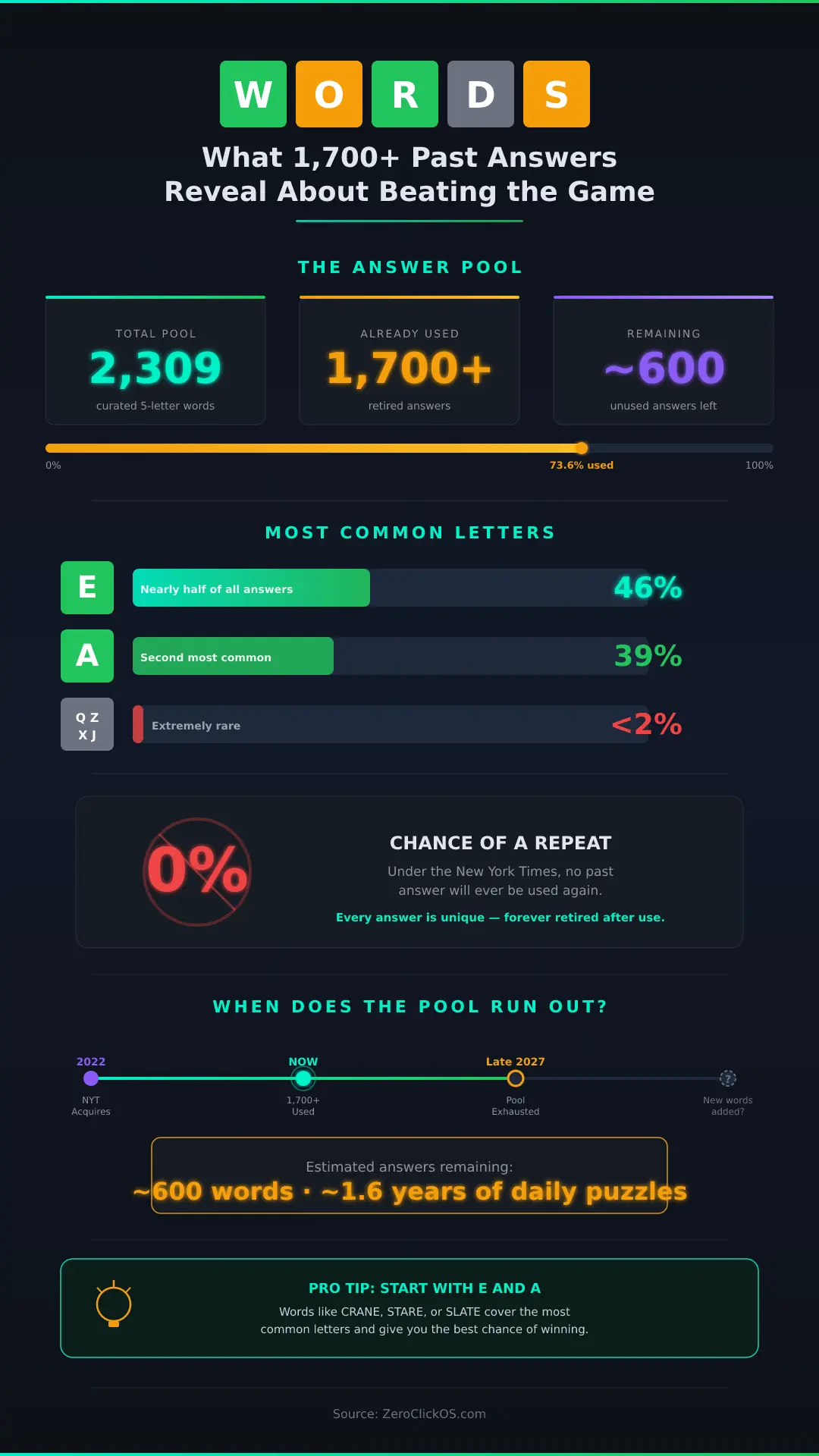
- Wordle draws daily answers from a curated pool of roughly 2,309 five-letter words used, completely separate from the 10,000+ guesses the game accepts.
- The New York Times removed obscure, offensive, and overly tricky words from the original list after acquiring Wordle in early 2022.
- Wordle does not repeat answers under current NYT editorial policy, meaning every past answer is permanently retired.
- With over 1,700 answers used by mid-2025, the remaining pool is shrinking, shifting optimal opener strategy over time.
- Letter-frequency analysis of used vs. unused answers gives daily players a measurable edge without spoiling any specific puzzle.
Stop memorizing random five-letter words. The conventional wisdom says knowing obscure vocabulary makes you better at Wordle, but the data tells a different story. Wordle’s answer list is deliberately loaded with common, everyday English. The player who understands how that list is built, what’s already been crossed off, and which patterns improve family vocabulary will consistently outperform someone hoarding obscure terms. Here’s the paradox: the more words you know, the less it helps, because Wordle’s curators specifically avoid the unusual ones.
How the Words Used in Wordle Are Actually Chosen
The words used in Wordle come from a curated pool of roughly 2,309 five-letter answers, distinct from the 12,500+ guesses the game accepts. With over 1,700 answers already retired by mid-2025, only about 600 remain—shifting optimal strategy away from common letters toward less frequent combinations. At Last Letter First, we track how this shrinking pool reshapes every opening move.
How NYT Changed the Wordle Word List
The New York Times acquired Wordle in January 2022 for a price reportedly in the “low seven figures,” and the word list didn’t survive untouched. NYT’s editorial group reviewed the full answer pool and quietly removed words they considered problematic.
|
Word Removed |
Likely Reason |
|
SLAVE |
Sensitive historical context |
|
LYNCH |
Offensive connotation |
|
WENCH |
Considered derogatory |
|
AGORA |
Too obscure for general audience |
|
PUPAL |
Uncommon outside scientific use |
The removals fall into two buckets: offensive words and words too obscure for a mainstream daily game. Frankly, both categories make sense if you’re running a puzzle played by millions every morning.
What this means for your game: the remaining pool is even more weighted toward plain, familiar English. You won’t get blindsided by a word nobody uses in conversation.
NYT also fixed a timing issue where the browser-cached version and the server version briefly served different answers on the same day. That bug fueled early conspiracy theories about NYT manipulating answers based on current events. They weren’t. The list was set months in advance.
Does Wordle Ever Repeat Words?
The New York Times has confirmed that Wordle does not repeat answers under its current editorial policy. Each daily Wordle answer is used exactly once, then permanently retired from the active pool. If CRANE appeared on a Tuesday in 2022, it won’t show up again. Period.
At one puzzle per day, the original pool of ~2,309 words lasts about six years and four months. Wordle launched in June 2021, putting exhaustion somewhere around late 2027. NYT almost certainly will intervene, likely adding a few hundred carefully curated words to buy time without anyone noticing a difficulty shift.
Here’s the paradox of the shrinking pool: every day, your odds of a first-try guess technically improve because fewer possibilities remain. Yet most players don’t feel that advantage because they aren’t tracking which words have been eliminated.
Strategic Picks: Best Starting Words and Patterns
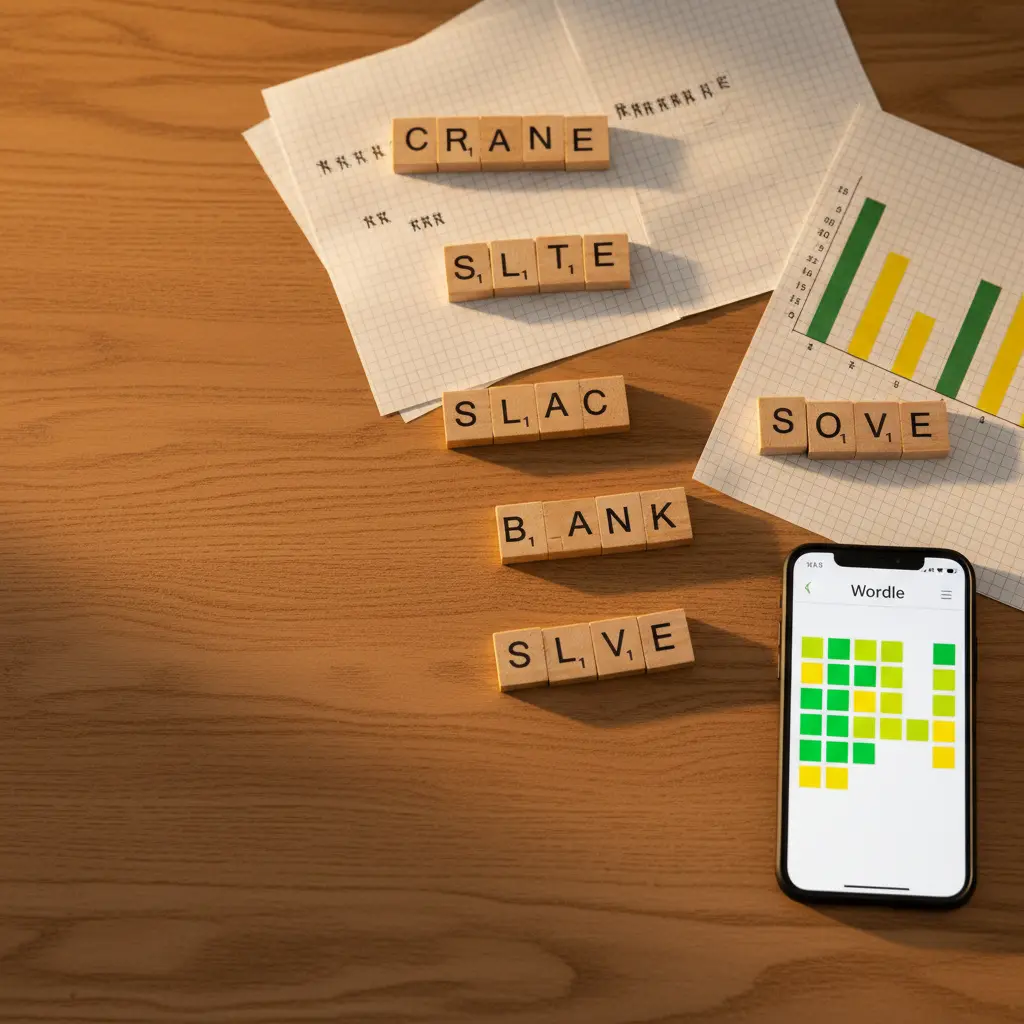
Choosing a strong opener isn’t about luck. It’s math. The letters E, A, R, O, T, and S appear most often across the answer pool. Words like SLATE, CRANE, and STARE perform well because they combine high-frequency consonants with common vowels. Mashable’s analysis of optimal starting words confirms that vowel coverage and letter frequency are the two biggest factors.
But the “perfect” opener changes as more answers get used. Don’t just memorize one and call it a day.
|
Letter |
Frequency |
Position |
|
E |
~46% |
5 |
|
A |
~39% |
2 |
|
R |
~31% |
2,4 |
|
T |
~25% |
1 |
|
H |
~20% |
1,3 |
E appears in roughly 46% of all Wordle answers, A in about 39%, and O in around 22%. Position matters too: S shows up most in position 1, E dominates position 5, and A clusters in positions 2 and 3. Players who think about where letters land, not just how often they appear, gain a real edge.
Avoid Q, Z, X, and J early. They’re present in fewer than 2% of answers combined. Burning a guess on JAZZY is like throwing darts blindfolded.
Level Up Your Word Skills Beyond Wordle
Wordle has used over 1,700 answers since launch, leaving roughly 600 in the original pool. Without intervention, the current list runs out within two years.
The smartest move? Treat every day’s puzzle as data. Track what’s been used. Notice which letter combinations are thinning out. And if you want to build vocabulary instincts that make word games feel effortless, explore structured word-learning approaches that go deeper than a single daily grid.
The answer pool is finite. Your word skills don’t have to be.
By the Last Letter First Editorial Team. We cover word games, vocabulary strategy, and language learning. Learn more about our editorial approach.