
Key Takeaways
- Word helpers can be learning tools, not just cheats!
- High-value Q-without-U, J/X/Z word lists give real edges.
- Board-state evaluation beats blind letter unscrambling.
- Spotting a cheater involves recognizing play-pattern red flags.
What a Words and Friends Cheat Tool Actually Does
- A words and friends cheat tool like the one at Last Letter First generates valid plays from your available tiles — and it’s far more common than most players realize.
- Memorizing high-value word lists (Q-without-U, two-letter words, J/X/Z gems) delivers a bigger long-term edge because the knowledge stays with you.
- The paradox: players who use word helpers most often end up needing them least, since repeated exposure builds genuine vocabulary.
Your cousin just played “QUIXOTIC” on a triple-word tile for 87 points. You’re staring at R, E, T, N, I, A, and G, convinced nothing longer than “RING” exists. So you do what roughly 40% of casual word game players do, per a 2023 YouGov survey: open a second tab and type those letters into a word finder. Three seconds later, you see “GRANITE,” “TEARING,” and “TANGIER.”
But did you cheat, or did you learn something? That tension sits at the heart of every “words with friends cheat” search. If you’re looking to improve your vocabulary through word games, the answer is more layered than you’d expect.
Is Using a Word Helper Cheating or Learning?
A Words With Friends cheat is any word-finding tool that takes your available letter tiles and returns every valid word you can form from them. No hacking, no exploits, no modified game files. These tools cross-reference your letters against the game’s official dictionary and return options ranked by length or point value.
The term “cheat” is honestly a bit loaded. Most are word unscramblers that rearrange letters into valid combinations. For players stuck on difficult combos, a word unscrambler isn’t a shortcut. It’s a flashlight in a dark room.
Players who review suggested words rather than blindly playing the highest scorer report recognizing those words in future games without help. That’s spaced repetition at work.
|
Feature |
Word Unscrambler |
Scrabble Word Finder |
|
Input |
Your tile letters only |
Tiles + board constraints |
|
Output |
All valid words from those letters |
Words fitting specific board positions |
|
Best for |
Learning new words |
Maximizing points per turn |
|
Typical user |
Casual players |
Competitive players optimizing placement |
High-Value Word Lists You Need to Memorize
This is the elephant in the room. Competitive tournament players operate under strict no-assistance rules. Using a tool mid-match in ranked play is unambiguously against the rules.
But most Words With Friends games aren’t tournaments. They’re casual matches between friends or strangers on a commute. A 2024 Reddit r/WordsWithFriends thread revealed that the majority of commenters viewed word finders as acceptable in casual play, with many arguing the tools helped them discover words they’d never encountered.
Here’s the paradox of word helper tools: the players who use them most often end up needing them least. Every looked-up word is a potential addition to your permanent vocabulary.
The shift from cheating to learning happens when you stop just playing the word and start studying it. See “RETINA” and wonder, “What about RETAIN? RATINE?” You’ve turned a word finder into a vocabulary-building exercise that sticks. The tool is the same. The outcome depends on you.
Beyond Any Words and Friends Cheat: Read the Board
The single biggest competitive advantage in Words With Friends isn’t software. It’s knowing which short, high-scoring words exist so you can play them from memory.
Q-Without-U and Two-Letter Power Words
The Q tile is worth 10 points, but it feels like a curse without a U. These words are your escape hatch:
|
Word |
Points |
Definition |
|
QI |
11 |
Life force in Chinese philosophy |
|
QAT |
12 |
A plant chewed as a stimulant |
|
QOPH |
15 |
Hebrew letter |
|
QANAT |
14 |
An irrigation tunnel |
|
QADI |
14 |
An Islamic judge |
|
QINTAR |
15 |
Albanian monetary unit |
Qi is the single highest-value two-letter word in Words With Friends, scoring 11 points with no setup required. Memorize it first.
Two-letter words let you play parallel to existing words, scoring on multiple rows simultaneously:
|
Word |
Points |
Word |
Points |
|
ZA |
11 |
JO |
9 |
|
QI |
11 |
XI |
9 |
|
EX |
9 |
XU |
9 |
|
AX |
9 |
OX |
9 |
Must-Know J, X, and Z Words
High-point tiles that fit tight board spots swing games:
|
Word |
Points |
Word |
Points |
|
JO |
9 |
ZAP |
14 |
|
JAB |
12 |
ZIT |
12 |
|
AXE |
10 |
OXO |
10 |
|
ZEP |
14 |
JIN |
10 |
The pattern is clear: learning 20 to 30 short words with premium tiles gives you scoring options on almost every turn. You don’t need a massive vocabulary. You need a strategic one.
Putting It All Together: Play Smarter Today
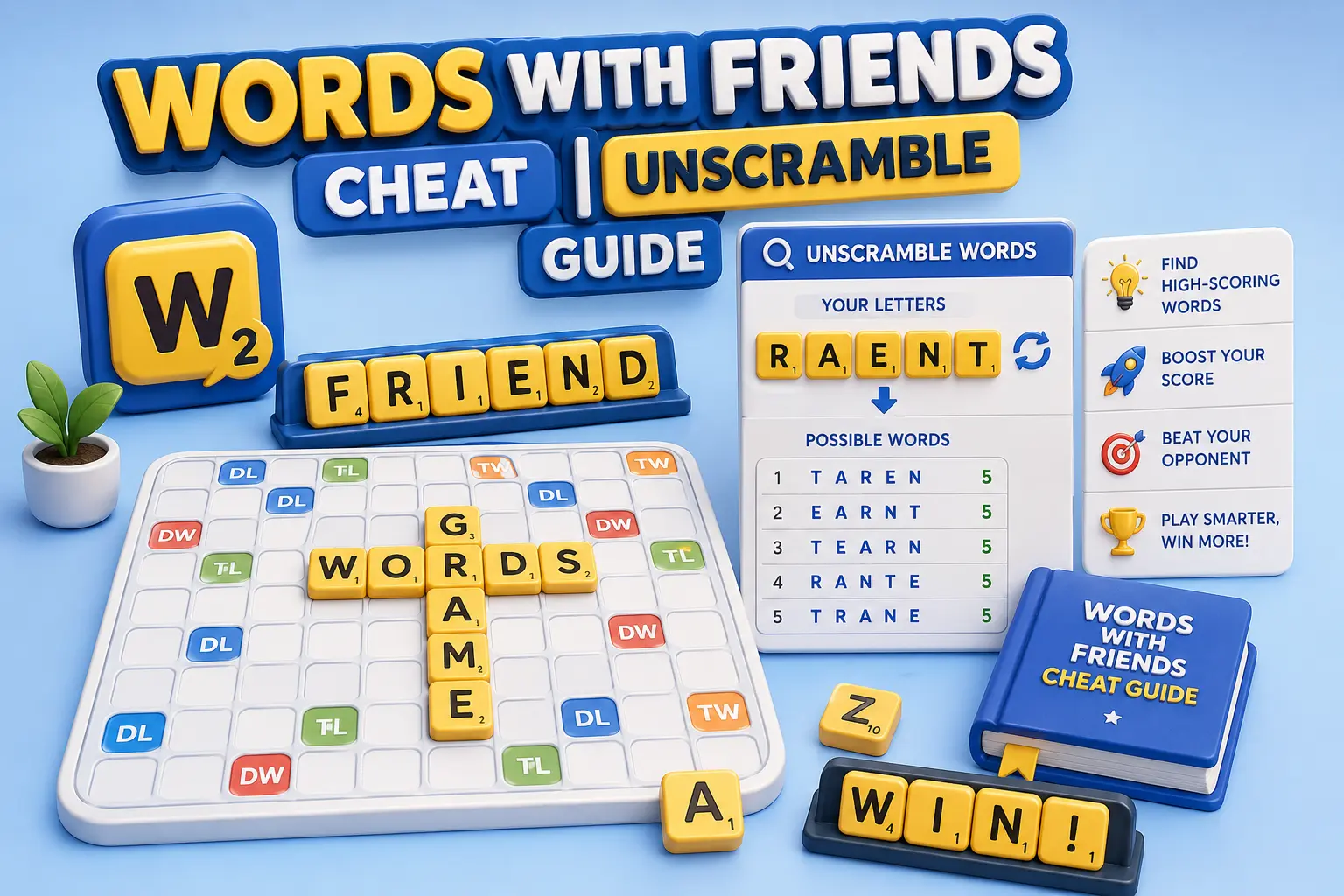
A words with friends cheat tool can hand you the highest-scoring word, but it can’t tell you where to play it. That’s the skill gap most casual players never close.
Sometimes the best move scores fewer points. Playing a 28-point word that opens a triple-word square for your opponent is worse than a 19-point word that locks it down.
Before placing a tile, scan for three things:
- Check open triple-word and double-letter squares. If a triple is one tile from an open lane, treat it as urgent.
- Map your opponent’s likely responses. Could they extend a word to reach a triple? Consider blocking.
- Weigh defense against offense. A 15-point defensive move that shuts down a 45-point opponent opportunity nets 30 points of relative value. Solid math.
- Check rack balance. Heavy on consonants? Dump difficult letters now. Sitting on Q with no U? Those Q-without-U words become lifesavers.
Your Next Move
The best word game players aren’t the ones with the biggest vocabularies. They’re the ones who treat every loss as a data point. Track which letter combinations stump you. Review words your opponent played that you didn’t know. And play against real people, not bots, because competitive games force adaptation faster than solo practice ever could.
Stay curious, stay competitive, and don’t feel guilty about looking up a word now and then.