
Key Takeaways About How to Play Scrabble
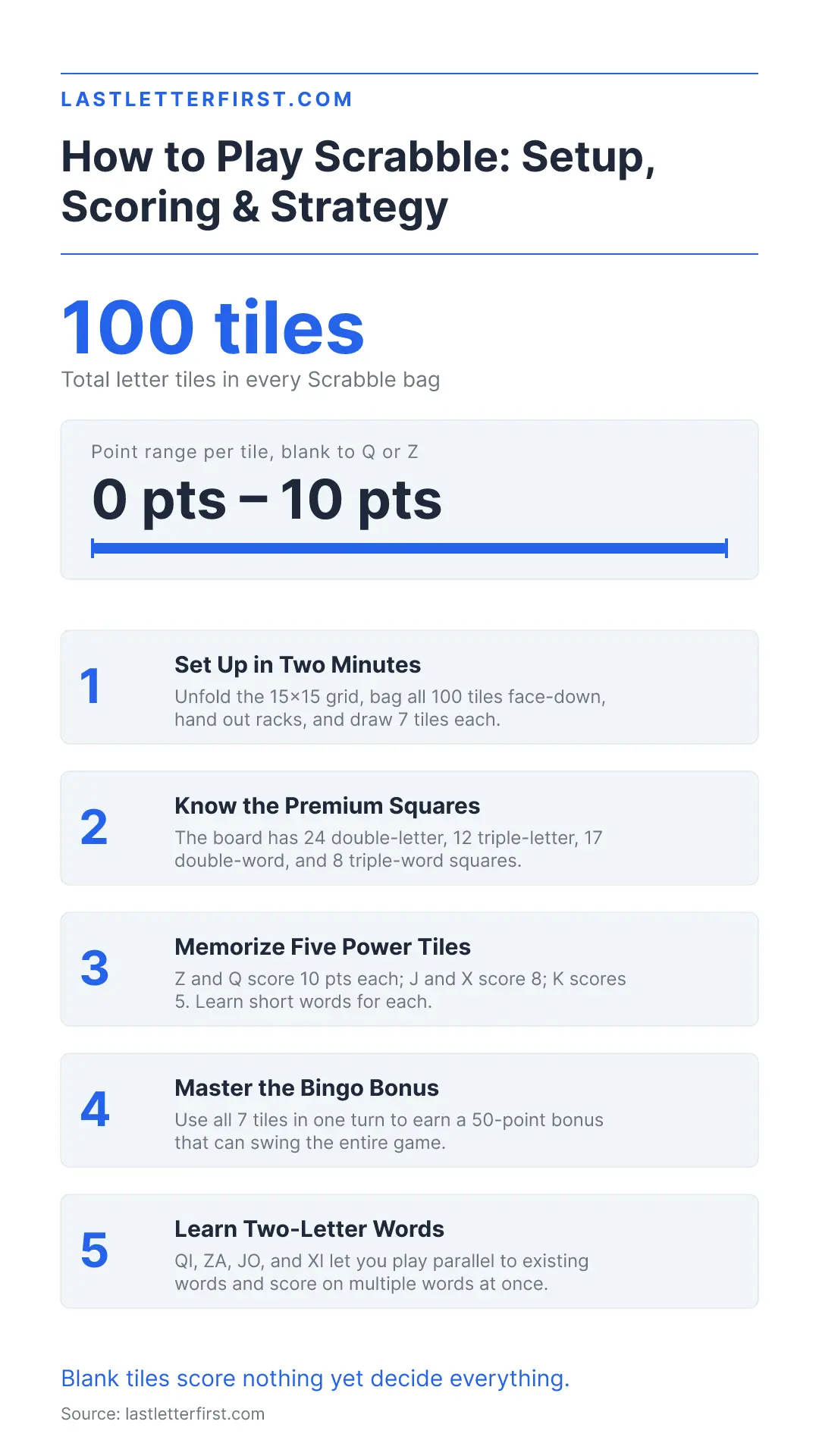
- Scrabble is a crossword-style board game where 2 to 4 players score points by forming interlocking words on a 15×15 grid using 100 lettered tiles.
- Setting up correctly matters more than most guides admit: tile draw order, rack management, and board orientation all shape the game before a single word is played.
- The 100-tile bag contains letters worth 0 to 10 points each, and memorizing just 5 high-value tiles gives beginners a real scoring edge.
- Two-player Scrabble plays faster and rewards board control strategies that don’t apply in 3- or 4-player games.
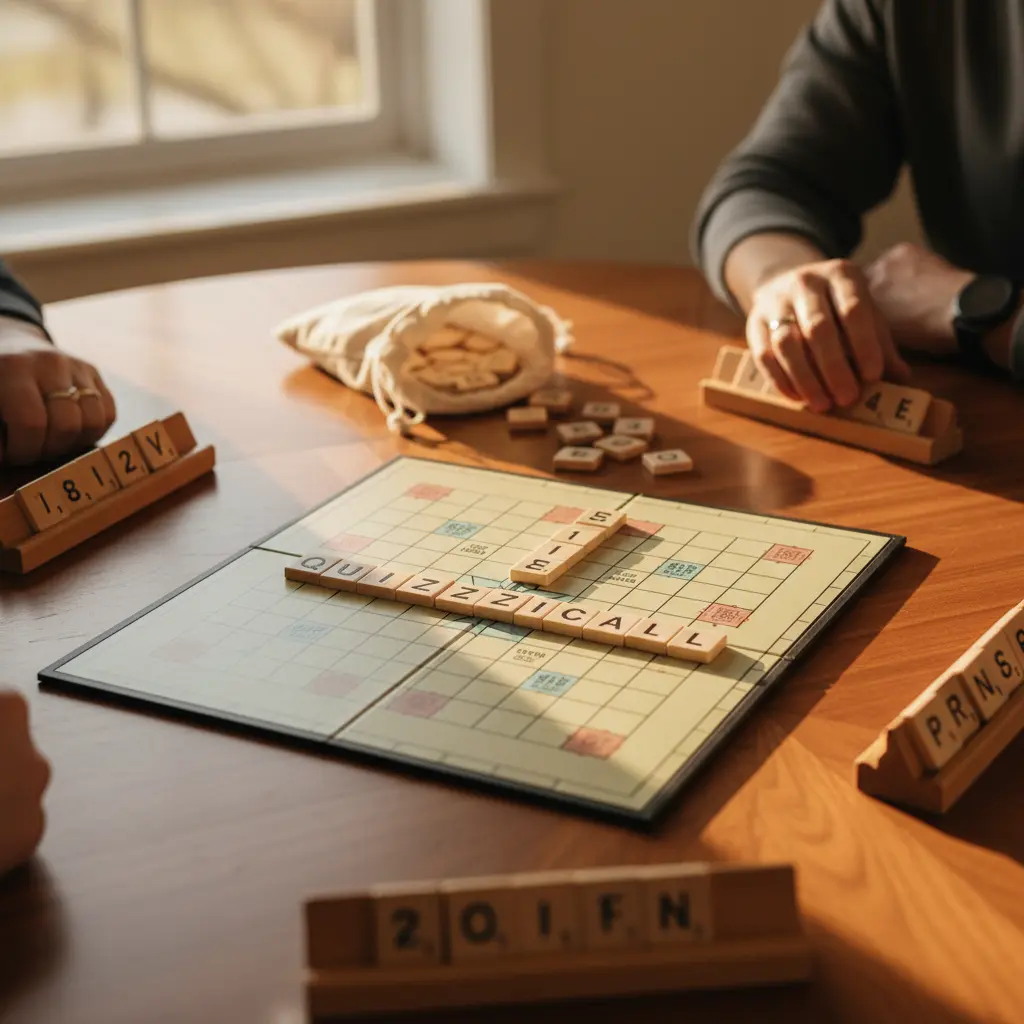
…so you’ve pulled the Scrabble box off the shelf, dumped the tiles onto the table, and now everyone’s staring at the board like it’s a crossword puzzle with no clues. You’re not alone. In 2026, Scrabble remains one of the most searched board games online, and the number one question people ask isn’t about strategy. It’s simpler: how do you actually play?
This walkthrough covers setup, scoring, tile values, and what changes when only two people are playing. If you’re looking to sharpen your word game vocabulary along the way, that’s a bonus.
How to Play Scrabble and Why It Still Rocks
Learning how to play Scrabble starts with a simple concept: form interlocking words on a 15×15 grid using lettered tiles to outscore your opponents. The rules take minutes to grasp, yet the strategic depth , managing your rack, targeting premium squares, and blocking rivals , keeps players engaged for a lifetime. At Last Letter First, we celebrate this kind of elegant word-game design, where curiosity with letter combinations matters more than memorizing the dictionary.
Setting Up Your Scrabble Board Step by Step
Proper setup takes about two minutes. Here’s the process:
- Unfold the board on a stable surface. It’s symmetrical, so orientation is about comfort, not rules.
- Place all 100 letter tiles face-down in the bag and mix thoroughly.
- Give each player a tile rack to hold letters upright and hidden.
- Determine who goes first. Each player draws one tile. Closest to “A” plays first. Blank tiles beat everything. Return drawn tiles and remix.
- Draw starting tiles. Beginning with the first player, each person draws 7 tiles onto their rack.
That’s it. You’re ready to play Scrabble.
The board is a 15×15 grid with four types of premium squares:
|
Square Type |
Color |
Effect |
Count |
|
Double Letter Score |
Light Blue |
Doubles the tile’s value |
24 |
|
Triple Letter Score |
Dark Blue |
Triples the tile’s value |
12 |
|
Double Word Score |
Pink/Rose |
Doubles the word’s score |
17 |
|
Triple Word Score |
Red |
Triples the word’s score |
8 |
The center star is a Double Word Score, and the first word must cover it. Premium bonuses only apply the first time a tile lands on them. One-and-done.
Each player draws 7 tiles from a bag of 100, keeping them hidden on a personal rack. I’d argue separating vowels from consonants helps beginners spot word possibilities faster. After every turn, draw replacements to bring your rack back to 7.
Complete Scrabble Letter Tile Values and Distribution
Scrabble rules assign a fixed point value to every letter. Alfred Butts originally calculated letter frequency by counting characters on the front page of The New York Times. Common letters score low; rare letters score high.
|
Letter |
Points |
Count |
Letter |
Points |
Count |
|
|
A |
1 |
9 |
N |
1 |
6 |
|
|
B |
3 |
2 |
O |
1 |
8 |
|
|
C |
3 |
2 |
P |
3 |
2 |
|
|
D |
2 |
4 |
Q |
10 |
1 |
|
|
E |
1 |
12 |
R |
1 |
6 |
|
|
F |
4 |
2 |
S |
1 |
4 |
|
|
G |
2 |
3 |
T |
1 |
6 |
|
|
H |
4 |
2 |
U |
1 |
4 |
|
|
I |
1 |
9 |
V |
4 |
2 |
|
|
J |
8 |
1 |
W |
4 |
2 |
|
|
K |
5 |
1 |
X |
8 |
1 |
|
|
L |
1 |
4 |
Y |
4 |
2 |
|
|
M |
3 |
2 |
Z |
10 |
1 |
|
|
Blank |
0 |
2 |
Five tiles carry the heaviest punch:
- Z (10 points) pairs with short words like ZA and ZIT.
- Q (10 points) traditionally requires a U, but QI lets you play it without one.
- X (8 points) works in AX, EX, OX, and XI.
- J (8 points) plays quickly in JO and JAB. Don’t hold it too long.
- K (5 points) is often overlooked, but KA and KI are valid plays that boost scoring in tight board situations.
Blank tiles act as wildcards that can represent any letter, but they’re worth zero points. Here’s the paradox with blanks: they’re the most strategically valuable tiles in the bag precisely because they score nothing. A blank lets you complete a 7-letter “bingo” (50-point bonus), and that swing often decides close games. Don’t waste a blank on a 12-point word.
Official Scrabble Rules and How Scoring Works
Every turn follows three steps: place tiles, tally your score, draw replacements. Form a word by placing tiles on the board. Every new word must connect to an existing word (except the first play, which crosses the center star). All tiles placed in a single turn must sit in one row or one column. If your tiles create additional words by touching adjacent letters, you score every new word formed.
You can also swap tiles instead of playing a word. Exchange any number, return them to the bag, draw fresh ones. You lose your turn, but sometimes a bad rack is a bad rack.
Challenging words is part of the official rules. If you suspect a fake word, challenge it against an official Scrabble dictionary. Invalid word? The player removes tiles and loses that turn. Valid word? The challenger loses their next turn.
Calculate letter bonuses first, then apply word multipliers. A word crossing two Double Word squares gets quadrupled. And the crown jewel: use all seven tiles in one turn for a 50-point bingo bonus on top of your word score.
The game ends when one player uses their last tile and the bag is empty, or when all players pass twice consecutively. Remaining tile values get subtracted from each player’s score. The player who went out first adds everyone else’s leftover tile values to theirs. Hanging onto Q or Z at the end can seriously sting.
2-Player Scrabble Strategy and Tips
Two-player Scrabble is a completely different animal. Fewer opponents mean a tighter board, faster turns, and every play matters more. Frankly, it’s where the real strategic depth lives.
Board control becomes everything. Sometimes the best move isn’t your highest-scoring word, it’s the word that blocks your opponent’s access to a Triple Word Score. Defensive play isn’t just smart here, it’s critical. Keep a balanced mix of consonants and vowels, and don’t dump all your high-value tiles early.
Want a reliable edge? Learn the two-letter words:
|
Word |
Points |
Why It Matters |
|
QI |
11 |
Only Q word without U |
|
ZA |
11 |
Easy Z dump |
|
JO |
9 |
Common J play |
|
XI |
9 |
X without awkward setup |
|
XU |
9 |
Clean X play |
|
AX |
9 |
Flexible placement |
These tiny words let you play parallel to existing words, scoring on multiple new words simultaneously. It’s a no-brainer once you get the hang of it.
If you love Scrabble’s vocabulary challenge but wish the pace were quicker, games like Last Letter First flip the script: players chain words where each must start with the last letter of the previous one. The Last Letter First learning hub has more guides worth exploring for families building language skills together.
By the Last Letter First Editorial Team. We cover word games, vocabulary strategy, and family-friendly language play. Explore more at the Last Letter First Learning Hub.