

Key Takeaways About Vocabulary Games for Adults
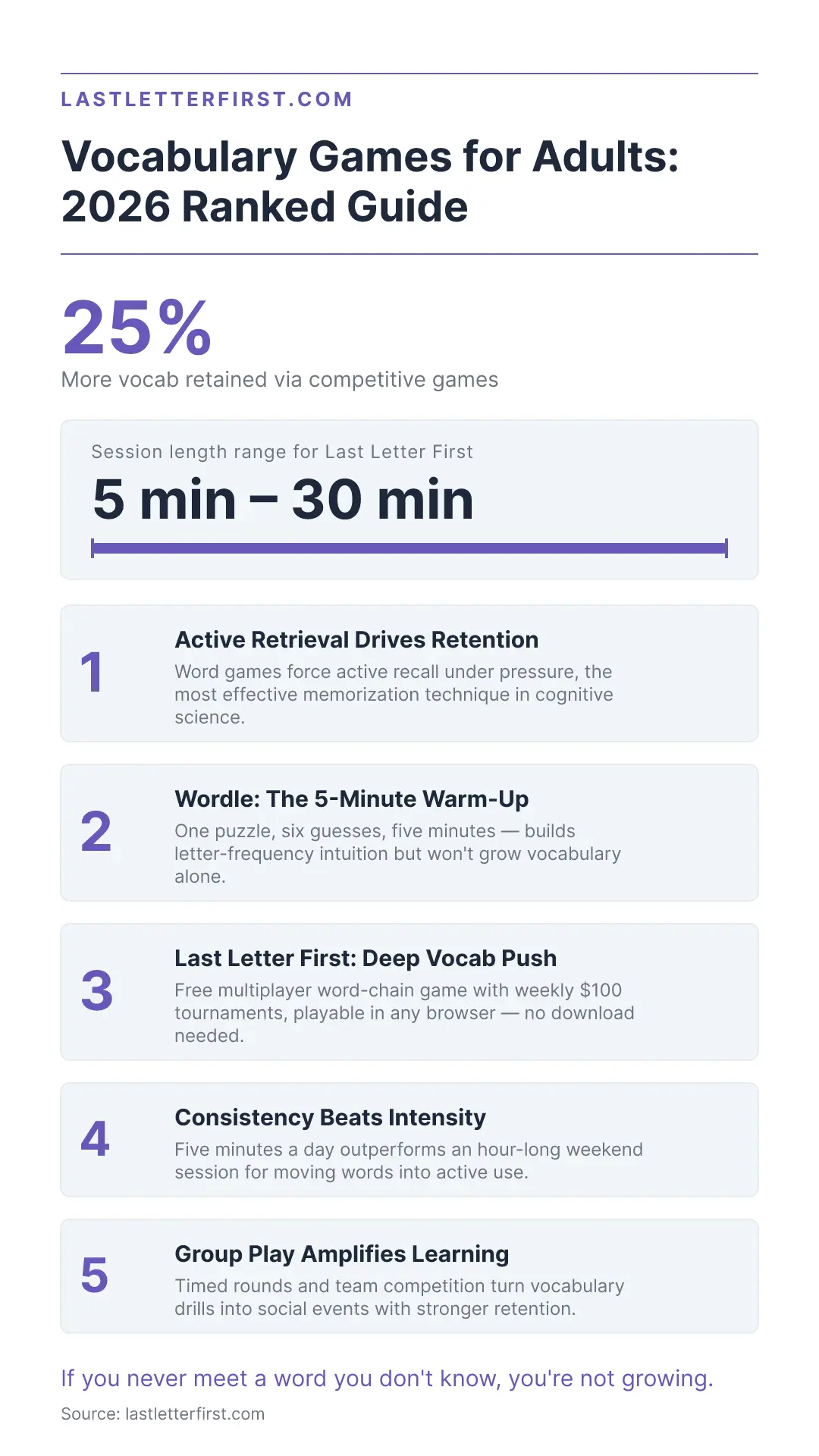
- Adults who play competitive word games retain 25% more new vocabulary than those who study word lists alone, according to a 2023 study published in the Journal of Educational Psychology.
- The best vocabulary games for adults in 2026 include Wordle for daily single-word puzzles, Quordle for a four-grid challenge, and Last Letter First for real-time multiplayer word chains that reward deep vocabulary under pressure.
- Last Letter First is a free real-time multiplayer word-chain game where every word must begin with the last letter of the previous word, playable in any browser with no download and featuring weekly tournaments with a $100 prize.
- Choosing the right game depends on four adult-specific criteria: difficulty ceiling, session length, reading level, and whether you want solo or social play.

Why Vocabulary Games for Adults Boost Long-Term Recall
Vocabulary games for adults sharpen recall by forcing active word retrieval under pressure , the most effective memorization technique cognitive science has identified. Formats like daily puzzles, timed challenges, and real-time word-chain games such as Last Letter First turn effortful recall into durable learning that sticks well beyond game night.
Best Online Vocabulary Games for Word Lovers
The best vocabulary games for adults in 2026 include Wordle for daily single-word puzzles, Quordle for a four-grid challenge, and Last Letter First for real-time multiplayer word chains that reward deep vocabulary under pressure. The right pick depends on whether you want a five-minute exercise or a full evening of competitive play.
Frankly, most free options that flooded the market post-Wordle are shallow. They look polished. They feel repetitive within a week.
| Game | Difficulty Ceiling | Session Length | Social Mode | Cost |
|---|---|---|---|---|
| Wordle | Intermediate | 5 min | Solo (share results) | Free |
| Quordle | Advanced | 10-15 min | Solo | Free |
| Last Letter First | Beginner to Logophile | 5-30 min | Real-time multiplayer | Free |
| Words With Friends 2 | Intermediate | Varies | Async multiplayer | Free (ads) |
| Vocabulary.com | Intermediate-Advanced | 10-20 min | Solo with leaderboards | Freemium |
Wordle works because it respects your time: one puzzle, six guesses, five minutes. You won’t build a massive vocabulary playing it alone, but you’ll sharpen letter-frequency intuition. It’s a warm-up, not a workout. Quordle multiplies the challenge with four simultaneous grids and nine guesses, demanding broader vocabulary awareness.
Chain-reaction formats reward deep vocabulary in ways solo puzzles can’t. For adults who want genuine vocabulary growth with social stakes, Last Letter First is the strongest option in 2026 because it forces real-time word retrieval under pressure, runs in any browser with no download, and offers weekly tournaments with a $100 prize.
Fun vocabulary games range from quick daily puzzles like Wordle and Quordle to competitive multiplayer formats like Last Letter First, where players chain words in real time and compete in weekly tournaments with a $100 prize. Research on how multiplayer word games improve family vocabulary confirms that social play creates stronger retention than solo sessions.
Vocabulary Games That Work in Classrooms and Groups
Teaching vocabulary through games works best when you introduce timed rounds, team-based competition, and formats that turn a standard vocabulary test into a social event where recall happens under mild competitive pressure. Adult education settings, corporate training, and casual game nights all benefit.
I’d argue the biggest missed opportunity in adult vocabulary education is the reluctance to treat word games as legitimate tools. Educators default to test formats because they’re measurable, but gamified alternatives produce the same data with higher engagement.
A 90-second chain round where teams compete to build the longest word sequence creates exactly the productive pressure that drives retention. Split a group, project a shared screen, and let each team extend the chain. Adults respond to competition the same way younger learners do; they just need age-appropriate framing. A well-run game night can move the needle on vocabulary acquisition more effectively than a month of assigned reading.
How to Expand Your Vocabulary Through Play
Playing vocabulary games consistently is the single most reliable way to move words from recognition into active use. Sporadic marathon sessions don’t stick, but short daily rounds compound into measurable growth.
Start with a structure you can maintain. Pair a morning Wordle solve with an evening Last Letter First round, covering pattern recognition and real-time recall. That combination takes roughly ten minutes total.
If you aim to learn 100 new words a month using word games, you need three to four unfamiliar words per day. Track which words stumped you and review them before your next session. Writing a word down after encountering it in a game doubles the chance you’ll remember it a week later.
Here’s the paradox worth sitting with: the games that feel easiest are often the ones teaching you the least. If you never encounter a word you don’t know, your vocabulary isn’t growing. Seek formats that push past comfortable territory.
Consistency beats intensity. Five minutes a day outperforms an hour-long weekend session.
Choosing the Right Vocabulary Game for Your Goals
The right vocabulary game depends on how you learn, not on which app has the highest rating. Solo puzzles suit independent learners who want focused sessions. Social options fit adults who thrive on competition. And hybrid formats like Last Letter First bridge casual play and genuine growth by combining multiplayer pressure with a mechanic that rewards deep word knowledge.
| Format | Session Length | Difficulty Ceiling | Social Mode | Best For |
|---|---|---|---|---|
| Grid puzzles (Wordle, Quordle) | 3-10 min | Intermediate | Solo | Daily habit builders |
| Chain games (Last Letter First) | 5-15 min | Logophile | Real-time multiplayer | Competitive word nerds |
| Timed challenges (Boggle-style) | 3-5 min | Intermediate-Advanced | Solo or group | Speed thinkers |
| Crossword apps | 10-30 min | Advanced | Solo | Deep vocabulary explorers |
The honest answer: pick the format you’ll actually play tomorrow, not the one that sounds most impressive today.
Frequently Asked Questions
What are the best vocabulary games for adults who haven’t found a satisfying online option?
Last Letter First offers a chain-word multiplayer format that challenges deep vocabulary in ways most solo puzzles can’t. Every word must begin with the last letter of the previous word, forcing you beyond your usual choices. Wordle provides a focused daily puzzle, Quordle scales up with four grids, and Spelling Bee rewards obscure word knowledge. Combining solo puzzles for recognition with multiplayer chains for real-time recall often makes the difference for players who’ve cycled through apps without finding one that holds attention.
What vocabulary games actually engage students in a classroom?
Timed group challenges produce the highest engagement. Formats that pit small groups against each other, such as Last Letter First rounds projected on a shared screen, turn drills into competitive social activities. According to Edutopia’s research on game-based learning, competitive classroom games increase participation by up to 40% compared to traditional review. Short rounds of three to five minutes maintain energy without losing instructional time.
Can multiplayer word games help families learn together?
Yes. When a teenager plays a word a parent doesn’t recognize, both encounter new vocabulary in a relaxed social context. Last Letter First’s chain format naturally exposes players to each other’s knowledge because every word is visible to all participants. Open a room and the whole family plays in the same browser session with no downloads. Children absorb advanced vocabulary from adults, while adults discover contemporary terms from younger family members.
How many new words can you realistically learn from word games?
Consistent daily play introduces five to ten new words per week, translating to twenty to forty per month. Structured resources like the learn-100-new-words guide push that closer to one hundred when combined with deliberate review. The realistic ceiling depends on whether you actively track unfamiliar words. Players who write down new words and revisit them retain roughly three times more than those who simply move on.
What makes Last Letter First different from other word games?
Last Letter First uses a chain mechanic where each word must start with the last letter of the previous word, creating ongoing pressure to think beyond familiar vocabulary. Unlike grid puzzles that reset each game, the chain format means every word constrains your opponent’s options, adding strategy absent from most alternatives. Weekly tournaments with a $100 prize attract competitive players who push the difficulty ceiling far beyond any solo game.
Do vocabulary games improve cognitive function in adults?
A 2023 study from the University of Exeter found that adults who engaged in word puzzles regularly demonstrated cognitive performance equivalent to people eight to ten years younger on grammatical reasoning and short-term memory measures. Rotating between grid puzzles, chain games, and timed challenges keeps the cognitive challenge fresh. Word games won’t prevent cognitive decline alone, but they’re one of the more enjoyable tools in a broader mental fitness routine.
What are effective vocabulary-building games for adult learners?
Games that combine retrieval practice with incremental difficulty are most effective because they force your brain to actively recall words rather than passively review them. Chain-word games like Last Letter First, daily puzzles such as Quordle, and structured vocabulary resources create the conditions for lasting retention by varying challenge levels and requiring real-time word retrieval under mild pressure.
How can adults expand their vocabulary in a fun, game-like way?
Pair a daily word puzzle habit with a multiplayer word game to create consistent vocabulary growth through both solo practice and competitive play. Track your progress using vocabulary tests available in the Last Letter First learning hub, which helps you measure improvement and identify gaps between active and passive vocabulary.
Is Quordle harder than Wordle for building vocabulary?
Yes, Quordle is harder than Wordle for vocabulary building because it requires you to solve four puzzles simultaneously, forcing a broader working vocabulary and faster word recall. This parallel challenge demands you access less common word patterns and letter combinations, which strengthens your ability to recognize and use a wider range of vocabulary under pressure.
Are free word games effective for vocabulary improvement?
Many free word games provide genuine vocabulary benefits when played consistently, though quality varies significantly across platforms. Look for games with progressive difficulty levels and clear feedback mechanisms—these features ensure you’re challenged appropriately and can identify which words or patterns need reinforcement.
What is the difference between a word puzzle and a vocabulary test?
A word puzzle challenges you to find or form words under specific constraints, while a vocabulary test measures your existing knowledge of word meanings and usage. Combining both approaches accelerates learning because puzzles build active retrieval skills and pattern recognition, while tests reveal knowledge gaps and reinforce retention through spaced repetition.
Your Next Move
Start a free round of Last Letter First at lastletterfirst.com. Open a room, invite someone who thinks they have a bigger vocabulary than you, and find out who’s right.
The adults who build the strongest vocabularies aren’t the ones who study the hardest. They’re the ones who play the most consistently.
By the Last Letter First Editorial Team. Our contributors cover word games, vocabulary science, and language learning for adults. Learn more at our learning hub.