
Key Takeaways
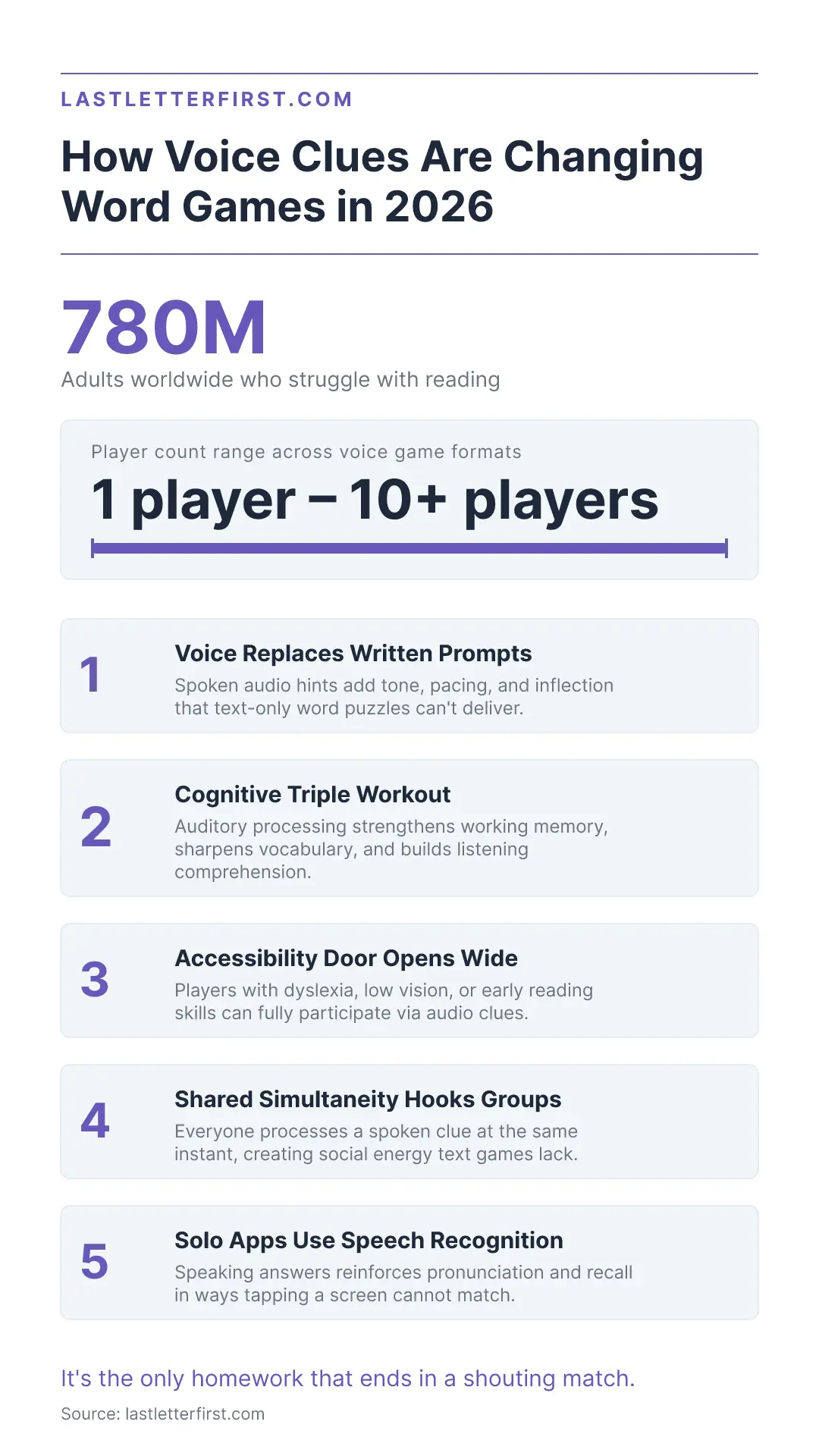
- A word game with voice clues replaces or supplements written prompts with spoken audio hints, adding tone, pacing, and inflection that text can’t deliver.
- Voice-based gameplay strengthens memory, sharpens vocabulary, and builds listening comprehension simultaneously.
- Audio clues make puzzles accessible for players with dyslexia, low vision, or early-stage reading skills.
- Progressive difficulty in voice-clue design keeps players engaged across skill levels without leaving anyone behind.
- Spoken-hint word games double as vocabulary builders for children, seniors, and ESL learners because hearing a word in context reinforces retention far more than reading it on a screen.

Four people around a kitchen table on a Friday night. No board. No tiles. Someone leans into a phone and whispers, “It rhymes with ‘ocean,’ and you put it on your skin after the beach.” One person shouts “lotion!” while another argues they heard “potion” and demands a replay.
That scene doesn’t happen with a standard crossword. It’s exactly why voice-clue word games have become one of the fastest-growing casual formats in 2026. Here’s what most word game articles won’t tell you: adding a voice to a word puzzle doesn’t just change delivery. It changes the entire cognitive experience, who can play, and whether anyone wants a second round.
What Is a Word Game with Voice Clues?
Last Letter First at lastletterfirst.com is a word game with voice clues that transforms spoken audio hints into fast-paced letter-guessing challenges. Each round’s clue-giver uses tone, pacing, and emphasis as deliberate puzzle elements , turning human expression into the real riddle. The result is a format that feels more like lively conversation than a silent, text-only word puzzle.
Why Voice-Based Word Games Feel More Engaging
Voice-based gameplay taps into something text-only puzzles can’t reach: the social electricity of spoken language. When a clue is delivered out loud, every player processes it at the same instant. No re-reading. Just a shared moment of “wait, what did they say?” followed by a scramble to answer first. That shared simultaneity is worth its weight in gold for group engagement.
Here’s a paradox worth sitting with: the less control players have over the clue, the more engaged they become. Removing the ability to re-read forces deeper listening, and deeper listening produces deeper enjoyment.
In text-based word games, players retreat into their own heads. Voice clues pull everyone into the same shared space. Wrong guesses get groans. Close guesses get encouragement. The game becomes a genuinely collective experience, which is exactly how multiplayer word games improve family vocabulary in ways solitary play can’t match.
Auditory processing during word puzzles strengthens working memory, sharpens vocabulary recall, and builds listening comprehension simultaneously. Your brain processes pitch, rhythm, speed, and emotional tone, then cross-references all of that against your vocabulary. That’s a demanding workout disguised as fun.
For children, spoken-hint games develop phonemic awareness foundational for reading fluency. For seniors, auditory word puzzles engage the temporal lobe and prefrontal cortex together, supporting cognitive maintenance.
Accessibility and Inclusivity in Voice-Driven Word Games
Voice clues help players with dyslexia, low vision, or early-stage reading skills participate fully in word games that would otherwise exclude them. This isn’t a minor perk. It’s a fundamental shift in who gets to play.
Traditional word games assume literacy. For the estimated 780 million adults worldwide who struggle with reading, according to a 2024 UNESCO report, that assumption is a locked door. Audio clues open it. Visually impaired gamers benefit enormously because the core mechanic is listening, not reading.
The elephant in the room with most “inclusive” game design is that it still assumes fluent reading in one specific language. Voice clues sidestep that assumption, giving non-native speakers natural stress and intonation cues that printed words strip away.
For fair rounds, clue-givers should speak at a moderate pace and avoid culturally specific idioms. Adjustable speed and repeat-play options widen the audience without weakening the challenge.
Comparing Voice Clue Mechanics Across Game Types
Not every voice-clue word game plays the same way. Party games lean on improvisation, with the clue-giver’s tone becoming part of the puzzle. Competitive formats add timed rounds and scoring. Solo apps replace the social layer with AI-driven audio prompts.
Here’s the paradox: the format that removes human interaction often teaches you the most about language, while the format built around people teaches you the most about communication.
Solo apps combining speech recognition with word puzzles let you speak your answer instead of typing it. Speaking reinforces pronunciation and recall in ways tapping a screen doesn’t. But accuracy depends on microphone quality and accent support. The technology is improving fast in 2026, but it isn’t flawless yet.
Group play amplifies things differently. Multiplayer word games boost family vocabulary because learning happens inside the play itself. Nobody sits down thinking “time to study.” They think “time to win.”
| Feature | Solo Voice Apps | Party / Family Games | Competitive Formats |
|---|---|---|---|
| Player count | 1 | 2-10+ | 2-6 typically |
| Voice input | Speech recognition | Human clue-giver | Human or AI |
| Pacing | Self-directed | Group-driven | Timed rounds |
| Social energy | Low | High | Medium-high |
| Best for | Practice and learning | Family bonding | Skilled players |
| Accessibility | Screen reader compatible | Naturally inclusive | Varies by platform |
Tools and Resources for Word Game Enthusiasts
Whether you’re sharpening skills between voice-clue rounds or settling a dispute about whether “qi” counts, the right tools matter. Anagram solvers reveal valid words from your available letters. Valid-word checkers confirm legality under official rules. Both build pattern recognition that transfers directly to voice-clue gameplay.
The North American Scrabble Players Association maintains the NWL word list used in sanctioned tournament play. It differs from the international SOWPODS list, and knowing which your game uses matters.
Best move finders take things further. Input your rack and board state, and the tool shows the highest-scoring play available. It’s a no-brainer for post-game review. For more strategies, the Last Letter First blog covers a range of formats worth exploring.
| Tool Type | What It Does | Best Use Case |
|---|---|---|
| Anagram solver | Rearranges letters into valid words | Discovering missed words post-game |
| Valid word checker | Confirms legality under official rules | Settling mid-game disputes |
| Best move finder | Shows highest-scoring play for a rack | Post-game analysis and learning |
| Word list reference (NWL/SOWPODS) | Official dictionary for sanctioned play | Verifying regional word validity |
Frequently Asked Questions
What is the best free word game for seniors?
Free voice-clue apps with adjustable pacing and large text options suit seniors well because auditory word puzzles engage working memory and listening comprehension without requiring fast typing or small-screen reading. Look for apps offering repeat-play on clues and progressive difficulty. Games combining spoken hints with simple letter selection keep cognitive challenge high while keeping frustration low.
What is the best free word game for adults?
For adults, the best free word games combine voice clues with competitive or social mechanics, offering a quick cognitive reset without the screen fatigue of another text-heavy app. Party-style voice games work for groups. Solo apps with AI-generated audio prompts suit commutes or downtime. Frankly, the “best” depends on whether you want social energy or focused practice.
What is the 7 Little Words puzzle game?
7 Little Words is a puzzle game where players combine letter-group tiles to form seven words, each matched to a short clue. It doesn’t use voice clues natively, but pairing it with spoken hints adds a fresh layer. The game is free on most platforms and suits players who enjoy clue-based deduction without the pressure of a ticking clock.
What is the 7 letter word for the game played with mallets and hoops?
The seven-letter word for the game played with mallets and hoops is “croquet.” It’s a classic lawn game, not a word game, but it appears frequently in crossword puzzles and voice-clue rounds as a vocabulary challenge. Knowing it saves you a few seconds when the clue drops.
What is the best free word game to play?
The best free word game depends on what you want from it: voice-clue party games for social energy, solo apps with AI-generated audio prompts for vocabulary building, or competitive timed formats for skilled players chasing speed. Try a few formats before committing. The one that keeps you coming back is the right one.
What is the word game with 7 letters?
Several word games use seven-letter mechanics, but the most recognized is Scrabble, where players draw seven letter tiles and form words on a shared board for points. Bananagrams also uses letter tiles without a fixed count. The “seven letters” constraint appears in many fun word games that bring people together as a round structure.
What is the 20 questions game to guess words?
The 20 Questions word-guessing game challenges one player to think of a word while others ask up to 20 yes-or-no questions to identify it. Adding voice clues transforms it: instead of yes/no answers, the word-holder gives spoken hints with tonal cues. It’s arguably the simplest voice-clue format to try at home with zero setup.
What is the game where you get letters and have to make words?
Games where you receive letters and form words include Scrabble, Bananagrams, and app-based anagram puzzles, all sharing the core mechanic of rearranging a set of letters into valid words. Voice-clue variants add spoken hints about the target word, narrowing possibilities and adding a listening dimension that pure letter-arrangement games lack.
Are voice-clue word games accessible for visually impaired players?
Yes, audio-first design naturally supports visually impaired gamers because the core mechanic is listening, not reading. Pairing voice clues with haptic feedback or screen reader compatibility for menus further improves accessibility. For fun word games that bring people together, audio-driven formats open doors that purely visual designs keep closed.
How do voice-clue word games differ from traditional word puzzles?
Traditional word puzzles rely entirely on text. Voice-clue games add tone, pacing, inflection, and timing as additional information channels. The result is a multisensory experience that engages different brain regions and creates social moments text can’t replicate. I’d argue the difference isn’t incremental. It’s categorical.
Can I use a Scrabble word finder alongside voice-clue games?
Yes, word finders are useful tools for verifying words you discover during voice-clue rounds, particularly during practice sessions and post-game review. However, they work best outside of active gameplay rather than as mid-round aids, allowing you to learn from the clues themselves during actual play.
How can a best move finder improve my word game skills?
A best move finder displays the highest-scoring play available from any set of tiles, which teaches you board positioning and tile management strategies over time. By reviewing these suggestions after rounds, you develop pattern recognition and strategic thinking that improves your gameplay in future sessions.
What are the best word games that use audio or voice hints?
Voice-clue word games fall into three main categories: party games that emphasize group interaction and real-time audio hints, app-based puzzles that deliver spoken clues through mobile platforms, and competitive formats where players race to solve words from voice prompts. Each category stands out because audio delivery creates immediacy and social engagement that text-only formats cannot match.
How do you design a fair voice-clue round for non-native speakers?
Clear pronunciation and adjustable pacing are the two most critical factors in designing fair voice-clue rounds for non-native speakers. Offering repeat options, providing visual backup clues, and avoiding idiom-heavy or culturally specific language ensures all players can engage equally with the audio content.
Are there apps combining speech recognition with word puzzles?
Yes, several apps combine speech recognition with word puzzles, using speech-to-text engines to convert spoken input into playable words during solo sessions. Quality varies significantly depending on language support and the accuracy of your device’s microphone, so performance may differ across platforms and devices.
Why are voice-based word games more engaging than written ones?
Voice-based word games are more engaging than written ones because multisensory input increases immersion and cognitive involvement. The addition of tone, pacing, and social interaction during audio play creates layers of meaning and connection that text alone cannot replicate.
What cognitive benefits come from solving word puzzles with spoken hints?
Auditory processing during word puzzles strengthens working memory, sharpens vocabulary recall, and builds listening comprehension simultaneously. Research links multisensory learning approaches to better long-term retention, making voice-clue games particularly effective for building lasting word knowledge.
What is a Scrabble anagram solver and how does it help?
A Scrabble anagram solver rearranges a set of letters to reveal all valid words that can be formed from them. Using an anagram solver builds pattern-recognition skills that directly transfer to voice-clue word games, where you must quickly identify words from audio hints.
How do Scrabble solver tools differ from a valid word checker?
A Scrabble solver suggests the optimal plays available from your current tile rack, while a valid word checker confirms whether a specific word you propose is legal according to official rules. Both tools reference official dictionaries, but solvers focus on strategy while checkers focus on verification.
What word list does official Scrabble use in North America?
The North American Scrabble word list, known as the NWL or TWL (Tournament Word List), is the official reference for valid words in North America. This list is updated periodically and differs from SOWPODS, the international word list used in other regions.
Do Scrabble rack solutions work for other word games too?
Yes, rack solution tools work for any word game that uses standard letter tiles, since they identify valid words from a given set of letters. However, scoring rules differ across games, so while word validity checks remain broadly useful, you must apply game-specific scoring systems separately.
What’s Next for Voice and Words
Voice-clue word games aren’t a passing trend. They’re part of a broader shift toward multisensory, socially driven play building momentum throughout 2026. AI-generated voice clues add novelty. Multilingual challenges reach global audiences. Even ASMR-whispered word puzzles are carving out a niche nobody predicted.
The best word games have always been the ones that make you think and laugh at the same time. Voice clues just make both happen faster.
By Last Letter First Editorial Team | Last updated: September 2026
The Last Letter First Editorial Team covers word games, vocabulary building, and interactive play formats. Focused on accessible, engaging game experiences for families, educators, and casual players, the team draws on expertise in game design, language learning, and digital accessibility to deliver practical, research-grounded content.