
Key Takeaways
- Word Whomp is a timed solo anagram puzzle from Pogo where you unscramble six letters before the clock runs out, but its availability has declined sharply since Adobe ended Flash support in December 2020.
- Last Letter First is a free multiplayer word-chain game where every word must begin with the last letter of the previous word, playable in any browser or via the app with no download required.
- Word Whomp suits players who want a quiet daily anagram ritual, while Last Letter First wins for anyone who craves live human competition in short sessions.
- The two games share a core appeal (short, vocabulary-driven rounds) but differ in mechanics, social features, and long-term accessibility.
- Last Letter First offers private rooms and a weekly tournament with a $100 prize, filling the social gap Pogo never addressed.

Is the word game you loved five years ago even still playable? If you’ve been searching for Word Whomp in 2026, you’ve probably noticed the answer is complicated. The Pogo classic that anchored thousands of daily routines has become harder to find, harder to load, and impossible to enjoy with a friend.
Word Whomp is a timed anagram puzzle from Pogo.com, EA’s casual gaming portal. Six letters are dealt and you spell every valid three- to six-letter word before the timer runs out, helped along by cartoon gophers who cheer your progress.
But here’s the question nobody comparing these two games asks: does the mechanic matter more, or does the experience around it? Last Letter First is a free multiplayer word-chain game where every word you play must begin with the last letter of the previous word. It isn’t an anagram game. It’s a chain game. And that distinction matters, because the people who loved Word Whomp aren’t really in love with anagrams. They’re in love with short, sharp sessions that make them feel clever.
The Last Letter First learning hub covers strategy guides and comparisons across the category.
Quick Verdict
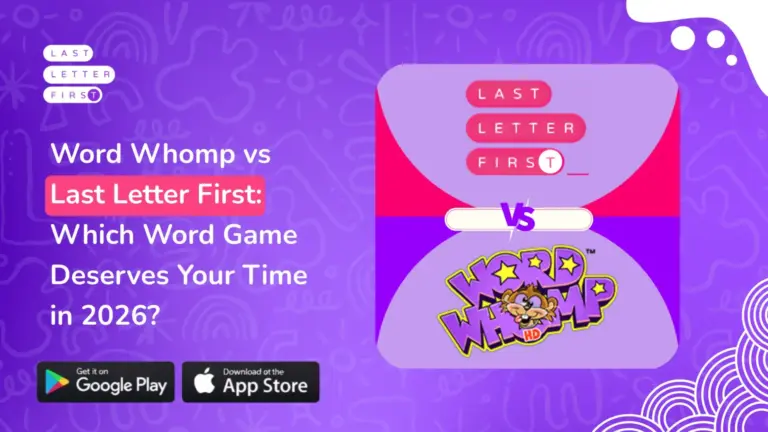
When comparing Word Whomp vs Last Letter First, the key difference is clear: Word Whomp was built for solo anagram puzzles, while Last Letter First at lastletterfirst.com delivers real-time, head-to-head word competition in your browser or app. With Word Whomp’s availability declining since Flash’s 2020 retirement, Last Letter First offers a reliably accessible alternative , complete with private rooms, weekly tournaments with a $100 prize, and zero ads.
Last Letter First vs word whomp: Side-by-Side
Core Gameplay
In Word Whomp, six letters appear on screen and you type every valid English word of three to six letters you can form from those letters before the timer expires. It’s a pure anagram puzzle. The skill is recognition: how quickly can you see “STREAM” hiding inside S, T, R, E, A, M?
Last Letter First works on a different axis. You and your opponent take turns playing words, and each word must start with the last letter of the previous word. The skill is contextual recall under pressure, pulling words from your vocabulary that fit a changing constraint every turn.
Social and Multiplayer
Word Whomp was always solo. Pogo offered chat rooms and leaderboards around its games, but gameplay itself was you against the clock. No opponent. No shared tension.
Last Letter First is built around the opposite premise. Every round is played against a real person. Compete against a random opponent, open a private room, or enter the weekly tournament.
Platform Availability
Word Whomp was hosted on Pogo.com as part of EA’s free-to-play portal, but the game’s availability has become unreliable since EA scaled back Pogo’s classic Flash-based library after Adobe ended Flash support in December 2020. Some users report accessing HTML5 versions of certain Pogo games, but Word Whomp’s status remains inconsistent.
Last Letter First runs in any modern browser at lastletterfirst.com and is available as a mobile app. No Flash. No plugins. No download.
Strategy Depth
Word Whomp strategy centers on letter-combination fluency and speed. The ceiling is relatively fixed once you’ve internalized common word patterns.
Last Letter First introduces tactical letter manipulation. Skilled competitors deliberately end words on difficult letters (Q, X, Z) to corner their opponent. You aren’t just recalling words. You’re choosing them strategically. That’s a meaningfully higher ceiling.

Family Suitability
Word Whomp’s cartoon gophers made it approachable for older adults, but it wasn’t designed for mixed-age family use. Last Letter First’s chain mechanic scales across age groups because younger participants contribute shorter words while experienced ones push for advanced terms. For families looking for word games for kids that also challenge adults, the chain format is a natural fit.
| Dimension | Word Whomp | Last Letter First |
|---|---|---|
| Mechanic | Timed anagram (unscramble 6 letters) | Word chain (start with last letter) |
| Opponents | None (solo vs. clock) | Live human opponents |
| Platform | Pogo.com (unreliable in 2026) | Browser + mobile app |
| Session length | 3-5 min | 3-7 min |
| Strategy ceiling | Medium (pattern recognition) | High (tactical letter manipulation) |
| Family suitability | Moderate | Strong (scales across ages) |
| Ads | Heavy (Pogo free tier) | None |
| Multiplayer modes | None | Random match, private rooms, weekly tournament |
What Users Say About word whomp
Word Whomp sentiment among loyal users follows a pattern common across legacy Pogo games: deep loyalty mixed with growing frustration.
Nostalgia and Simplicity
Word Whomp fans don’t just like the game. They built daily routines around it. Many describe it as a morning ritual, something they did with coffee before the day started. Users consistently appreciate that it didn’t try to be more than it was: no progression systems, no loot boxes, just letters and a timer.
Ad Fatigue and the Multiplayer Gap
The most common complaint across Pogo communities is advertising. The free tier has long been heavy on ads, and users describe the experience as increasingly cluttered. Pogo Club removes some ads but introduces subscription friction.
A recurring theme is the wish for competitive features. Users wanted to challenge friends or compare scores in real time. Pogo never added those features. That gap is arguably what makes the comparison with Last Letter First most relevant.
Decline
Word Whomp’s availability declined after Adobe discontinued Flash in December 2020, and EA has not released a standalone replacement or a modernized version of the game outside the Pogo ecosystem. The elephant in the room for any Word Whomp loyalist is straightforward: the game you love may not be there tomorrow.
Where Last Letter First Is a Strong Fit
Last Letter First is the strongest fit for users who want the same short, vocabulary-driven sessions that made Word Whomp appealing but with a live human opponent on the other side.
The Social Layer Pogo Never Built
Word Whomp fans asked for multiplayer for years. Last Letter First was built around it from the start. Private rooms, the weekly tournament with a $100 prize, and random matchmaking all ship free. The social element isn’t a feature request on a roadmap. It shipped.
Vocabulary Building Through Contextual Recall
Here’s a second paradox: the game that gives you letters to rearrange may exercise a narrower cognitive skill than the game that asks you to generate words under a changing constraint. Anagram games test recognition. Chain games test retrieval, flexibility, and decision-making simultaneously. The Last Letter First learning hub includes guides for improving chain-word technique.
No Ads, No Download, Short Sessions
Matches run three to seven minutes. No ads interrupt gameplay. No download is required. For users whose biggest frustration with Pogo was ad clutter and subscription pressure, this is a solid alternative that doesn’t ask you to pay for a clean experience. The FAQ page covers details on private rooms and tournaments.
Active Development in 2026
Last Letter First is actively maintained and receiving updates in 2026. I’d argue that’s worth its weight in gold for anyone who’s been burned by a favorite game vanishing. Committing habit-building energy to a game that could disappear carries a real cost.
Switching and Migration
Switching from Word Whomp carries none of the friction you’d expect from migrating between productivity apps.
There’s no save data to transfer. Word Whomp tracks scores within Pogo accounts, but those records aren’t portable. Last Letter First starts every user fresh, so switching has zero data-loss risk.
Honestly, the real barrier isn’t technical. It’s habit. But comfort and quality aren’t the same thing. A game can feel familiar without actually challenging you anymore.
The lowest-risk approach is running both for a week. Do your usual Word Whomp session, then open Last Letter First in a second tab. You’ll know within three or four sessions whether the chain mechanic clicks. The Last Letter First FAQ page covers common onboarding topics.
Pricing Comparison
Both games position themselves as free, but the cost structures differ once you look past the landing page.
| Cost Element | Word Whomp (Pogo) | Last Letter First |
|---|---|---|
| Base access | Free with ads | Free, no ads |
| Ad-free option | Pogo Club (~$3.99/month per Pogo’s membership page) | Not applicable (no ads) |
| Annual cost (ad-free) | ~$47.88 | $0 |
| In-app purchases | Pogo tokens for badges/power-ups | None |
| Tournament entry | Not available | Free ($100 weekly prize pool) |
The cheaper the tool, the more expensive the mistakes it hides. Pogo’s “free” tier costs you attention through dozens of pre-roll and interstitial ads per session. Last Letter First sidesteps that tradeoff entirely.
Verdict
Word Whomp vs Last Letter First isn’t a question with a single right answer. It’s a question about what you want from a word game in 2026.
Word Whomp remains the stronger pick for solo anagram purists who treat their daily session as a private ritual. The scramble-and-solve mechanic is meditative. You aren’t competing against anyone. For users who value that quiet experience, nothing about Last Letter First replicates it.
Last Letter First is the better choice for users who want a human on the other side. The chain-word mechanic adds a social and tactical layer Word Whomp never attempted. Private rooms, the weekly tournament, and random matchmaking all ship free. For families, the game doubles as a vocabulary-building activity for kids without feeling like homework.
Neither game replaces the other entirely. Anagram puzzles reward recognition within a fixed letter set, while chain-recall rewards breadth of vocabulary and tactical letter placement. They exercise different parts of the same skill set. And the best word-game enthusiasts tend to enjoy more than one format anyway.
Frequently Asked Questions
Is there any game data to migrate from Word Whomp to Last Letter First?
No. Word Whomp tracks scores within your Pogo account, but those records aren’t portable. Last Letter First starts every user with a clean slate, so switching carries zero data-loss risk. Your Pogo score history stays on Pogo’s servers whether you keep playing or not. The only thing you bring is your vocabulary.
Can I play both Word Whomp and Last Letter First at the same time?
Yes, running both in tandem is the easiest way to compare. Neither game requires an exclusive commitment. Many users enjoy alternating, using Word Whomp for solo warm-ups and Last Letter First for social rounds later in the day.
Will I lose my Pogo Club subscription benefits if I switch?
Your Pogo Club membership is independent of any other game you use. Last Letter First is free and browser-based, so trying it doesn’t affect an existing Pogo subscription. If you eventually cancel Pogo, that’s a separate decision handled through Pogo’s account settings.
What are the best starter words to maximize letter coverage in word games?
In anagram games like Word Whomp, start with common vowel-consonant combinations such as RATES or STONE to quickly identify which letters are in the mix. In chain-based games like Last Letter First, the opening word matters less than the ending letter you leave for your opponent. Choosing a word ending in X or Z puts immediate pressure on the other participant. The Last Letter First learning hub offers deeper guides on letter selection.
How do strategies differ between Wordle-style and anagram-based games?
Wordle rewards elimination logic, narrowing the solution space with each guess. Anagram games like Word Whomp reward recognition within a fixed letter pool. Last Letter First’s chain mechanic adds a positional constraint neither format shares: you must start each word with a specific letter while choosing an ending letter that disadvantages your opponent. The Last Letter First learning hub breaks down how approaches differ across game types.
Is Last Letter First suitable for kids and family play?
Yes. The word lists are family-friendly, and the chain format naturally scales to a participant’s vocabulary level. Younger users contribute simpler words while adults push for advanced terms. The dedicated word games for kids guide covers how to use private rooms for family play.
Does Last Letter First require a download or app install?
No, it runs entirely in a web browser with no install required. Last Letter First also offers a mobile app, but the browser version is fully featured and requires no account creation to try. According to Statista’s 2024 mobile gaming report, browser-based access remains a significant driver of casual game adoption.
How long is a typical Last Letter First session compared to Word Whomp?
Both games offer sessions under 10 minutes. Word Whomp uses a countdown timer per round, usually two to three minutes. Last Letter First sessions vary by opponent pace but stay similarly brief: a fast match might finish in four minutes, while a deliberate round could stretch to eight. The NPD Group’s 2024 gaming report found that casual word-game sessions averaging under 10 minutes have the highest daily return rates.
Is Last Letter First free or does it have a subscription fee?
Last Letter First is completely free with no subscription required. There are no ads, no premium tier gating core features, and no in-app purchases. This contrasts with Word Whomp’s ad-supported free tier on Pogo, where users either watch ads or pay for Pogo Club. Private rooms, tournaments, and full multiplayer functionality are all included at no cost.
Can I play Last Letter First solo if I do not have an opponent?
The game is built around live opponent play, which is its core differentiator, so solo play isn’t the primary experience Last Letter First offers. That said, solo practice modes or AI opponents may be available to help you sharpen your skills between matches; check the /faq/ section on our site for the latest feature list and options.
Should I reuse confirmed letters or try new ones in anagram word games?
Reusing confirmed letters is usually more efficient in anagram games because you’re working with a fixed set of tiles. Word Whomp rewards this rearranging strategy since you unscramble the same six letters into multiple words, while Last Letter First rewards broad vocabulary recall since each new word must start with the prior word’s last letter—making letter reuse less relevant to success.
Where This Heads Next
The word-game landscape in 2026 is splitting along a clear line. Legacy solo puzzles like Word Whomp serve a loyal audience that values routine and quiet focus. Multiplayer formats like Last Letter First pull in users who want the same short sessions but with a person across the table.
Both sides have staying power. But the trajectory favors social play. The users searching for this comparison right now are, frankly, the ones already feeling that pull.
If you’re on the fence: play Last Letter First free in your browser, open a private room, and invite someone who used to enjoy Word Whomp with you. One round will tell you more than any comparison article can.
The Last Letter First Editorial Team covers word-game strategy, comparisons, and vocabulary-building techniques. For more guides and resources, visit the Last Letter First learning hub.