
Key Takeaways
- Words ending in A are disproportionately borrowed from Latin, Spanish, and Italian, giving English a huge pool of valid game words most players overlook.
- Five-letter words ending in A balance accessibility and scoring power, with rare picks like “aboma” and “durra” delivering more points per play than common choices.
- High-scoring words containing J, Q, X, or Z can reach 25+ points in Scrabble before any premium tile bonuses.
- Organizing words by rarity tier helps players memorize strategically rather than drowning in alphabetical lists.
Think you already know enough words ending in A? Most players do. And most players are leaving serious points on the table.
Here’s the paradox: the letter A is one of the most common tiles in your rack, yet it’s also one of the most underused strategically. Players burn through A tiles on low-value words like “area” when uncommon endings are worth two or three times the points. If you’ve been building your word game vocabulary with generic lists, this guide ranks A-ending words by what matters most: point value, rarity, and cross-game usefulness.
Why Words Ending in A Matter for Word Games
Words ending in a span thousands of valid entries across Scrabble, Words With Friends, and chain-style games where your last letter launches your opponent’s next move. At Last Letter First, we track these versatile words because they force opponents into tough “A” starts. From “pizza” to “trivia,” A-enders deliver surprising strategic value across every major word game format.
Five-Letter Words Ending in A You Should Know
Five-letter words ending in A hit the sweet spot between playability and scoring power in most word games. Long enough for meaningful points, short enough to build from common tile combinations.
|
Tier |
Words |
Scrabble Points |
Strategic Notes |
|
Common |
pasta, plaza, opera, ultra, extra |
7-14 pts |
Most players know these; low surprise value |
|
Intermediate |
quota, tiara, flora, sauna, llama |
10-14 pts |
Familiar but underused; good in timed rounds |
|
Rare |
aboma, chela, durra, loofa, theca |
9-12 pts |
Opponents won’t challenge; high disputed-play value |
The rare tier is where things get interesting. “Aboma” (a large South American snake, 9 points) and “durra” (a grain sorghum, 6 points) aren’t flashy scorers, but they’re practically impossible to challenge successfully. That psychological edge is worth its weight in gold during competitive play. “Chela” (a claw-like appendage, 10 points) and “theca” (a biological sheath, 10 points) sit in a useful zone of decent scoring and genuine obscurity.
High-Scoring A-Ending Words and Point Breakdowns
Words ending in A account for a disproportionate share of high-value plays in Scrabble because many contain uncommon consonants like J, X, and Z.
|
Word |
Scrabble Points |
Definition |
Cross-Game Valid? |
|
pizza |
25 |
Flatbread dish with toppings |
Scrabble, WWF, LLF |
|
piazza |
26 |
An open public square |
Scrabble, WWF, LLF |
|
bonanza |
19 |
A source of great wealth or luck |
Scrabble, WWF, LLF |
|
influenza |
22 |
A viral respiratory illness |
Scrabble, WWF, LLF |
|
stanza |
16 |
A grouped set of lines in a poem |
Scrabble, WWF, LLF |
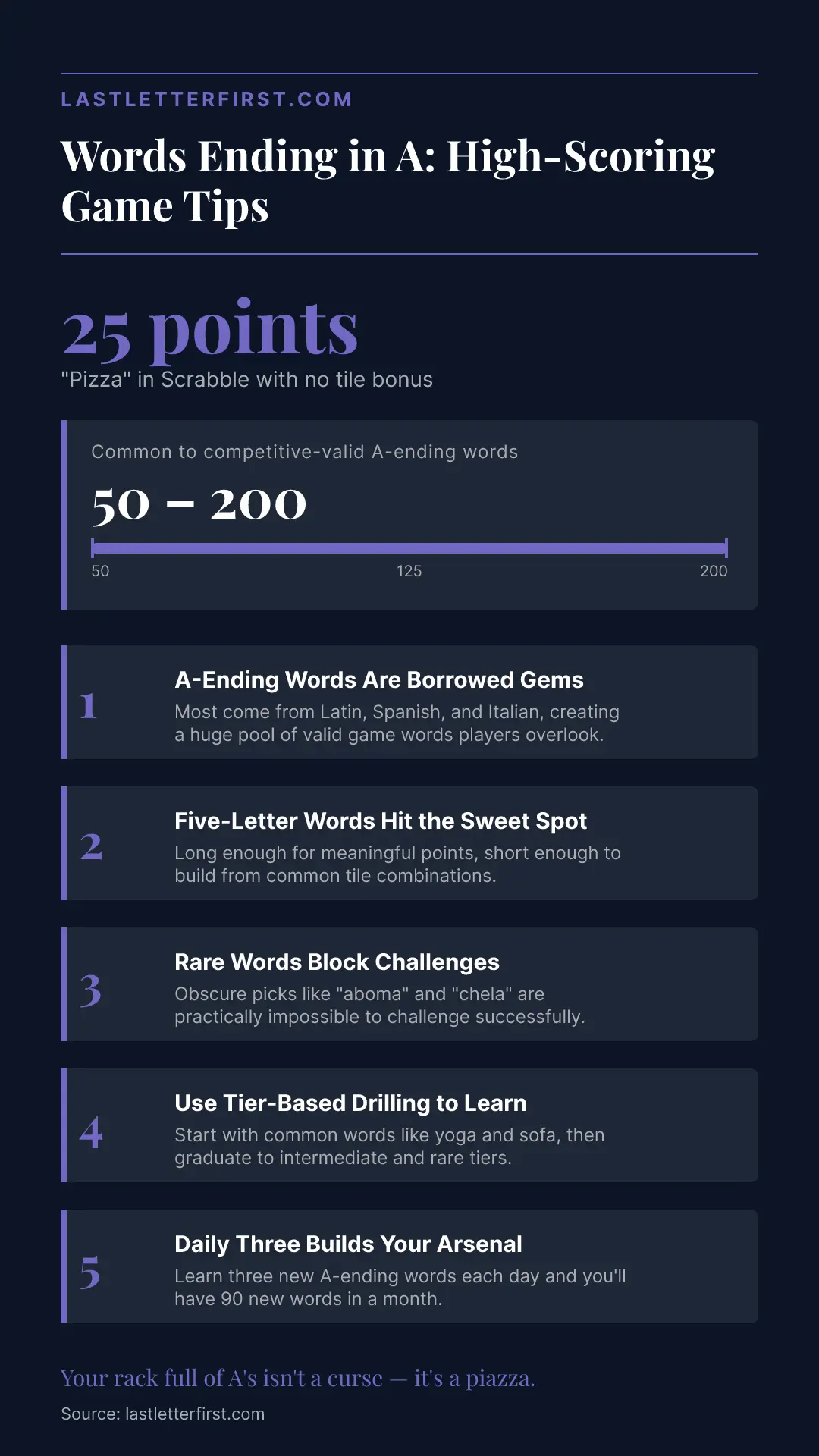
The word “pizza” scores 25 points in Scrabble without any premium tile placement. Drop that Z on a triple-letter square and you’re looking at 35+ points from five letters. But frankly, how often you can play a word matters just as much as its peak value. “Stanza” and “pizza” use common enough tiles that opportunities arise multiple times per session, while “influenza” requires specific combinations you might wait rounds to assemble.
Crossover Words That Work in Multiple Games
Flashcards are fine. But playing regularly beats passive study every single time. Here’s the paradox of vocabulary building: the more pressure you’re under, the better the words stick.
Three approaches that genuinely help:
- Tier-based drilling. Start with common words (yoga, sofa, pasta), graduate to intermediate (quota, tiara), then tackle rare picks. Don’t skip tiers.
- Chain practice. Play word chain games where every answer must end in A, building recall speed and strategic thinking simultaneously.
- Daily three. Learn three new A-ending words each day. In a month, that’s 90 words, and most players only need 30-40 uncommon ones for a serious edge.
According to the American Speech-Language-Hearing Association, word games strengthen phonological awareness and vocabulary retention across all age groups.
How to Practice and Memorize A-Ending Words
The best word game players aren’t the ones with the biggest vocabularies. They’re the ones who know which words hit hardest when it counts. Pick five high-scoring words ending in A today. Play them this week.
By the Last Letter First Editorial Team. We cover word game strategy, vocabulary building, and language learning at lastletterfirst.com/learning-hub.