
Key Takeaways
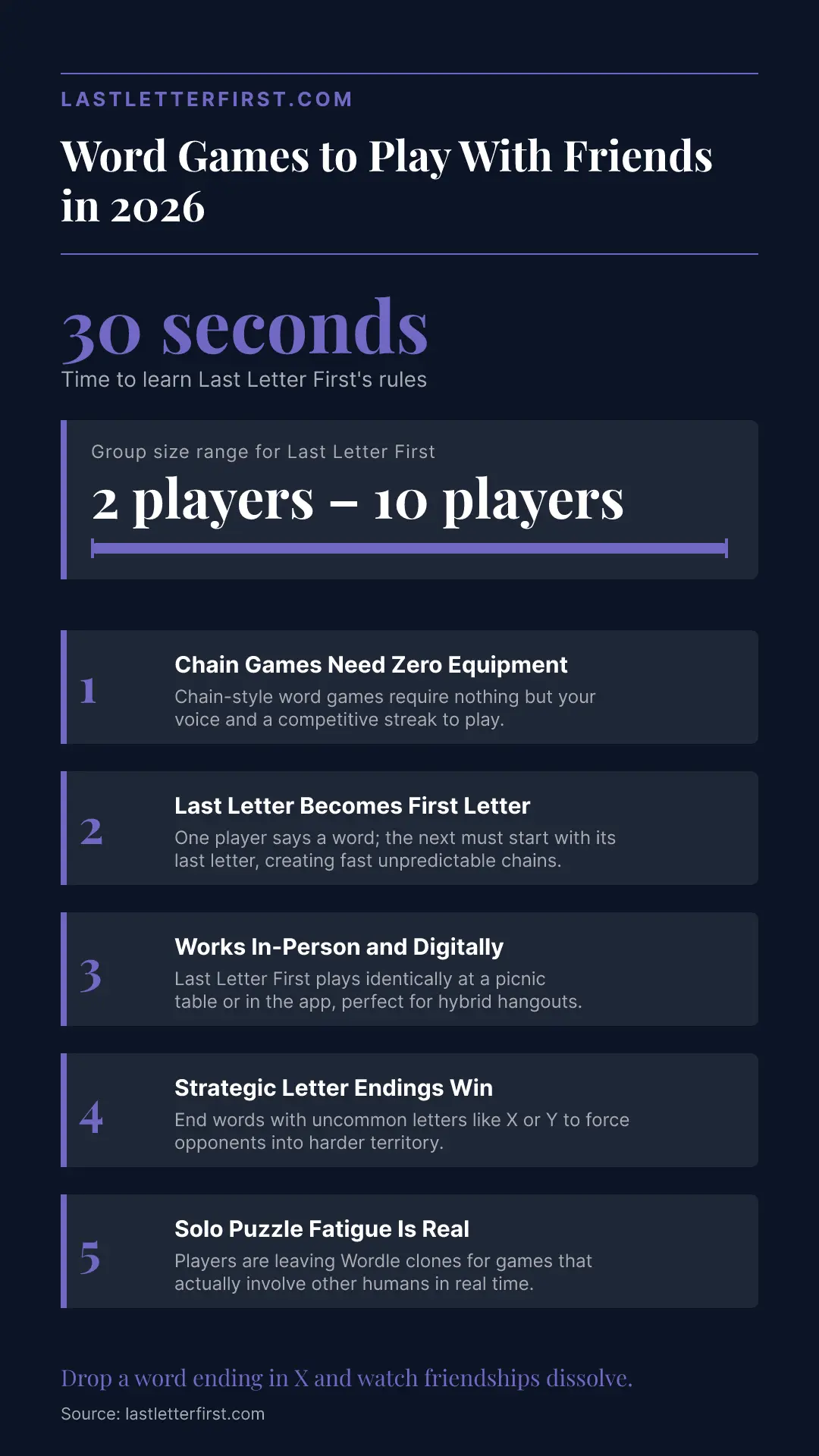
- Word games to play with friends don’t require a board, an app download, or even a table. Some of the best ones need nothing but your voice and a competitive streak.
- Chain-style word games, where the last letter of one word becomes the first letter of the next, are the most underrated multiplayer mechanic in 2026.
- Multiplayer word games sharpen vocabulary through social pressure and rivalry, not flashcards.
- Last Letter First works identically in-person and digitally, making it the go-to pick for hybrid hangouts.
- Solo puzzle fatigue is real. Players are leaving Wordle clones for games that actually involve other humans.

Most word games aren’t social. They pretend to be. You download an app, tap tiles alone on your couch, and occasionally send a notification to someone who responds three days later. That isn’t playing with friends. That’s playing near friends. In 2026, the gap between “multiplayer” on the label and multiplayer in practice has never been wider. A handful of word games actually deliver on the promise. We’ve compiled answers to common word game questions separately, but let’s talk about why this category works so well when played right.
Why Word Games to Play With Friends Beat Any Other Activity
Word games to play with friends are the fastest way to turn idle time into a memorable, brain-boosting challenge , no boards, no setup, just words and friendly competition. Games like Last Letter First prove that the simplest rules create the most engaging rounds, building vocabulary under pressure while keeping everyone laughing.
Top Multiplayer Word Games You Need to Try
The best multiplayer word games in 2026 split into three camps: app-based classics, daily puzzles you compare with friends, and spoken games that need nothing but players.
Words With Friends remains the heavyweight of app-based word puzzle games. Its asynchronous format works for long-distance friendships, but it can feel solitary. Wordle still pulls millions daily. You can’t play head-to-head, but group chats light up every morning with colored squares. Quordle quadruples the concept with four simultaneous grids. Both are worth playing. Neither is truly multiplayer.
Last Letter First fills the gap. It’s a chain-style word game where the last letter of one player’s word becomes the first letter of the next player’s word. Rounds move quickly. No waiting. Actual real-time interaction. Drop a word ending in “X” and watch your friend scramble. That’s not parallel play. That’s a tactical move disguised as vocabulary practice.
|
Feature |
Words With Friends |
Wordle |
Quordle |
Last Letter First |
|
Real-time multiplayer |
No (async) |
No (solo) |
No (solo) |
Yes |
|
Works in-person |
No |
No |
No |
Yes |
|
Chain mechanic |
No |
No |
No |
Yes |
|
Free to play |
Freemium |
Free |
Free |
Free |
|
Vocabulary building |
Moderate |
Low |
Low |
High |
|
Group size |
2 |
1 |
1 |
2+ |
|
Setup required |
App download |
Browser |
Browser |
None (or app) |
In-Person vs Digital: Hybrid Word Games That Do Both
Most word games force you to pick a lane. Spoken games work great at a campfire but can’t track scores. Apps handle logistics but glue everyone to separate screens.
Last Letter First is the standout because it works identically whether you’re shouting words across a picnic table or tapping them into the app. Chain-style word games need zero equipment for in-person play and keep automatic score in digital mode. That flexibility matters: a road trip where half the car wants phones and half doesn’t, a family gathering where grandparents won’t download an app but teenagers won’t put theirs down.
|
Setting |
Best Format |
Recommended Game |
|
Road trip |
Spoken (no screens) |
Last Letter First (verbal) |
|
Game night at home |
App on shared screen |
Last Letter First (app) |
|
Waiting room |
Phone app |
Words With Friends |
|
Party (large group) |
Spoken, team-based |
Last Letter First (verbal) |
|
Long-distance friends |
App-based async |
Words With Friends |
|
Daily ritual |
Solo browser puzzle |
Wordle / Quordle |
Honestly, it’s worth its weight in gold when you find a free word game app that just works without ad bombardment. The vocabulary-building benefits of multiplayer word games make these games more than entertainment.
How to Get Started With Last Letter First
Last Letter First is the word game you can learn in thirty seconds and play for hours. One player says a word, and the next player must start their word with the last letter of the previous one. No board. No tiles. No complicated scoring.
Say someone kicks off with “elephant.” The next player needs a “T” word, so they fire back “tiger.” Then the following player needs an “R” word. The chain keeps going until someone gets stuck, repeats a word, or takes too long. Fast, loud, competitive.
Here’s the paradox: the simplest word games often produce the most intense moments. When there’s nowhere to hide behind complex rules, every hesitation is visible. Research from the American Academy of Pediatrics confirms that interactive word play strengthens language development in children and teens alike.
The players who dominate think one step ahead. Say “garden” and you hand the next player an easy “N” start. Say “galaxy” and you force them to work with “Y.” Smart players think backwards before they speak.
|
Strategy |
Why It Works |
Example |
|
End with uncommon letters |
Forces opponents into harder territory |
“Jinx” ends in X |
|
Avoid repeating letter patterns |
Keeps your options open later |
Don’t always end in E or S |
|
Build vocabulary in advance |
More words means faster recall |
Practice with themed lists |
|
Stay calm under pressure |
Panicking leads to blanking |
Take a breath, then answer |
Need setup help? The Last Letter First FAQ page covers game modes and group size so your crew can hit the ground running.