
Key Takeaways
- Most vocabulary app roundups only compare solo drill tools and gamified flashcard apps, ignoring multiplayer competitive word games as a legitimate learning category.
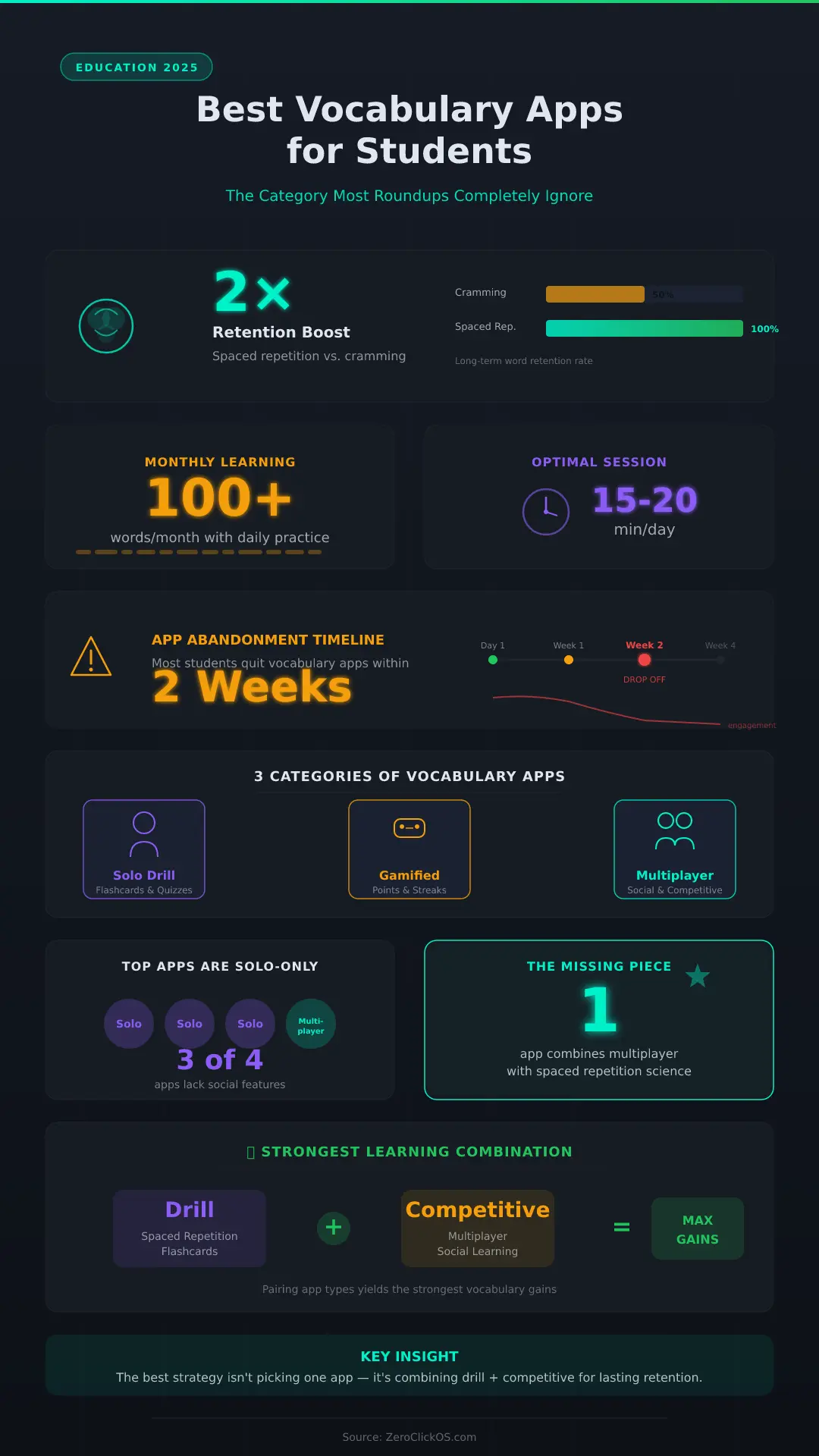
- Spaced repetition systems improve long-term vocabulary retention by roughly two times compared to cramming, according to a 2024 meta-analysis in Educational Psychology Review.
- Last Letter First is the only Vocabulary Apps for students roundup that combines real-time multiplayer competition with spaced repetition science.
- A useful three-category framework for evaluating vocabulary apps is solo drill, gamified, and multiplayer/social, because each serves a different motivation profile.
- Pick apps based on how they sustain daily practice, not just how many words they claim to teach.

Here’s the uncomfortable truth about vocabulary apps in 2025: most are digital flashcards wearing a fresh coat of paint. Students download them, tap through a few rounds, and quietly abandon them within two weeks. If you’re tired of that loop, this roundup takes a different approach. We break vocabulary apps into three categories, compare them head-to-head, and explain why one entire category, multiplayer word games that boost family vocabulary, gets overlooked by almost every competitor article.
Why Vocabulary Apps for Students Beat Traditional Study Methods
Vocabulary apps for students work best when they combine spaced repetition with competitive play — quiet solo quizzes build recognition, but head-to-head word games like Last Letter First add emotional stakes that push recall into long-term memory. Reading gives students raw material; the right app turns that material into permanent knowledge.
Top Vocabulary Apps Compared: Features at a Glance
|
App |
Free Tier |
Paid Plan |
Learning Method |
Solo or Social |
Best For |
|---|---|---|---|---|---|
|
Vocabulary.com |
Yes (limited) |
~$3/month |
Adaptive quizzes |
Solo (Vocab Jam for classrooms) |
SAT/ACT prep, definition mastery |
|
Membean |
No (school license) |
School pricing |
Spaced repetition, contextual learning |
Solo |
Classroom-assigned vocab building |
|
WordUp |
Yes |
Premium ~$5/month |
Word ranking by real-world frequency |
Solo |
Prioritizing high-impact words |
|
Last Letter First |
Yes |
Premium available |
Spaced repetition + multiplayer competition |
Multiplayer/Social |
Students who need motivation and social play |
Three of four apps are solo experiences. Only one adds real-time competitive multiplayer.
Vocabulary.com works well for standardized test prep with its adaptive quiz engine. Membean takes a school-licensed approach with contextual spaced repetition (the Membean login portal is school-specific). Both do their jobs. But they share a ceiling: when novelty fades, students stop opening them.
Last Letter First fills that gap. Players compete in real-time multiplayer word games, racing to recall vocabulary under time pressure. Explore strategies in the Learning Hub. WordUp complements this with smart word prioritization by frequency, though it remains solo.
Why Multiplayer Word Games Build Vocab Faster
Competition creates emotional stakes, and emotional stakes make words stick. That’s not a marketing claim. It’s a pattern backed by decades of memory research showing that even mild competitive excitement strengthens memory consolidation.
How to Pick the Right App for Your Goals
No single app does everything well. Drill tools like Membean excel at structured repetition but feel isolating after a few weeks. Gamified platforms like WordUp make learning lighter yet rarely push past comfortable difficulty. Multiplayer word games like Last Letter First create social pressure that keeps students returning.
The smartest approach? Pair a drill app with a competitive app. Use one for systematic word exposure, the other for active recall under real-time pressure. A 2024 meta-analysis in Educational Psychology Review found retrieval practice combined with social motivation produces significantly stronger long-term gains than either method alone. Set a concrete target, like learning 100 new words a month using word games.
Students (middle school through college): Pair Membean for daily drills with Last Letter First for competitive sessions. Membean handles exposure; Last Letter First turns recall into a challenge you want to win.
Families: Last Letter First is the clear pick for shared sessions, one of the few vocabulary apps where parents and kids play together in real time. That shared experience does more for retention than any solo flashcard deck. Learn more about multiplayer word games and family vocabulary.
Educators: Membean’s classroom dashboard handles assignments and tracking. Layer in Last Letter First as a weekly group activity. Honestly, the self-driven repetition that competition creates is worth its weight in gold.
Here’s the paradox worth sitting with: the app that feels least like studying often produces the strongest results. Fun and rigor aren’t opposites. They’re partners.
Start Building Your Vocabulary Today
Strong vocabulary isn’t a nice-to-have. It’s the foundation supporting reading comprehension, test scores, and career advancement. Try Last Letter First for free and challenge a friend to your first match. You’ll be surprised how quickly competitive play turns unfamiliar words into words you actually use.