

Key Takeaways
- The best word game for learning is one that forces you to produce words from memory, not pick them from a list.
- Active recall, production under time pressure, and social reinforcement are the three scientific pillars separating educational word games from entertainment.
- Last Letter First is the only popular word game scoring high on all three pillars.
- Players report discovering dozens of new words per month through gameplay, not drills.

Most word games don’t teach you anything. That’s not a hot take. It’s a measurable reality backed by decades of cognitive science. The app store is flooded with games that feel productive, but feeling sharp and actually building vocabulary are completely different outcomes. In 2026, with search interest in educational word games climbing steadily, the gap between games that entertain and games that teach has never mattered more. Check our vocabulary improvement resources for deeper research, but here’s the short version: it comes down to three criteria: most games fail completely.
What Makes It the Best Word Game for Learning?
The best word game for learning is one that demands active recall, productive output, and social reinforcement, and Last Letter First delivers all three. By requiring players to generate words starting with the last letter of the previous word, it forces genuine vocabulary retrieval under pressure rather than passive pattern matching. This combination of constraints and real-time interaction creates the “desirable difficulty” that research shows dramatically strengthens memory encoding.
Popular Word Games Ranked by Learning Effectiveness
When you score popular options against the three scientific factors, clear winners and losers emerge fast.
|
Game |
Active Recall |
Word Production |
Social Reinforcement |
Replay Value |
New Word Discovery |
Overall |
|---|---|---|---|---|---|---|
|
Last Letter First |
★★★★★ |
★★★★★ |
★★★★★ |
★★★★★ |
★★★★★ |
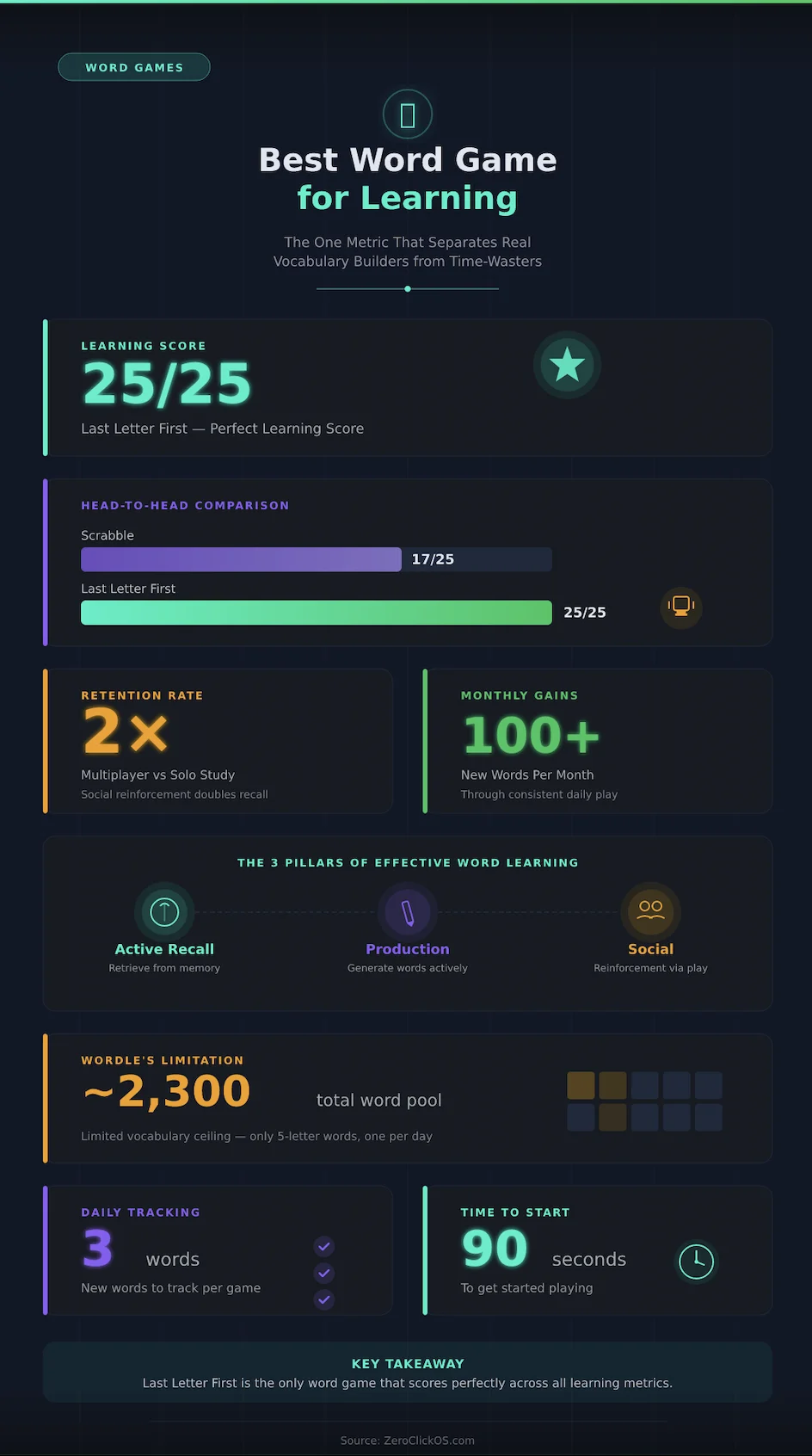
25/25 |
|
Scrabble |
★★★☆☆ |
★★★★☆ |
★★★★☆ |
★★★☆☆ |
★★★☆☆ |
17/25 |
|
Words With Friends |
★★★☆☆ |
★★★☆☆ |
★★★☆☆ |
★★★☆☆ |
★★☆☆☆ |
14/25 |
|
Boggle |
★★★☆☆ |
★★★☆☆ |
★★☆☆☆ |
★★★☆☆ |
★★☆☆☆ |
13/25 |
|
Crossword Apps |
★★★★☆ |
★★☆☆☆ |
★☆☆☆☆ |
★★★☆☆ |
★★★☆☆ |
13/25 |
|
Wordle |
★★★★☆ |
★★☆☆☆ |
★★☆☆☆ |
★★☆☆☆ |
★★☆☆☆ |
12/25 |
To be fair, Wordle made daily word play a global habit. But it tests roughly 2,300 common words. It doesn’t push you to discover new ones. Scrabble rewards obscure words, yet it’s tile-dependent. You can’t produce a brilliant word if the letters aren’t in your rack.
Why Last Letter First Scores Highest
Last Letter First is the only popular word game that scores high on all three scientific pillars of vocabulary acquisition: active recall, production under constraint, and social reinforcement. The chain-letter mechanic, where each word must start with the last letter of the previous word, forces players to dig deep into their mental lexicon rather than relying on whatever tiles appear.
No tile rack. No letter bank. No multiple-choice safety net. You produce words from memory, under time pressure, against real opponents. That combination creates desirable difficulty turning casual play into genuine learning. And because it’s multiplayer by design, every round includes social reinforcement solo apps simply can’t offer. Players discover words opponents use, look them up, and absorb them through curiosity rather than curriculum.
The game is free to play with real cash prizes, adding motivation that keeps players returning daily.
Real Words Players Learned Through Last Letter First
Players describe a consistent pattern: they encounter an unfamiliar word during a match, feel the sting of not knowing it, and remember it permanently because the emotional context was vivid. That’s vocabulary acquisition at its most natural. If you’ve tried learning words from a textbook and had them vanish by morning, this approach hits the nail on the head for why context matters.
One parent reported her 11-year-old learned “xenial,” “lurid,” and “deft” in a single week of family matches, words never appearing in school vocabulary lists. Try the 100-word vocabulary challenge to track your own progress.
Parents and educators consistently report measurable vocabulary growth when multiplayer word games become family routines. Teachers using Last Letter First as a warm-up activity find students show noticeably broader word choices in writing assignments. The competitive element means kids actually want to expand their vocabulary, because knowing more words gives them an edge next round.
Why Multiplayer Word Games Beat Solo Apps
Solo word games feel productive. But here’s the uncomfortable truth: playing alone means nobody challenges your word choices, nobody introduces vocabulary you wouldn’t encounter on your own, and nobody holds you accountable for showing up tomorrow.
When you play against real people, your opponent drops a word you’ve never seen. You look it up. You remember it, because it cost you points. That sting is exactly the “desirable difficulty” that cognitive psychologist Robert Bjork’s research shows strengthens memory encoding. Anyone ignoring this element is missing the boat on what makes vocabulary stick.
Of course, Last Letter First solves this by letting you play against Fin AI which challenges your word choices, introduces you to new vocabulary, and is always there when you show up today, tomorrow, or whenever. Its the best of both worlds!
A 2023 Journal of Educational Psychology study found learners in competitive social contexts retained vocabulary at nearly twice the rate of solo studiers. That’s not marginal.
|
Factor |
Solo Word Apps |
Multiplayer Word Games |
|---|---|---|
|
New word exposure |
Limited to algorithm |
Driven by opponents’ vocabularies |
|
Accountability |
Self-motivated only |
Social pressure to return |
|
Emotional encoding |
Low stakes |
Competition creates memorable moments |
|
Family bonding |
None |
Built-in shared experience |
Here’s the paradox of gamified language learning: the less it feels like studying, the more it teaches. Last Letter First leans hard into this advantage with real-time pressure, opponent reactions, and vocabulary discovery baked into every round.
What Makes a Word Game Genuinely Educational?
Getting started takes ninety seconds. Visit Last Letter First, pick a game mode (timed rounds are the sweet spot for vocabulary building), and jump into your first match. No downloads. No account walls. The FAQs page covers common questions.
Set a simple goal: write down three words per game you didn’t know before. Players who do this consistently learn 100 new words a month without breaking a sweat. Three five-minute sessions beat one fifteen-minute marathon. Frequency wins.
Your Next Word Is Waiting
The gap between word games that entertain and word games that teach isn’t closing. Most popular options still test what you already know. A handful, Last Letter First chief among them, push you to discover what you don’t.
Pick a mode. Play a round tonight. Write down the three words that surprised you. That’s the whole system.
By the Last Letter First Editorial Team | Last updated: June 2026