
Key Takeaways
- Not all brain games deliver equal cognitive benefits
- Word games uniquely boost verbal fluency and memory
- Neuroplasticity means consistent play yields real results
- Match game type to the cognitive skill you want
What Are Brain Games and Why Do They Matter?
- Brain games are structured activities targeting specific cognitive functions, but not all deliver equal benefits.
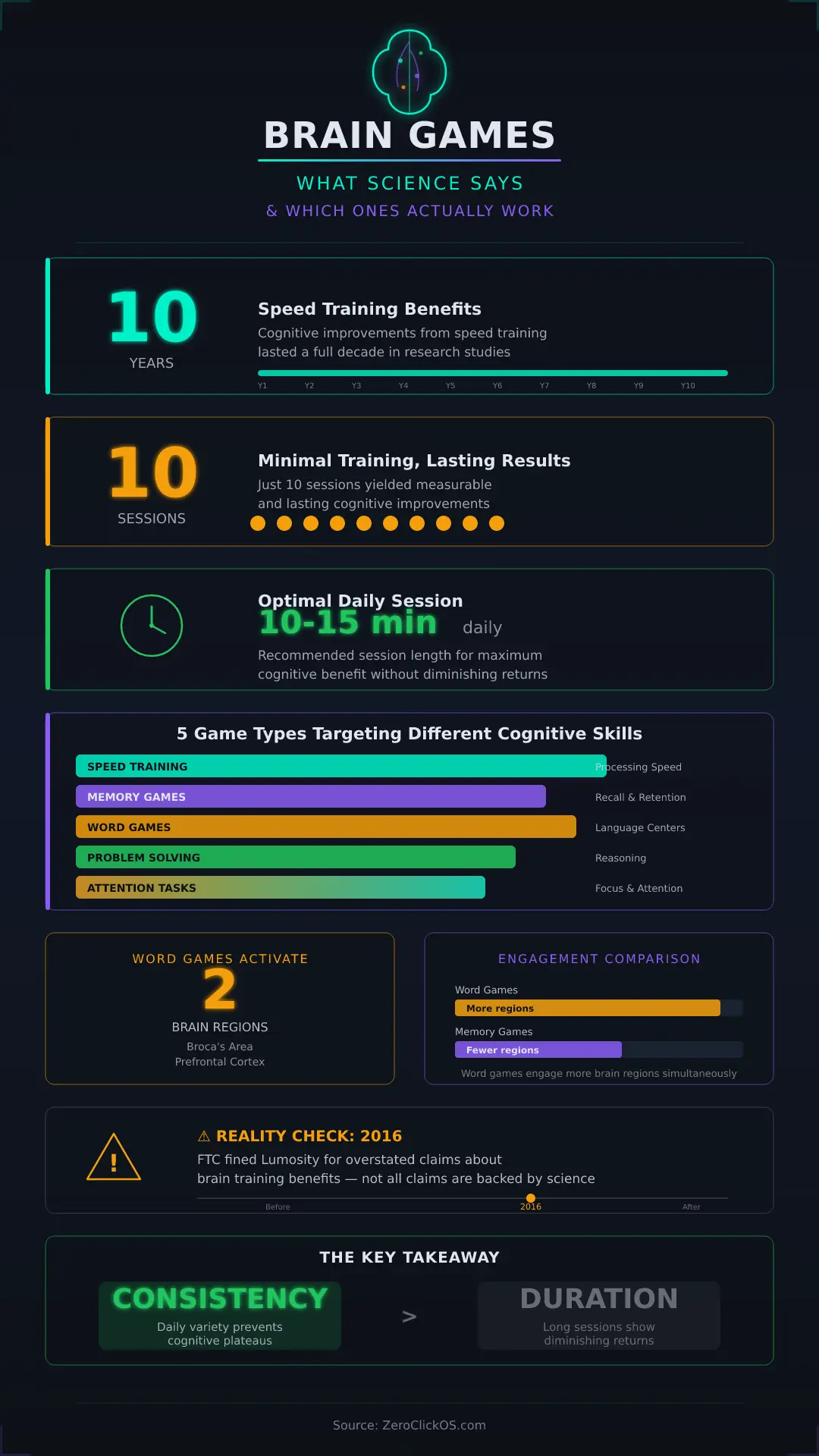
- The NIH-funded ACTIVE trial found processing speed gains that persisted for a decade.
- Word games build verbal fluency and linguistic flexibility, two domains that transfer more reliably to everyday life than most other game types.
- Consistency and variety matter far more than which specific app you pick.
—
That ACTIVE trial follow-up found participants who completed just 10 sessions of speed training still showed measurable improvements a full decade later. A striking return on a modest investment. But the study didn’t find lasting benefits for every training type. Results were specific, conditional, and far more complex than most brain training app marketing suggests.
Does the Science Actually Back Brain Training?
Brain games are structured activities designed to challenge specific cognitive functions like working memory, processing speed, and verbal fluency. Crossword puzzles, chess, and card games have served this purpose for centuries. What’s changed is accessibility: free online games now put cognitive training in everyone’s pocket.
The underlying science is neuroplasticity. Your brain physically rewires itself in response to repeated challenges. The catch is whether improvement transfers beyond the specific task you practiced. That’s where the debate gets interesting.
Which Game Types Target Which Cognitive Skills?
The ACTIVE trial remains the largest randomized controlled study of cognitive training in older adults, tracking participants for over a decade. Speed-of-processing training produced lasting benefits. That’s solid.
But critics raise a fair point: improvements in a brain teaser don’t always translate to remembering where you parked. A 2016 review in Psychological Science in the Public Interest found people get better at the specific game they practice, but evidence for broad cognitive transfer remains thin.
Here’s the paradox: the games that feel easiest are probably helping you least. Cognitive growth requires struggle. Rotating between different word challenges, memory tasks, and logic puzzles keeps your brain adapting rather than coasting.
Word Games: The Underrated Brain Training Category
The real question isn’t “are brain games good?” It’s “which games for which goal?”
|
Game Type |
Primary Skill |
Secondary Benefit |
Examples |
|
Memory games |
Working memory, recall |
Attention span |
Card matching, Simon |
|
Logic puzzles |
Problem-solving |
Processing speed |
Sudoku, Nonograms |
|
Brain teasers |
Processing speed |
Creative thinking |
Riddles, lateral puzzles |
|
Word games |
Verbal fluency |
Linguistic flexibility |
Last Letter First, Scrabble |
|
Strategy games |
Planning, decision-making |
Working memory |
Chess, Go |
Word games are consistently underrated as cognitive tools. A 2019 study in JMIR Serious Games found word-based tasks engaged both Broca’s area and the prefrontal cortex simultaneously. That’s a two-for-one workout most memory games can’t match.
And multiplayer word games add another layer. You’re predicting opponents, adjusting strategy, and managing time pressure. For families, that combination is worth its weight in gold. Kids build vocabulary while parents sharpen recall.
I’d argue the most important tip is simple: don’t turn it into a chore. Ten to fifteen minutes daily is enough, according to ACTIVE trial follow-up data. Rotate game types weekly. Pair solo brain teasers with social word games for the broadest benefit.