
Key Takeaways
- The missing letter game is any word puzzle where players identify absent letters in partially revealed words, spanning crosswords, worksheets, party games, and daily digital puzzles.
- Popular formats range from the Merriam-Webster daily puzzle to live rounds where players race to spot the gap first.
- Adults benefit just as much as children: regular word puzzle play is linked to stronger working memory and sharper recall.
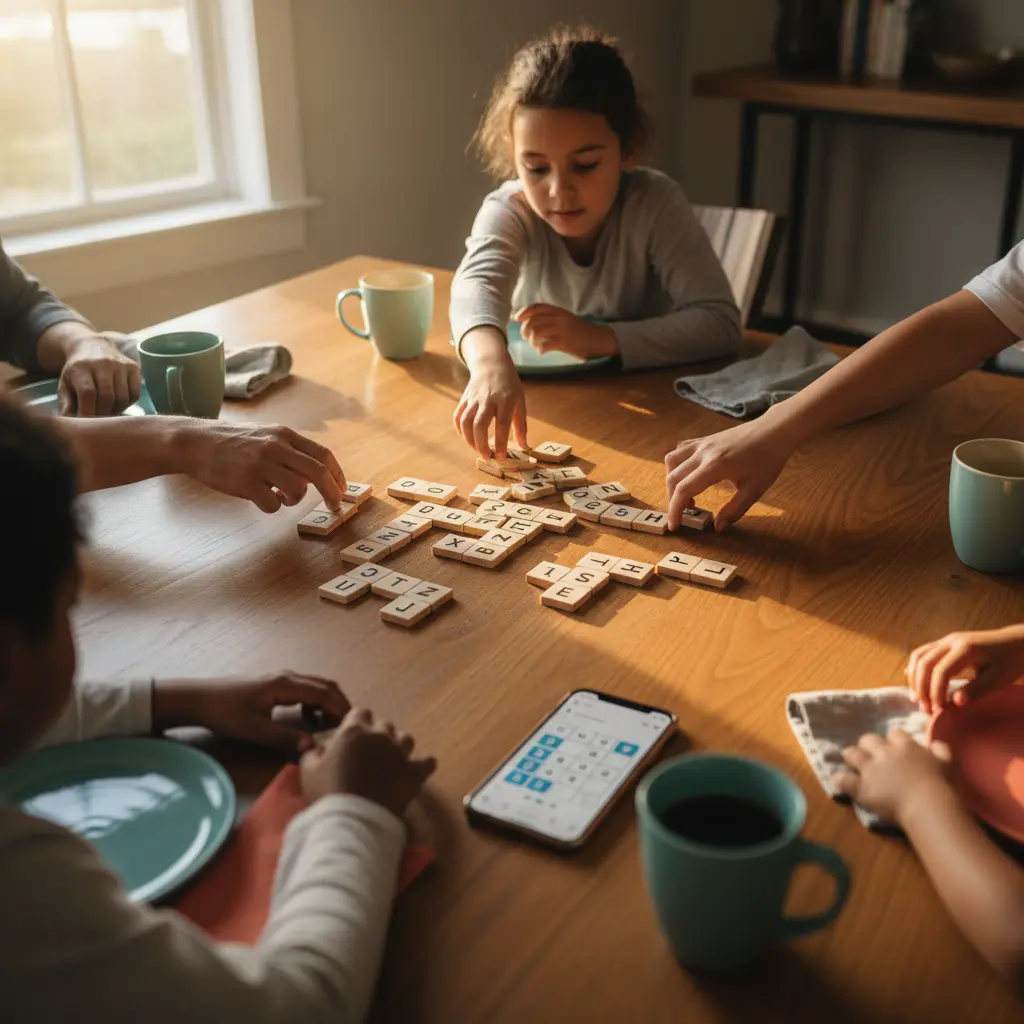
Last Tuesday a friend pulled out her phone at dinner: “Guess this movie: _N_E_S_E_L_A.” Three of us shouted answers over each other. That silly prompt, a handful of blanks where letters should be, held a table of adults captive for twenty minutes. The missing letter game does that. It looks simple. It isn’t.
Search for “the missing letter game” right now and you’ll find a crossword on one site, a kindergarten worksheet on another, a party game on a third. Nobody puts them all in one place. This guide does. And if you’re curious about how word games boost family vocabulary, that connection runs deeper than you’d expect.
What Is the Missing Letter Game?
The missing letter game challenges players to identify absent letters within partially revealed words — a deceptively simple mechanic that demands precise pattern recognition over broad vocabulary. At Last Letter First, we embrace this principle: constraints sharpen thinking. Seeing “N_pt_n_” and knowing the blanks are E, U, and E requires a different skill than generating words from scratch, making these puzzles uniquely rewarding.
Tips to Sharpen Your Missing Letter Skills
Picking the right format depends on context: solo relaxation, classroom learning, or competitive group play.
Print and Digital. The most familiar format is the newspaper-style missing letter crossword. Merriam-Webster’s daily puzzle is probably the most popular digital version in 2025, refreshing every day. App-based versions add timed modes and streak tracking. I’d argue printable worksheets remain underrated for teachers: free, zero tech, scalable to any class size.
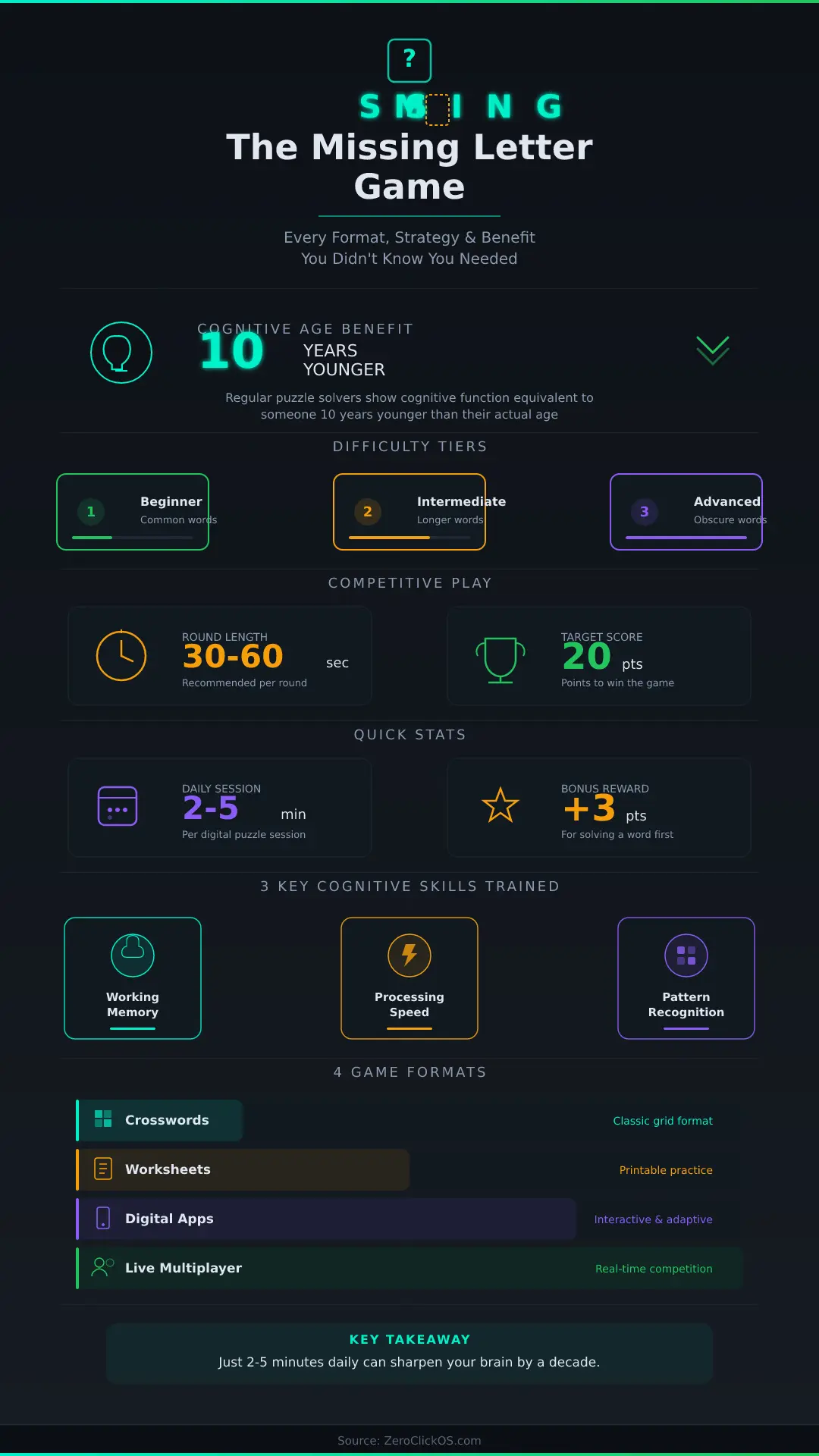
Live Multiplayer. Write a word on a whiteboard with one letter blanked. First person to shout the correct answer scores a point. Timed 30-second rounds keep energy high. Family game nights and classroom contests both thrive on this format’s low setup and high replay value.
Cognitive Benefits for Kids and Adults
The simpler the base game, the fiercer the competition. Because everyone can play, nobody wants to lose.
Award one point per correct letter, three bonus points for solving an entire word first. Set 60-second rounds for beginners, 30 seconds for advanced players. First to 20 points winsRotate tiers each round so nobody feels left out. For scoring ideas that reward collaboration, explore how word games boost family vocabulary.
How to Play Missing Letter Games Competitively
Missing letter puzzles strengthen spelling and phonemic awareness in children. That’s well documented. But the benefits don’t stop at age twelve.
A 2019 study in the International Journal of Geriatric Psychiatry found that adults who solved word puzzles regularly performed as well on attention and reasoning tests as people ten years younger. Working memory, processing speed, and visual pattern recognition all showed measurable improvement. Honestly, dismissing letter games as kid stuff is a missed opportunity.
Frankly, the simplest puzzles often deliver the sharpest cognitive returns. A five-minute session exercises the same mental muscles as complex brain-training apps, without the subscription fee. The American Psychological Association’s research on cognitive training confirms consistent puzzle work strengthens working memory across age groups. For more ways to start, check the FAQs on playing English word games free.
Your Next Move
Missing letter games scale beautifully from a kindergarten spelling drill to a competitive adult party format. The cheapest tools deliver the richest returns. Pick one format tonight. Set a timer. Keep score.
By Last Letter First Editorial Team | Last updated: June 2026