

Key Takeaways
- Vocabulary building games that use active recall and social competition produce 25-40% better word retention than passive study methods like flashcards.
- The best vocabulary games match the player’s age: picture-based for kids, competitive quizzes for teens, strategy-driven multiplayer for adults.
- Multiplayer word games like Last Letter First add social accountability and real-time pressure that solo apps can’t replicate.
- Gamified learning triggers dopamine release during play, strengthening the neural pathways that lock new words into long-term memory.
- Competition forces deeper word recall under pressure, and that’s a scientifically supported mechanism, not just a fun bonus.

Here’s a take that might sting: most solo vocabulary apps are designed to feel productive without making words stick. You swipe, you match, you get a green checkmark. Two weeks later, half those words are gone. The uncomfortable truth is that quiet solo repetition contradicts what cognitive science tells us about language retention. Vocabulary building games, especially ones that pit you against other players in real time, consistently outperform passive methods. You can explore the research behind this in the Learning Hub.
Why Game-Based Vocabulary Learning Beats Rote Memorization
Vocabulary building games strengthen word retention by combining active recall with the motivational power of competition and stakes. At Last Letter First, every round forces players to retrieve words under pressure — exactly the condition research shows improves long-term memory by 25–40% compared to passive review. When scoring points triggers dopamine, your brain treats new vocabulary as worth keeping.
Best Vocabulary Games by Age Group
Not every vocabulary game fits every learner. A quiz designed for a 7-year-old won’t challenge a college student, and a strategy-heavy multiplayer game might frustrate a beginning reader.
|
Age Group |
Best Format |
Why It Works |
Example |
|---|---|---|---|
|
Kids (6-9) |
Picture-based matching |
Visual association builds foundational vocabulary |
Sight word bingo, picture-word pairs |
|
Tweens (10-13) |
Timed vocabulary quizzes |
Speed pressure forces active recall |
Online quiz platforms, classroom games |
|
Teens (14-17) |
Competitive head-to-head |
Social stakes and rankings drive motivation |
Last Letter First, word tournaments |
|
Adults (18+) |
Strategy-driven multiplayer |
Complex word selection under real-time pressure |
Last Letter First, crossword competitions |
|
Families (mixed) |
Cooperative or team-based |
Cross-generational play builds shared vocabulary |
Last Letter First, word charades |
Children aged 6 to 9 retain new words best through picture-based matching games that connect visual cues to language. Flashcards can work here, frankly, but only in short, playful bursts with images.
Teens want competition, ranking, and bragging rights. A vocabulary quiz on a leaderboard against classmates holds attention far longer than any solo app.
Adults benefit most from strategy-driven multiplayer games where choosing the optimal word under pressure engages higher-order thinking that passive study doesn’t reach.
Last Letter First works across all these groups. Each player says a word starting with the last letter of the previous word. Choosing a word ending in a difficult letter (like “x” or “j”) pressures the next player. That scalable difficulty means everyone is challenged at their own level. See how multiplayer word games improve family vocabulary in ways solo apps can’t.
Vocabulary Quizzes and Tests That Track Your Progress
Here’s where most vocabulary game roundups drop the ball. They list ten solo apps, rank them by star rating, and ignore the single biggest factor in whether a learner sticks with practice: other people.
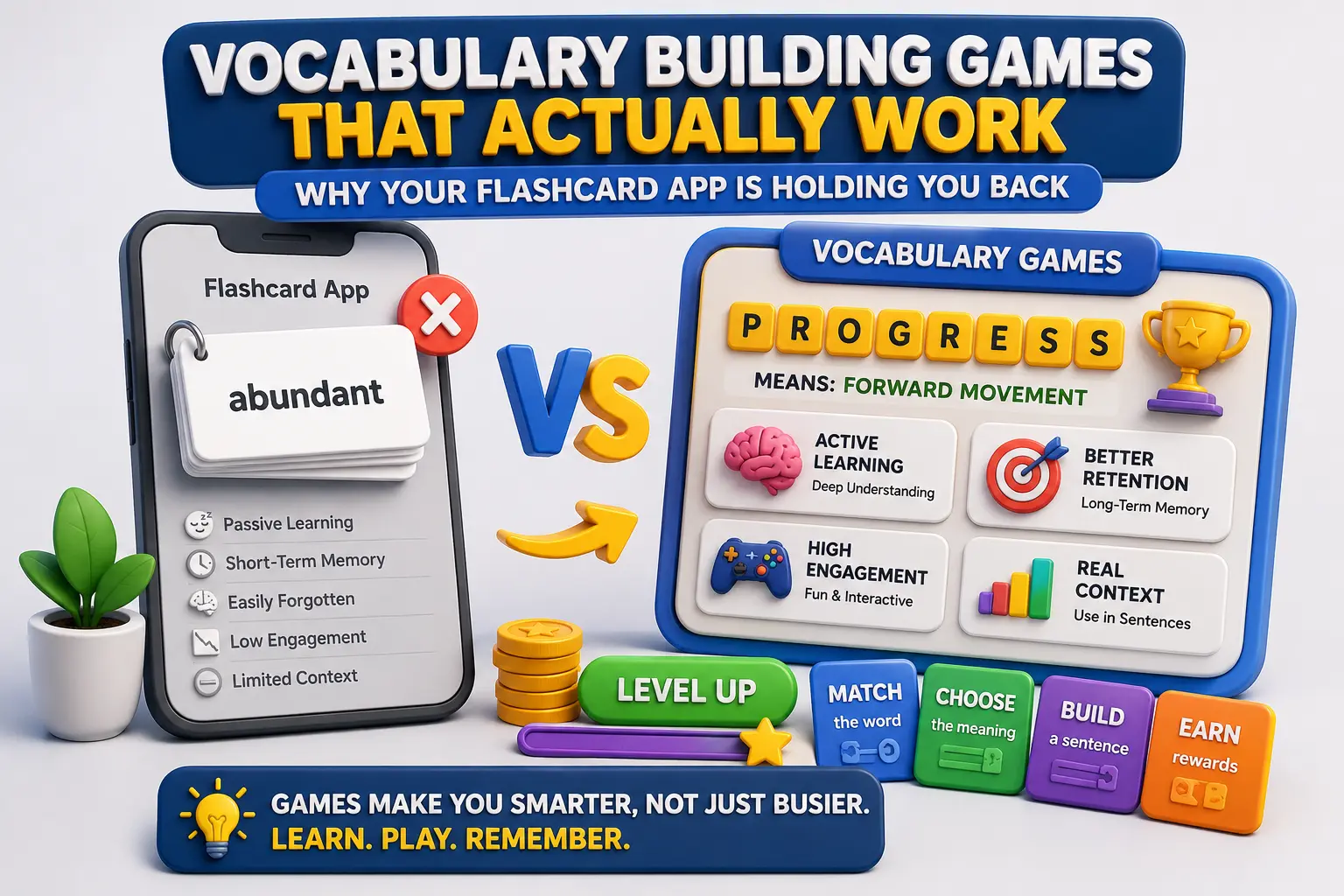
Multiplayer word games add social accountability that solo apps can’t manufacture. When you’re playing against someone, you don’t want to lose. That drive pushes you to dig deeper into your mental word bank, pulling out vocabulary you didn’t know you’d retained. Solo apps let you quit quietly. Multiplayer games make quitting feel like forfeiting.
Last Letter First is a multiplayer word game where players chain words using the last letter of each previous word, turning vocabulary practice into real-time competition. You can’t memorize a deck and coast. You adapt to what your opponent plays, think on your feet, and pull from your full vocabulary under genuine time pressure. The game also offers prize incentives up to $100, adding motivation no solo app matches.
But competition isn’t the only path. In team-based word games, a teen might know informal terms a parent doesn’t, while the parent brings formal vocabulary the teen hasn’t encountered. That cross-pollination is worth its weight in gold for expanding everyone’s word bank simultaneously.
Getting Started With Vocabulary Building Games Today
A vocabulary quiz does more than measure what you know. It reveals what you don’t know yet. The best formats use active recall, forcing retrieval under pressure rather than passive recognition from a list.
|
Feature |
Solo Flashcard Apps |
Multiplayer Word Games |
|---|---|---|
|
Active recall |
Limited (recognition-based) |
High (production-based) |
|
Social accountability |
None |
Built-in |
|
Dopamine triggers |
Minimal |
Frequent (wins, streaks, competition) |
|
Difficulty scaling |
Algorithm-driven |
Player-driven and adaptive |
|
Long-term retention |
Moderate with spaced repetition |
Strong with competitive pressure |
|
Quit rate |
High (no social cost) |
Low (social stakes) |
Here’s the paradox most learners miss: the words you get wrong are more valuable than the ones you get right. Each mistake pinpoints a gap you can target in your next session. Without that feedback loop, you’re flying blind.
Pair your quiz habit with game time. A 2023 study in the Journal of Educational Psychology confirmed that students who combined testing with game-based practice retained 34% more vocabulary after 30 days than those using either method alone. Check out the guide on how to learn 100 new words a month using word games.
The pattern is simple: quiz, identify gaps, play with purpose, retest. That loop turns scattered gaming into a structured vocabulary system.
Your Next Move
Pick one game today. Set a 10-minute timer tomorrow morning. Take a quick vocab test at the end of the week. That three-step loop is more effective than any course you’ll spend months researching but never finish.
And if you’re choosing between playing alone and playing with someone else? Choose the competitor. Choose the pressure. Choose the game that makes you a little uncomfortable when you can’t think of a word fast enough. That discomfort is your vocabulary growing.
The Last Letter First Editorial Team covers vocabulary science, word game strategy, and gamified learning research. Visit the Learning Hub for more guides and resources.