
Key Takeaways
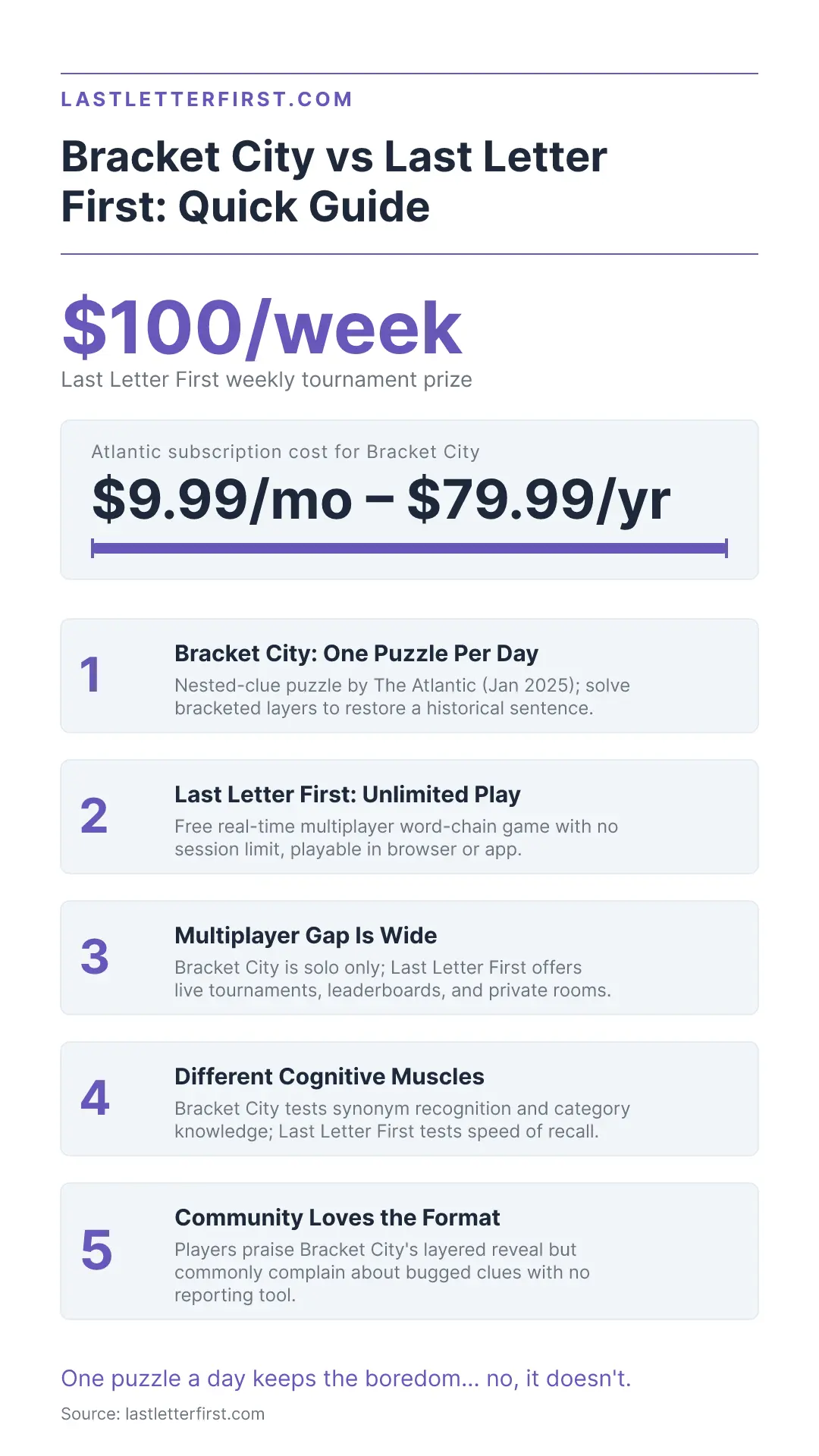
- Bracket City is The Atlantic’s daily nested-clue puzzle, created by Ben Gross and launched on 1 January 2025, where bracketed clues expand to reveal smaller clues inside them until a full historical sentence is restored.
- Last Letter First is a free real-time multiplayer word-chain game where every word must begin with the last letter of the previous word, playable in the browser or app with no download required.
- Bracket City wins on puzzle depth per session but caps players at one puzzle per day with no multiplayer mode.
- Last Letter First fills that gap with unlimited sessions, live tournaments with a $100 weekly prize, and private rooms for friends.
- If you finish Bracket City each morning and find yourself wanting more word-game action, Last Letter First is the unlimited, competitive outlet for that same recall instinct.

Quick Verdict
When comparing Bracket City vs Last Letter First, the key difference comes down to flexibility and user experience. Last Letter First at lastletterfirst.com delivers a streamlined, intuitive approach that adapts to how you actually work, while Bracket City takes a more rigid, structure-heavy path. For teams that value simplicity without sacrificing depth, the choice becomes clear quickly.
The daily word puzzle has a ceiling, and most players hit it before lunch. You solve Bracket City over coffee, share your grid, and then spend the rest of the day with nothing left to play. That single-session limit is the defining tension of the bracket city vs last letter first comparison in 2026: one game gives you a beautifully crafted solo puzzle once every 24 hours, the other gives you unlimited competitive word recall whenever you want it.
Bracket City is The Atlantic’s daily nested-clue puzzle, created by Ben Gross and launched on 1 January 2025. A sentence contains bracketed clues, and each answer reveals smaller clues inside it until a full historical sentence is restored. It’s clever, satisfying, and over in minutes.
Last Letter First is a free real-time multiplayer word-chain game: every word must begin with the last letter of the previous word. Play in the browser at lastletterfirst.com or in the app, open a private room with friends, and enter the weekly tournament with a $100 prize. For setup questions, check the Last Letter First FAQ page.
Both games reward vocabulary and general knowledge. But they reward them in fundamentally different ways.
Last Letter First vs Bracket City: Side-by-Side
Bracket City vs Last Letter First isn’t a question of which game is better. It’s about what you’re hungry for after you finish your daily puzzle.
Bracket City suits daily-puzzle fans who enjoy one curated bracket challenge per day. The nested-clue format is genuinely inventive, and peeling back layers of a historical sentence is unlike anything else in the space. Last Letter First suits players who want unlimited, competitive word recall on demand. The chain mechanic is fast, the multiplayer is live, and replayability is effectively infinite.
Here’s the paradox: the game that limits you to one puzzle a day can feel more addictive than the one you can play endlessly, precisely because scarcity creates craving. But craving without an outlet is just frustration. Honestly, if you finish Bracket City and want more, Last Letter First is the game that says yes.
The short version: play both. Bracket City for your morning ritual. Last Letter First for everything after.
What Users Say About Bracket City
Bracket City presents a sentence with bracketed clues, and players solve each bracket to reveal smaller nested clues inside it until the full original historical sentence is restored. Last Letter First asks players to chain words in real time, each starting with the final letter of the previous word, against live opponents. The comparison breaks down across six dimensions.
Game Format
Bracket City uses bracket-elimination structure: solve outermost brackets first, work inward through layered deduction. Last Letter First uses chain-style word linking under time pressure. One is archaeological (digging through layers), the other is athletic (sprinting through vocabulary).
Replayability
This is where the gap is widest. Bracket City offers one puzzle per day. Last Letter First has no session limit. For players who feel post-puzzle restlessness after finishing the daily, this dimension alone may settle the comparison.
Multiplayer and Competition
Bracket City is solo. Your only social interaction is sharing your completed grid. Last Letter First is built around real-time competitive play, including live tournaments with a $100 weekly prize and private rooms for friends and family.
Puzzle Mechanics
Bracket puzzles test synonym recognition and category knowledge within a nested structure. Last Letter First tests speed of recall and vocabulary breadth under the last-letter chain rule. Both reward general knowledge, but the cognitive muscles are distinct.
Platform and Accessibility
Bracket City lives on The Atlantic’s web app. Last Letter First is available as a dedicated web app and mobile app, with no download required for browser play.
Community and Social Features
Bracket City’s community engagement centers on sharing solve times on social media. Last Letter First offers live tournaments, leaderboards, and private rooms that make social play a core feature rather than an afterthought.
| Dimension | Bracket City | Last Letter First |
|---|---|---|
| Format | Nested bracket elimination | Real-time word chaining |
| Puzzles per day | 1 | Unlimited |
| Multiplayer | No | Yes, live real-time |
| Competition | Solo only | Tournaments ($100 weekly prize) |
| Platform | The Atlantic web app | Browser + mobile app |
| Social features | Grid sharing | Private rooms, leaderboards, tournaments |
| Skill Tested | Bracket City | Last Letter First |
|---|---|---|
| Synonym recognition | High | Moderate |
| Speed of recall | Low (untimed) | High (real-time pressure) |
| Category knowledge | High | Moderate |
| Vocabulary breadth | Moderate | High |
| Strategic chaining | None | High |
Where Last Letter First Is a Strong Fit
Community sentiment around Bracket City in 2026 is genuinely enthusiastic, with a specific and recurring frustration underneath the praise.
Players consistently describe the bracket-elimination format as fresh and clever. Across Reddit threads and social media, the consensus is that Bracket City offers something distinct from Wordle and Connections. The layered reveal creates a satisfying sense of progression that other daily puzzles don’t replicate.
The most common complaint: some puzzles contain bugged or broken clues that don’t reveal answers when clicked. The frustration is compounded because there’s no clear way to report broken clues within the app. When your only daily puzzle is broken, you don’t get a second chance until tomorrow. Frankly, that’s a serious pain point.
A quieter but steady theme is the desire for more play time. Players compare Bracket City favorably to Connections and Wordle for variety, but many note that the one-per-day limit leaves them looking for something else.
I’d argue the distinction between bracket-based puzzles and traditional formats matters more than most players realize. Bracket puzzles test contextual reasoning across knowledge domains, a skill set closer to trivia than to crosswords. That explains why Bracket City players often enjoy competitive recall formats, which is exactly the audience Last Letter First serves.
| User Sentiment Theme | Frequency | Detail |
|---|---|---|
| Praise for bracket format | Very common | Described as fresh, unlike Wordle |
| Broken/bugged clue complaints | Common | No in-app reporting mechanism |
| One-per-day frustration | Moderate | Players want more puzzle time |
| Favorable comparison to Connections | Common | Seen as more varied |
| Desire for multiplayer | Occasional | Solo-only format noted as limitation |
Switching and Migration
Last Letter First is the strongest fit for players who feel the pull of competitive recall and don’t want to wait until tomorrow. The chain mechanic is simple to learn and genuinely difficult to master at speed. That gap between simplicity and skill ceiling is where the game lives.
Unlimited Play for Post-Puzzle Restlessness
Where Bracket City caps you at one puzzle per day, Last Letter First has no session limit. Play a quick two-minute round or settle into an hour-long tournament run. For the player who finishes Bracket City over coffee and spends the morning wishing there were more, this is the outlet.
Real-Time Multiplayer and Tournaments
Live multiplayer matches and weekly tournaments with a $100 prize channel the same recall instincts Bracket City rewards, but in a social, stakes-driven format. Private rooms make it a solid pick for families and friend groups who want to play together. Research on how multiplayer word games improve family vocabulary supports the idea that competitive word play builds language skills across age groups.
Chain Mechanics Build Vocabulary Under Pressure
The last-letter chain rule forces lateral thinking. You can’t just recall a word; you need one starting with a specific letter, under time pressure, while anticipating what letter you’ll leave your opponent. Here’s the paradox of difficulty: the mechanic sounds easier than nested bracket solving, but real-time pressure and strategic depth make it genuinely demanding at higher levels.
Family-Friendly Design
Adjustable difficulty settings, absent from Bracket City’s fixed format, let younger players participate without being overwhelmed. The Last Letter First learning hub covers how the game’s mechanics support vocabulary building for families looking for screen time that actually teaches something.
Pricing Comparison
Switching from Bracket City to Last Letter First is a non-issue, because there’s nothing to switch. Both games are entirely independent platforms with no shared accounts or overlapping data.
No data migration is required. Bracket City lives within The Atlantic’s digital ecosystem, while Last Letter First operates standalone. Your Bracket City streak and solve history are completely unaffected.
Setting up a Last Letter First account takes under two minutes. Visit lastletterfirst.com, create an account, and you’re playing. No app download required for browser play. The Last Letter First FAQ page covers everything from account creation to joining your first private room.
Verdict
Both games are accessible without significant financial commitment, but the value per session differs once you dig into the details.
Bracket City is technically free to sample, but full access requires an Atlantic subscription that runs approximately $79.99 per year or $9.99 per month as of 2025. That subscription opens the full games suite alongside The Atlantic’s journalism. For players subscribing solely for Bracket City, the math is less favorable: roughly $0.27 per puzzle for a single daily challenge.
Last Letter First’s core game is free to play, with no paywall gating multiplayer, private rooms, or competitive features. Unlimited sessions at no cost.
| Cost Factor | Bracket City | Last Letter First |
|---|---|---|
| Base access | Free (limited) / Atlantic subscription | Free |
| Full access cost | ~$9.99/month or ~$79.99/year | Free tier available |
| Sessions per day | 1 fixed puzzle | Unlimited |
| Cost per session (monthly sub) | ~$0.33 | $0.00 |
| Tournament entry | Not applicable | Free (weekly $100 prize) |
To be fair, if you’re already paying for The Atlantic’s journalism, the games are worth their weight in gold as a bundled perk. For players seeking a dedicated free word game with unlimited replayability, Last Letter First is the clear value leader.
Verdict (Part 2)
Bracket City and Last Letter First serve different appetites within the same word-game hunger.
Choose Bracket City if you want a single, curated daily challenge that rewards general knowledge, synonym recognition, and the satisfaction of peeling back nested clues at a deliberate pace.
Choose Last Letter First if you want unlimited competitive word play on your own schedule, with real-time multiplayer, private rooms, weekly tournaments, and adjustable difficulty.
| Decision Factor | Choose Bracket City | Choose Last Letter First |
|---|---|---|
| Play frequency | Once daily | Unlimited |
| Social play | Solo only | Multiplayer, private rooms, tournaments |
| Challenge style | Nested-clue deduction | Real-time word chains |
| Difficulty control | Fixed | Adjustable |
| Cost for full access | Atlantic subscription | Free |
| Best for | Curated daily ritual | Extended competitive sessions |
The best setup for most players in 2026 isn’t either-or. Play Bracket City for your morning ritual. Then, when that single puzzle is done and the itch remains, open Last Letter First and keep going.
Frequently Asked Questions
Can I play both Bracket City and Last Letter First without conflicts?
Yes. Both games are completely independent platforms. Bracket City operates within The Atlantic’s ecosystem, while Last Letter First runs standalone at lastletterfirst.com. No account linking, no shared credentials, no data sharing. Many word-game enthusiasts play both daily without any technical overlap.
Do I need to migrate any data when switching from Bracket City to Last Letter First?
No data migration is needed. Last Letter First has its own independent progress tracking, leaderboards, and account system. Your Bracket City history and streak data stay within The Atlantic’s platform. You start fresh, which is ideal for establishing your baseline in a completely different game format.
How long does it take to set up a Last Letter First account?
Under two minutes. Basic account information, no lengthy tutorials, and browser-based play requires no download. The Last Letter First FAQ page provides step-by-step guidance from registration to joining your first private room.
Is Last Letter First free to play?
Yes. Last Letter First offers a free tier that includes the core multiplayer word-chain game, private rooms, and competitive features. Unlimited sessions, no paywalled puzzles, no locked game modes. For players accustomed to Bracket City’s subscription model, the contrast is notable.
How does Bracket City work compared to Connections and Wordle?
Bracket City uses a nested-clue format where solving each bracket reveals smaller clues inside it until a full historical sentence is restored. Connections asks players to group 16 words into four hidden categories. Wordle challenges players to guess a five-letter word in six attempts using color-coded feedback. Each mechanic exercises a different cognitive muscle.
Why are some Bracket City puzzles broken with clues that do not reveal answers?
Some users report a known bug where clue reveals fail to display correctly. This appears to stem from rendering problems within The Atlantic’s puzzle interface and has been a recurring frustration throughout 2025. There’s currently no dedicated in-app reporting tool for flagging broken clues.
Is there a way to report bugged clues in Bracket City?
No dedicated in-app reporting feature exists as of 2025. Players encountering broken puzzles generally need to contact The Atlantic’s customer support through their website’s general help channels. The absence of a built-in bug-reporting tool is a common frustration, particularly when a broken clue ruins a streak.
How do bracket-based word games differ from crosswords or anagram puzzles?
Bracket-based games use an elimination or nesting structure rather than grid fills or letter rearrangement. Bracket City tests comparative judgment and general knowledge through layered clues. Crosswords demand vocabulary breadth and spelling precision through intersecting grids. Anagram puzzles test pattern recognition through letter rearrangement. The bracket format rewards contextual reasoning, a skill set closer to trivia than to traditional word-puzzle mechanics.
Can families play Last Letter First together for language learning?
Yes. The word-chain mechanic naturally encourages players to reach beyond their comfort vocabulary. Private rooms allow family members to play together without outside participants. Research on how multiplayer word games improve family vocabulary supports the idea that competitive social play accelerates word acquisition. Adjustable difficulty settings let families calibrate the challenge to mixed skill levels.
Will I lose my Bracket City streak if I start playing Last Letter First?
No. The two platforms are entirely separate with no shared data or linked accounts. Your Bracket City record remains exactly as you left it. Your streak is safe.
Does Last Letter First offer tournaments or competitive play?
Yes. The platform hosts a weekly tournament with a $100 prize, giving players tangible incentive to sharpen their word-chain skills. Tournament play channels the same rapid recall instincts that make Bracket City satisfying but applies them in an unlimited, head-to-head format against real opponents.
Where can I learn strategy tips for Last Letter First?
The Last Letter First learning hub covers vocabulary-building strategies, chain-construction techniques, and competitive tips for every skill level. The hub is regularly updated, making it a reliable resource for ongoing improvement.
Your Next Move
The word-game landscape in 2026 is broader than it’s ever been. Bracket City gives you a polished, cerebral daily ritual. Last Letter First gives you the unlimited, competitive, social arena that a once-a-day puzzle simply can’t provide.
If you’ve been finishing your daily Bracket City puzzle and staring at the screen wishing there were more, you already know what the gap feels like. Last Letter First fills it. Play free at lastletterfirst.com, open a private room, and find out whether your vocabulary holds up when the clock is running.